

Money laundering is one of the most serious financial crimes affecting economies worldwide. Every year, billions of dollars generated from illegal activities such as fraud, drug trafficking, corruption, and cybercrime are “cleaned” to appear legitimate. This process not only supports criminal activities but also weakens financial systems and institutions.
In simple terms, money laundering means disguising illegally obtained money to make it look like it comes from a legal source. Understanding what money laundering is, how it works, and how to prevent it is crucial for businesses, banks, and individuals.
What is Money Laundering? (Definition)
Money laundering is the process of converting “dirty money” (earned through illegal activities) into “clean money” that appears legitimate.
Criminals use various methods to hide the origin of funds so they can use them without attracting attention from authorities. For example, illegal cash from drug trafficking may be routed through businesses or financial systems to make it appear as normal income
What Does Money Laundering Mean in Banking?
In banking, money laundering refers to the use of financial institutions to process illegal funds. Criminals deposit, transfer, and withdraw money in ways that make it difficult to trace its origin.
Banks are particularly vulnerable because they handle large volumes of transactions daily. That’s why strict AML (Anti Money Laundering) regulations require banks to monitor customer activities and report suspicious transactions.
Enroll in the Certification in Anti-Money Laundering (CAML)
How Many Stages of Money Laundering Are There?
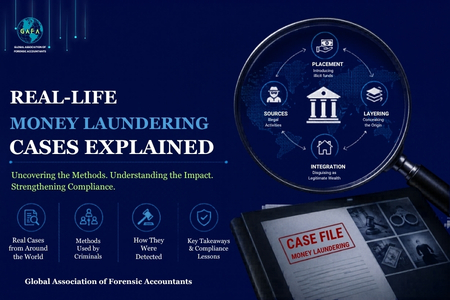
Money laundering typically involves three main stages:
1. Placement
This is the initial stage where illegal money is introduced into the financial system.
Examples:
- Depositing cash into bank accounts
- Using cash heavy businesses
- Purchasing assets
2. Layering
At this stage, criminals move money through multiple transactions to hide its origin.
Examples:
- Transferring money between accounts
- Using offshore accounts
- Converting currency or assets
3. Integration
In the final stage, the money re enters the economy as “clean” money.
Examples:
- Investing in real estate
- Buying luxury goods
- Funding legitimate businesses
These stages often overlap, making detection difficult
Common Money Laundering Techniques
Criminals use various techniques to launder money. Some of the most common methods include:
1. Cash Intensive Businesses
Businesses like restaurants or car washes are used to mix illegal cash with legitimate income.
2. Structuring (Smurfing)
Large amounts of money are broken into smaller transactions to avoid detection.
3. Real Estate Laundering
Criminals buy and sell properties to convert illegal money into legal profits.
4. Shell Companies
Fake companies are created to hide ownership and move money across accounts.
5. Cryptocurrency Laundering
Digital currencies are used to transfer funds anonymously across borders.
6. Trade Based Money Laundering
Fake invoices or manipulated trade transactions are used to disguise money flow.
These evolving techniques make it challenging for authorities to track illegal activities.
AML certification course in India
Real World Money Laundering Examples
Understanding real world cases helps explain how money laundering works.
Example 1: Cash Business Laundering
A restaurant generates ₹2 lakh daily but reports ₹4 lakh by adding illegal cash into its accounts. This makes the extra money appear legitimate.
Example 2: Real Estate Laundering
A criminal buys a luxury property using illegal funds and later sells it, converting dirty money into clean profits.
Example 3: Casino Laundering
A person buys casino chips using illegal money, plays minimally, and cashes out as “winnings.”
Example 4: Cryptocurrency Laundering
Funds are split into small transactions and passed through crypto wallets or mixers to hide their origin.
Example 5: Banking Case
Some global banks have faced penalties for failing to detect suspicious transactions, allowing criminals to move billions through their systems
Money Laundering Punishment
Punishments for money laundering vary by country but generally include:
Common Penalties
- Heavy fines
- Confiscation of assets
- Imprisonment (often 5–20 years)
- Business restrictions
Authorities also hold organizations accountable if they fail to prevent money laundering.
Red Flags of Money Laundering
Financial institutions monitor certain warning signs to detect suspicious activities.
Common Red Flags
- Large or unusual cash transactions
- Frequent small transactions (structuring)
- Complex or unexplained transfers
- Use of shell companies
- Customers avoiding identity verification
Identifying these signs early is crucial for preventing financial crime.
How to Prevent Money Laundering
Preventing money laundering requires a combination of policies, technology, and awareness.
1. Implement Strong KYC (Know Your Customer)
- Verify customer identity
- Collect necessary documents
- Assess customer risk
2. Monitor Transactions Continuously
- Use AML tools to track transactions
- Identify suspicious patterns
3. Use Risk Based Approach
- Focus on high risk customers
- Apply enhanced due diligence (EDD)
4. Conduct Regular Audits
- Review compliance processes
- Identify gaps and improve systems
5. Employee Training
- Train staff to recognize suspicious activities
- Stay updated on new laundering techniques
6. Use Advanced Technology
- AI based monitoring systems
- Automated alerts and reporting
Financial institutions must adopt proactive strategies to stay ahead of criminals.
Get certified in anti-money laundering today
Best Practices for AML Compliance
Organizations should follow these best practices to strengthen their AML programs:
- Develop a risk based compliance framework
- Integrate AML with overall governance systems
- Perform regular due diligence on customers
- Maintain accurate records and audit trails
- Use automated AML tools for efficiency
A strong AML framework helps reduce risks and ensures compliance with regulations.
Future Trends in Money Laundering
Money laundering methods are evolving with technology.
Emerging Trends
- Increased use of cryptocurrencies
- AI driven fraud detection
- Cross border financial crimes
- Stronger global regulations
As criminals adopt new techniques, organizations must continuously upgrade their systems.
Conclusion
Money laundering is a complex and evolving financial crime that affects businesses, banks, and economies worldwide. Understanding its definition, techniques, and real world examples is essential for identifying risks and preventing illegal activities.
By implementing strong AML practices, using advanced tools, and staying compliant with regulations, organizations can effectively combat money laundering and protect their financial systems.
FAQs
Q1. What is money laundering?
Money laundering is the process of making illegally obtained money appear legal by disguising its source.
Q2. How many stages of money laundering are there?
Answer: There are three stages: placement, layering, and integration.
Q3. What are common money laundering techniques?
Answer: Common techniques include structuring, shell companies, real estate transactions, and cryptocurrency laundering.
Q4. Is money laundering illegal?
Answer: Yes, money laundering is a criminal offense punishable by fines and imprisonment.
Q5. What is a money laundering case?
Answer: A money laundering case involves individuals or organizations disguising illegal funds to make them appear legitimate.
Q6. How to prevent money laundering?
Answer: It can be prevented through KYC verification, transaction monitoring, AML tools, and compliance programs.
Q7. What is money laundering in banking?
Answer: It refers to using banks to process illegal funds and make them appear legitimate.