

Professional Certifications by Global Association of Forensic Accountants
GAFA offers globally focused professional certifications designed for modern finance, compliance, cybersecurity, fraud risk, and investigation professionals. Each certification is developed to deliver practical industry knowledge, investigative capability, and real-world application aligned with evolving financial crime risks and global compliance expectations.

Forensic Accounting Certifications
Forensic accounting is a specialized field of accounting that combines accounting, auditing, financial analysis, investigative techniques, and legal principles to detect, investigate, and prevent financial fraud. Unlike traditional accounting, which focuses on recording and reporting financial information, forensic accounting focuses on analysing financial evidence, identifying suspicious transactions, tracing fund flows, quantifying financial losses, and supporting legal or regulatory proceedings.
As financial crimes continue to evolve with digital technologies, artificial intelligence, and global financial systems, forensic accounting has become an essential capability for organizations seeking to protect their assets, maintain stakeholder trust, and respond effectively to financial misconduct.
Get in Touch
Most In Demand Skills in FinCrime Field
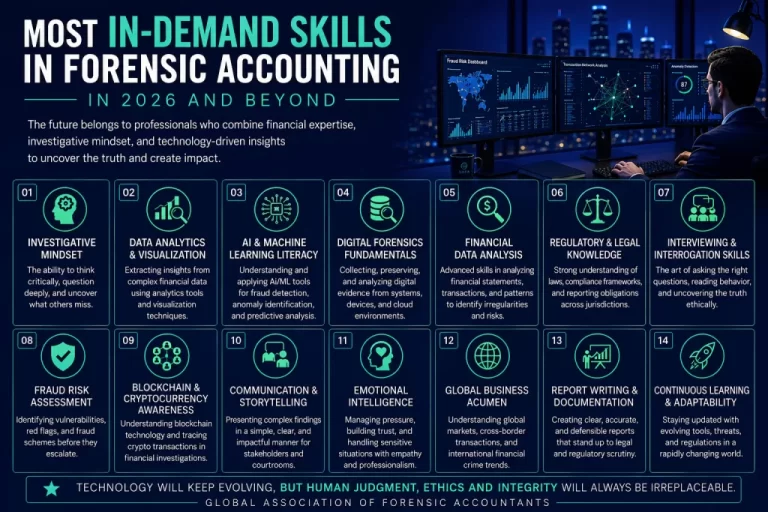
Human Skills That Matter Most in the AI Era
- Critical Thinking
- Professional Judgment
- Professional Skepticism
- Ethical Decision-Making
- Fraud Interviewing
- Behavioural Analysis
- Investigative Planning
- Evidence Corroboration
- Root Cause Analysis
- Strategic Risk Assessment
- Expert Report Writing
- Courtroom & Expert Witness Communication
- Stakeholder Communication
- Negotiation & Conflict Resolution
- Adaptive Investigative Thinking
AI can analyse transactions and identify anomalies. Human intelligence will still be required to interpret context, assess credibility, establish intent, and transform evidence into defensible conclusions.
Certification in Anti Money Laundering
CAML
Professional Anti-Money Laundering (AML) certifications developed by the Global Association of Forensic Accountants (GAFA), covering transaction monitoring, KYC, sanctions , suspicious activity reporting (SAR), terrorist financing, trade-based money laundering (TBML), beneficial ownership, and emerging financial crime risks.
Certification in Financial Fraud Investigation
CFFI
Professional certifications in forensic accounting, financial fraud investigation, forensic auditing, and financial crime analysis. Develop practical skills in financial statement analysis, fund flow analysis, evidence examination, fraud detection, asset tracing, and investigation reporting to support corporate, banking, insurance, regulatory, and legal investigations.
Certification in Insurance Investigation
CIIP
CIIP is a Professional certifications in insurance fraud investigation and fraud risk management. It covers the global insurance regulations, compliances ,insurance frauds claims investigation, underwriting fraud, healthcare fraud, motor insurance fraud, property insurance fraud, corporate insurance fraud, evidence analysis, and fraud prevention.
Certified AI Investigator
CAII
Learn how AI transforms fraud investigations. CAII covers Generative AI, LLMs, NLP, fraud analytics, forensic accounting, and real-world case studies.
Artificial Investigation Assisted Investigation
Advanced certifications integrating artificial intelligence with forensic accounting, fraud analytics, AML investigations, compliance monitoring, and modern investigative intelligence.
Digital Forensics and GRC Certifications
Professional certifications designed to prepare CXOs and risk leaders for cyber incident response, log preservation, regulatory readiness, governance, risk management, and compliance practices within financial institutions.
Forensic Investigation in Blockchain
Professional certifications focused on blockchain investigations, cryptocurrency transaction tracing, digital asset analysis, fraud detection, and financial crime risks involving virtual assets and decentralized ecosystems.
Get Certified with GAFA
Validate your expertise, boost professional development, and enhance your career prospects with globally recognized certifications in Anti Fraud Field.
GAFA Exam Overview
GAFA assessments go beyond traditional objective tests to evaluate practical knowledge, critical thinking, and real-world application. The exam includes:
• Case Study
• Lab Exam
• Objective Type Assessment.
GAFA examinations are conducted with the highest standards of integrity, security, and professionalism in association with our trusted examination partners Mercer Mettl ensuring a fair, reliable, and globally credible assessment process for all candidates.
GAFA TraceLab
GAFA TraceLab is
Advanced Financial Crime & Intelligence Lab
offer a unique testing experience in a lab environment, requiring you to perform hands-on assignment that mirror real life investigation cases.
Candidates are required to pass this Lab assignment in every certification exam.
This approach sets GAFA apart from other skill providers.
Life Time Certified
Your knowledge and skills do not need Revalidations, but only updations!
You need to earn 20 CPE hours, theses are required for your skill updations and enhancement.
GAFA's webinars, events and podcasts are rich source of continuous professional education (CPE) and its Lifetime FREE for members and registered students .
The GAFA community is built on knowledge and resource sharing .
GAFA Certifications FAQs
What is Global Association of Forensic Accountants?
GAFA is a global certification body which provides the certification in forensic accounting, fraud investigation and anti-money laundering (AML).
What is the eligibility for GAFA certifications?
The minimum eligibility for GAFA certification is -Bachelor’s degree (Any Stream). Certain certifications may also require the relevant work experience.
Are GAFA certifications relevant for the job market?
Yes. The GAFA certifications are prepared after consultation with industry. The course contents and delivery method is such- that provide real corporate exposure.
How GAFA Certifications can help in global job opportunities?
GAFA certifications focus on practical skills used by professionals working in global banks, consulting firms, fintech companies, insurance organizations, and multinational corporations. Organizations such as HSBC, Standard Chartered, Deloitte, EY, and KPMG look for professionals with strong capabilities in AML, fraud investigation, compliance, and forensic accounting. GAFA helps you build these in-demand skills and strengthen your profile for global career opportunities.
Home » Certifications