

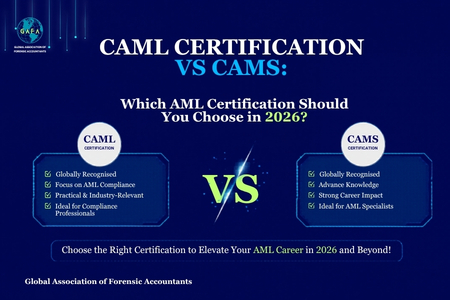
Choosing the right Anti Money Laundering (AML) certification can shape your career in compliance, banking, and financial crime prevention. Two of the most popular options today are CAML (Certification in Anti Money Laundering) and CAMS (Certified Anti Money Laundering Specialist). If you’re confused about which one to pursue in 2026, you’re not alone.
This guide breaks down everything you need to know from course structure and cost to career value so you can make a smart, future proof decision.
What is CAML Certification?
CAML (Certification in Anti Money Laundering) is designed to give foundation to intermediate level knowledge of AML principles. It focuses on practical learning, making it ideal for beginners and professionals who want to enter the AML domain.
Key Features:
- Covers AML concepts, KYC, risk management, and compliance
- Suitable for students, freshers, and early professionals
- Often more affordable and flexible
- Industry focused with practical examples
Who Should Choose CAML?
- Fresh graduates
- Entry level banking or finance professionals
- Individuals switching careers into compliance
- Those looking for cost effective certification
You can start your AML career with certification and gain real-world skills
What is CAMS Certification?
CAMS (Certified Anti Money Laundering Specialist) is a globally recognized certification offered by ACAMS. It is considered a gold standard in AML compliance and financial crime prevention.
Key Features:
- Advanced level certification
- Globally accepted across banks and financial institutions
- Focuses on AML laws, regulations, and investigation techniques
- Requires prior experience or qualifications
Who Should Choose CAMS?
- Experienced professionals in banking or compliance
- Risk analysts, auditors, and legal professionals
- Individuals aiming for global career opportunities
- Professionals targeting senior AML roles
CAML vs CAMS Certification: Key Differences
| Factor | CAML Certification | CAMS Certification |
| Difficulty Level | Beginner to intermediate level | Advanced and more comprehensive |
| Eligibility Criteria | Open to most candidates, including freshers | Requires work experience or educational credits |
| Course Content | Covers basics of AML, KYC, fraud detection, and compliance processes | Covers global AML regulations, case studies, investigations, and risk frameworks |
| Cost Comparison | Affordable and budget friendly for students | Expensive compared to CAML |
| Global Recognition | Growing recognition, especially in India | Globally recognized across financial institutions |
| Career Opportunities | Entry level roles like AML Analyst, KYC Analyst | Mid to senior roles like Compliance Manager, AML Specialist |
| Time to Complete | Short duration (few weeks to months) | Longer preparation time required |
Explore the AML course with AI-powered tools to stay ahead
CAML vs CAMS: Which One Should You Choose in 2026?
The right choice depends on your current career stage and goals.
Choose CAML if:
- You are starting your career in AML or banking
- You want affordable and practical training
- You need quick certification to get a job
- You are exploring AML as a career option
Choose CAMS if:
- You already have AML or compliance experience
- You want global recognition
- You aim for senior roles and higher salary
- You can invest time and money in advanced certification
Industry Demand for AML Certifications in 2026
With increasing financial fraud, stricter regulations, and digital banking growth, AML professionals are in high demand. Governments and financial institutions are heavily investing in compliance frameworks.
Trends in 2026:
- Increased hiring for AML analysts in fintech and banks
- Demand for certified professionals in global markets
- Strong need for fraud detection and risk management experts
Both CAML and CAMS can help you tap into this growing demand, but your entry point matters.
Salary Expectations
After CAML:
- Entry level roles: ₹3 LPA – ₹6 LPA
- Roles: AML Analyst, KYC Analyst
After CAMS:
- Mid to senior roles: ₹8 LPA – ₹20+ LPA
- Roles: Compliance Manager, AML Specialist, Risk Analyst
CAMS certified professionals generally earn higher due to their expertise and experience.
Learn AML course with practical training
Can You Do Both CAML and CAMS?
Yes and it’s actually a smart strategy.
Many professionals start with CAML to build a strong foundation and later pursue CAMS for career growth. This step by step approach helps you:
- Gain knowledge gradually
- Enter the job market faster
- Build experience before attempting CAMS
Final Verdict
There is no “one size fits all” answer.
- CAML is best for beginners looking to enter the AML field quickly and affordably.
- CAMS is ideal for experienced professionals aiming for global recognition and senior roles.
If you’re starting from scratch in 2026, CAML is the smarter first step. Once you gain experience, upgrading to CAMS can significantly boost your career.
FAQs
Q1. Which is better: CAML or CAMS certification?
Answer: It depends on your experience. CAML is better for beginners, while CAMS is suitable for experienced professionals aiming for advanced roles.
Q2. Is CAML certification worth it in 2026?
Answer: Yes, CAML is valuable for entering the AML field, especially in India where demand for compliance professionals is growing.
Q3. Is CAMS difficult to pass?
Answer: CAMS is more challenging than CAML because it covers advanced topics and requires a deeper understanding of AML regulations.
Q4. Can a fresher do CAMS certification?
Answer: Generally, CAMS requires prior experience or eligibility credits, so it may not be ideal for freshers.
Q5. Which certification has better salary potential?
Answer: CAMS offers higher salary potential due to its advanced level and global recognition.
Q6. How long does it take to complete CAML vs CAMS?
Answer: CAML can be completed in a few weeks to months, while CAMS requires longer preparation.
Q7. Can I switch from CAML to CAMS later?
Answer: Yes, many professionals start with CAML and later pursue CAMS after gaining experience.
Q8. Is CAMS recognized globally?
Answer: Yes, CAMS is widely recognized across international banks and financial institutions.