

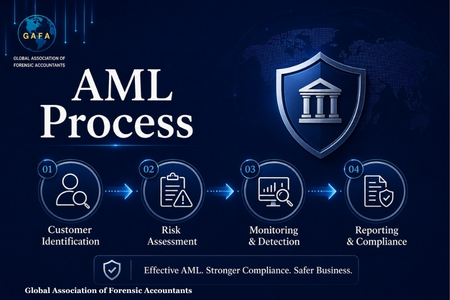
Money laundering continues to be one of the biggest financial threats globally, affecting banks, fintech companies, and even governments. Businesses today are under constant pressure to comply with strict regulatory frameworks to detect and prevent illegal financial activities.
If you’re trying to understand how it all works, this guide on the AML process explained step-by-step will walk you through every stage in a simple, practical way. Whether you’re a student, finance professional, or compliance officer, this breakdown will give you clarity on how organizations implement Anti-Money Laundering (AML) systems effectively.
What is the AML Process?
The Anti-Money Laundering (AML) process refers to a structured set of procedures that financial institutions follow to detect, prevent, and report suspicious financial activities.
At its core, the AML process is designed to stop criminals from disguising illegally obtained funds as legitimate income. This includes activities such as fraud, terrorism financing, and corruption.
A strong AML framework ensures:
- Regulatory compliance
- Risk mitigation
- Protection of financial systems
- Enhanced trust among customers
Why is the AML Process Important?
Before diving into the steps, it’s important to understand why the AML compliance process is critical:
- Governments impose heavy penalties for non-compliance
- Financial institutions risk reputational damage
- Illegal financial activities can destabilize economies
- Customer trust depends on secure systems
In short, AML is not optional it’s a necessity.
Get Certified in Anti-Money Laundering
AML Process Explained Step-by-Step
Let’s break down the AML process step-by-step in a practical, real-world flow.
1. Customer Identification Program (CIP)
The first step in the AML process is identifying who your customer is.
Organizations collect basic details such as:
- Full name
- Date of birth
- Address
- Government-issued ID
This step ensures that the individual or entity is genuine before any financial relationship begins.
Why it matters: Without proper identification, institutions cannot track suspicious activity effectively.
2. Know Your Customer (KYC) Verification
Once identification is done, the next step is KYC verification, which dives deeper into the customer’s background.
This includes:
- Identity verification (documents, biometrics)
- Address verification
- Business verification (for companies)
KYC helps organizations understand the nature of the customer and their financial behavior.
Key insight: KYC is not a one-time process—it continues throughout the customer lifecycle.
3. Customer Due Diligence (CDD)
Customer Due Diligence evaluates the risk associated with each customer.
Customers are typically categorized as:
- Low risk
- Medium risk
- High risk
Factors considered:
- Occupation
- Country of residence
- Transaction behavior
- Source of funds
Enhanced Due Diligence (EDD) is applied to high-risk individuals such as politically exposed persons (PEPs).
4. Risk Assessment
Risk assessment is a critical stage in the AML process.
Organizations analyze:
- Customer risk
- Geographic risk
- Product/service risk
This helps in creating a risk profile for each customer.
Example: A customer transferring large sums internationally may be flagged as higher risk compared to someone with minimal domestic transactions.
5. Ongoing Transaction Monitoring
This is where AML becomes dynamic.
Financial institutions continuously monitor transactions to identify unusual patterns such as:
- Large or frequent transfers
- Sudden spikes in activity
- Transactions involving high-risk countries
Advanced tools and AI-driven systems are often used to detect anomalies.
Important: Monitoring is continuous not just during onboarding.
Learn AML skills for banking & fintech
6. Suspicious Activity Detection
When unusual behavior is detected, it is flagged for further investigation.
Examples of suspicious activity:
- Structuring transactions to avoid reporting thresholds
- Use of multiple accounts
- Inconsistent financial behavior
At this stage, compliance teams manually review alerts generated by systems.
7. Reporting (SAR/STR Filing)
If suspicious activity is confirmed, organizations must report it to regulatory authorities.
Common reports include:
- Suspicious Activity Report (SAR)
- Suspicious Transaction Report (STR)
Failure to report can result in severe penalties.
8. Record Keeping
Regulations require institutions to maintain records for several years.
This includes:
- Customer data
- Transaction history
- KYC documents
- Investigation reports
Why this matters: Authorities may request these records during audits or investigations.
9. AML Compliance Review & Audits
The final step in the AML process is regular audits and compliance checks.
Organizations:
- Review internal AML policies
- Update procedures based on regulations
- Train employees
This ensures the system remains effective and compliant.
Key Components of a Strong AML Compliance Process
A well-structured AML process includes:
- Automated monitoring systems
- Strong KYC frameworks
- Risk-based approach
- Regular employee training
- Regulatory reporting mechanisms
Companies that invest in these components are better equipped to prevent financial crimes.
Challenges in Implementing AML Processes
Even with clear steps, organizations face several challenges:
- High volume of false alerts
- Evolving regulatory requirements
- Integration of technology systems
- Managing customer experience alongside compliance
Balancing strict compliance with smooth customer onboarding is one of the biggest hurdles.
Future of AML Process
The AML landscape is evolving rapidly with technology.
Key trends include:
- AI and machine learning in fraud detection
- Blockchain for transparent transactions
- Real-time monitoring systems
- Global regulatory alignment
Organizations that adapt early will have a significant advantage.
How GAFA Helps You Master AML
If you’re looking to build a career in AML or strengthen your expertise, Global Academy of Financial Analysts (GAFA) offers industry-focused training programs.
Their courses are designed to:
- Simplify complex AML concepts
- Provide real-world case studies
- Prepare you for global certifications
- Enhance job readiness
Whether you’re a beginner or a working professional, structured learning can significantly improve your understanding of AML processes.
Become a Certified AML Professional
Conclusion
Understanding the AML process explained step-by-step is essential in today’s financial environment. From customer identification to transaction monitoring and reporting, every stage plays a vital role in preventing financial crime.
For businesses, a strong AML framework ensures compliance and trust. For professionals, it opens doors to high-demand career opportunities in compliance, risk management, and financial security.
Mastering AML is no longer optional—it’s a critical skill in the modern financial ecosystem.
FAQs
Q1. What is the AML process in simple terms?
Answer: The AML process is a series of steps that financial institutions follow to prevent illegal money from entering the financial system. It includes identifying customers, verifying their identity, assessing risk, monitoring transactions, and reporting suspicious activities. The goal is to detect and stop money laundering, fraud, and terrorism financing. It ensures that financial systems remain transparent, secure, and compliant with regulations.
Q2. What are the main steps in the AML process?
Answer: The main steps include Customer Identification, KYC verification, Customer Due Diligence, Risk Assessment, Transaction Monitoring, Suspicious Activity Detection, Reporting, and Record Keeping. Each step plays a crucial role in identifying and preventing financial crimes. Together, they form a comprehensive AML compliance process that helps organizations detect irregularities and take appropriate action.
Q3. Why is KYC important in the AML process?
Answer: KYC (Know Your Customer) is essential because it helps organizations verify the identity of their customers. Without KYC, it becomes difficult to track suspicious activities or prevent fraud. It ensures that businesses know who they are dealing with and can assess potential risks. KYC also supports regulatory compliance and reduces the chances of financial crimes entering the system.
Q4. What is transaction monitoring in AML?
Answer: Transaction monitoring involves continuously analyzing customer transactions to detect unusual or suspicious behavior. It helps identify patterns such as large transfers, frequent transactions, or activities involving high-risk regions. Advanced systems use AI to flag anomalies, which are then reviewed by compliance teams. This step is critical in detecting money laundering activities in real-time.
Q5. Who needs to follow the AML process?
Answer: The AML process must be followed by banks, financial institutions, fintech companies, insurance firms, and any organization dealing with financial transactions. Regulatory authorities mandate these processes to prevent financial crimes. Even non-financial businesses in certain sectors may need to comply. Following AML guidelines ensures legal compliance and protects organizations from penalties and reputational risks.