

Financial fraud has become one of the biggest challenges for businesses, banks, financial institutions, insurance companies, and digital payment platforms. As online transactions and digital financial systems continue growing, cybercriminals are also developing more advanced fraud techniques to steal money, manipulate transactions, and exploit financial systems.
Organizations worldwide lose billions of dollars every year because of fraud activities such as phishing attacks, identity theft, money laundering, payment fraud, insurance fraud, investment scams, and cryptocurrency related crimes. Because of these growing threats, financial fraud investigations have become a critical part of cybersecurity, risk management, and compliance operations.
A financial fraud investigation is the process of identifying, analyzing, and examining suspicious financial activities to determine whether fraud has occurred. Investigators gather evidence, analyze transactions, identify fraud patterns, and uncover individuals or organizations involved in illegal financial activities.
Modern financial fraud investigations combine traditional investigative techniques with advanced technologies such as artificial intelligence, blockchain forensics, transaction monitoring systems, digital forensics, and cybersecurity analytics. Organizations use these methods to detect fraud early, reduce financial losses, and improve security operations.
Understanding the financial fraud investigation process is important for cybersecurity professionals, compliance analysts, financial institutions, and businesses handling digital transactions.
What is Financial Fraud?
Financial fraud refers to illegal activities involving deception, manipulation, or unauthorized financial gain. Fraudsters use various techniques to steal money, access sensitive financial information, or exploit weaknesses in digital systems.
Financial fraud can occur in multiple forms including banking fraud, investment scams, insurance fraud, credit card fraud, money laundering, accounting fraud, cryptocurrency fraud, and identity theft.
Cybercriminals often use phishing attacks, fake websites, malware, social engineering, and stolen credentials to carry out fraudulent activities.
Financial fraud investigations aim to identify how the fraud occurred, trace financial activities, recover assets when possible, and support legal action against individuals involved in the crime.
Importance of Financial Fraud Investigations
Financial fraud investigations are important because fraud activities can cause severe financial losses, reputational damage, legal issues, and operational disruptions for organizations.
Banks and financial institutions must investigate suspicious transactions to maintain customer trust and comply with anti money laundering regulations. Businesses also conduct fraud investigations to identify insider threats, payment fraud, and unauthorized financial activities.
Government agencies and law enforcement organizations investigate large scale fraud schemes, cybercrime operations, and money laundering activities that impact national financial systems.
Effective fraud investigations help organizations identify security weaknesses, improve internal controls, and prevent future financial crimes.
With digital transactions increasing rapidly worldwide, fraud investigation processes have become essential for maintaining financial security and cybersecurity resilience.
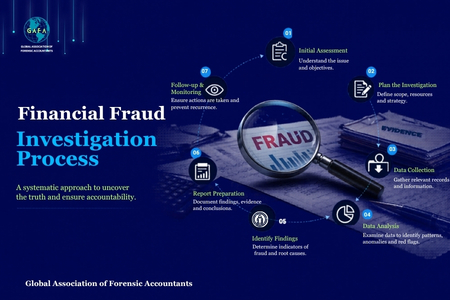
Step 1: Fraud Detection and Initial Reporting
The first stage of the financial fraud investigation process is fraud detection. Investigations usually begin when suspicious financial activities are identified by employees, customers, transaction monitoring systems, cybersecurity teams, or compliance departments.
Fraud indicators may include unusual transaction patterns, unauthorized account access, unexpected fund transfers, fake invoices, suspicious payment requests, or abnormal customer behavior.
Modern organizations use artificial intelligence driven fraud detection systems that continuously monitor transactions and identify anomalies in real time.
Once suspicious activities are detected, the incident is reported to the fraud investigation team, compliance department, or cybersecurity unit for further analysis.
Initial reporting is critical because early detection helps organizations reduce financial losses and prevent additional fraudulent activities.
Step 2: Preliminary Investigation
After suspicious activities are reported, investigators begin a preliminary assessment to determine whether fraud may have occurred.
During this stage, investigators review transaction histories, account activities, customer information, system logs, and communication records related to the incident.
The goal of the preliminary investigation is to identify the nature of the fraud, estimate potential financial losses, and determine the scope of the investigation.
Investigators also identify high risk transactions, suspicious accounts, and possible fraud indicators during this phase.
If sufficient evidence suggests fraudulent activities, the investigation moves into a more detailed forensic analysis stage.
Step 3: Evidence Collection
Evidence collection is one of the most important stages in financial fraud investigations.
Investigators gather digital records, transaction histories, bank statements, emails, invoices, communication logs, system access records, and financial documents related to the suspected fraud activity.
In cyber related fraud cases, investigators may also collect device data, network logs, IP addresses, and digital forensic evidence from computers or mobile devices.
Evidence must be collected carefully to maintain integrity and ensure it remains legally admissible during legal proceedings or compliance reviews.
Organizations often use digital forensic tools and secure storage systems to preserve investigation evidence safely.
Proper documentation and chain of custody procedures are essential during evidence collection processes.
Step 4: Transaction Analysis
Transaction analysis is a critical part of the financial fraud investigation process.
Investigators analyze transaction records to identify suspicious financial patterns, unusual payment activities, and unauthorized fund transfers.
Financial institutions often use transaction monitoring platforms and artificial intelligence based analytics systems to examine large amounts of financial data efficiently.
In cryptocurrency related fraud cases, blockchain forensic tools are used to trace wallet activities and analyze blockchain transactions across decentralized networks.
Transaction analysis helps investigators identify fraud methods, trace stolen funds, and uncover hidden connections between accounts or individuals involved in fraudulent activities.
Investigators also examine transaction timing, payment frequency, account relationships, and geographical patterns during this stage.
Step 5: Digital Forensic Investigation
Many modern fraud investigations involve digital evidence and cybersecurity analysis.
Digital forensic investigators examine computers, mobile devices, emails, databases, cloud systems, and network logs to identify evidence related to fraudulent activities.
Forensic analysis may reveal phishing attacks, malware infections, unauthorized account access, insider threats, or compromised credentials used during the fraud operation.
Cybersecurity teams often work alongside fraud investigators to identify vulnerabilities exploited by attackers and determine how systems were compromised.
Digital forensic investigations are especially important in online banking fraud, cryptocurrency theft, payment fraud, and cybercrime cases.
Step 6: Interviewing Involved Parties
Investigators may interview employees, customers, vendors, or other individuals connected to the suspicious financial activities.
The purpose of interviews is to gather additional information, clarify transaction details, identify suspicious behavior, and verify statements related to the investigation.
Interviewing techniques are important because fraud cases often involve deception, manipulation, or attempts to hide evidence.
Investigators must document interviews carefully and compare statements with transaction records and collected evidence.
In some cases, interviews may reveal internal fraud schemes or insider involvement in fraudulent activities.
Step 7: Identifying Fraud Methods and Patterns
Fraud investigators analyze collected evidence to determine how the fraud occurred and which techniques were used.
This stage may involve identifying phishing attacks, fake invoices, identity theft, unauthorized account access, social engineering tactics, or money laundering methods.
Artificial intelligence and behavioral analytics systems help investigators identify hidden fraud patterns and suspicious user activities.
Understanding fraud methods is important because it helps organizations improve fraud prevention systems and strengthen cybersecurity controls.
Investigators also examine whether similar fraud patterns exist in other transactions or accounts within the organization.
Step 8: Reporting and Documentation
Once the investigation is complete, investigators prepare detailed reports documenting findings, evidence, financial losses, and fraud methods identified during the investigation.
Fraud investigation reports typically include transaction analysis results, forensic findings, interview summaries, risk assessments, and recommendations for future prevention measures.
Reports are shared with management teams, compliance departments, legal teams, regulatory authorities, or law enforcement agencies depending on the severity of the fraud case.
Clear and accurate documentation is essential because investigation reports may be used during legal proceedings or regulatory reviews.
Step 9: Legal Action and Compliance Procedures
In serious fraud cases, organizations may involve law enforcement agencies or initiate legal action against individuals responsible for the fraud activities.
Financial institutions are also required to comply with anti money laundering regulations and suspicious transaction reporting requirements.
Regulatory authorities may review investigation findings and impose penalties if organizations fail to maintain proper fraud prevention controls.
Legal teams work alongside investigators to ensure evidence handling procedures and reporting processes follow regulatory standards.
Fraud investigations often contribute to improving industry wide cybersecurity and financial compliance practices.
Role of Artificial Intelligence in Fraud Investigations
Artificial intelligence is transforming financial fraud investigations by improving detection speed, automation, and risk analysis capabilities.
AI powered systems continuously monitor transaction activities, identify suspicious behavior patterns, and generate fraud alerts in real time.
Machine learning algorithms analyze historical transaction data and detect anomalies that may indicate fraud attempts.
Behavioral analytics systems examine customer activities, device usage patterns, login behavior, and account interactions to identify unusual activities.
AI significantly reduces manual investigation time and helps organizations detect large scale fraud operations more efficiently.
As fraud techniques evolve, AI will continue becoming more important in cybersecurity and financial crime investigations.
Challenges in Financial Fraud Investigations
Financial fraud investigations often involve multiple challenges including encrypted communications, cross border transactions, identity theft, and sophisticated cybercrime techniques.
Cybercriminals use advanced technologies, fake identities, decentralized financial systems, and social engineering tactics to avoid detection.
Large organizations also process massive amounts of financial data, making manual transaction analysis difficult.
Privacy regulations and compliance requirements add additional complexity to evidence collection and investigation procedures.
Despite these challenges, modern forensic technologies and AI powered analytics are improving fraud investigation capabilities significantly.
Future of Financial Fraud Investigations
The future of financial fraud investigations will rely heavily on artificial intelligence, blockchain intelligence, automation, and cybersecurity analytics.
Financial institutions are increasingly adopting AI driven transaction monitoring systems and predictive fraud detection technologies.
Blockchain forensic investigations will also become more important as cryptocurrency adoption and decentralized finance ecosystems continue expanding.
Organizations will continue investing in cybersecurity, fraud prevention systems, and compliance technologies to strengthen financial security operations.
As cybercrime evolves, fraud investigation professionals will remain essential for protecting financial systems and digital assets worldwide.
Conclusion
The financial fraud investigation process plays a critical role in identifying fraudulent activities, reducing financial losses, and strengthening cybersecurity operations. Modern investigations combine transaction analysis, digital forensics, artificial intelligence, and compliance monitoring to uncover fraud schemes and support legal actions.
As financial systems become increasingly digital, organizations must continue improving fraud investigation capabilities to combat evolving cyber threats and financial crimes.
Effective fraud investigations help businesses protect customers, maintain regulatory compliance, and improve long term financial security.
FAQs
Q1. What is a financial fraud investigation?
Answer: A financial fraud investigation is the process of examining suspicious financial activities to identify fraud, collect evidence, and uncover illegal financial operations.
Q2. What are the steps in a fraud investigation?
Answer: Common steps include fraud detection, preliminary analysis, evidence collection, transaction analysis, forensic investigation, interviews, reporting, and legal action.
Q3. How is AI used in fraud investigations?
Answer: AI analyzes transaction patterns, user behavior, and financial data to detect suspicious activities and improve fraud detection accuracy.
Q4. What tools are used in financial fraud investigations?
Answer: Investigators use transaction monitoring systems, blockchain forensic tools, digital forensic software, and AI based analytics platforms.
Q5. Why are fraud investigations important?
Answer: Fraud investigations help organizations reduce financial losses, identify cybercrime activities, maintain compliance, and strengthen security operations.