

What is OSINT? –A Practical Guide to Open-Source Intelligence and its use in Forensic Accounting
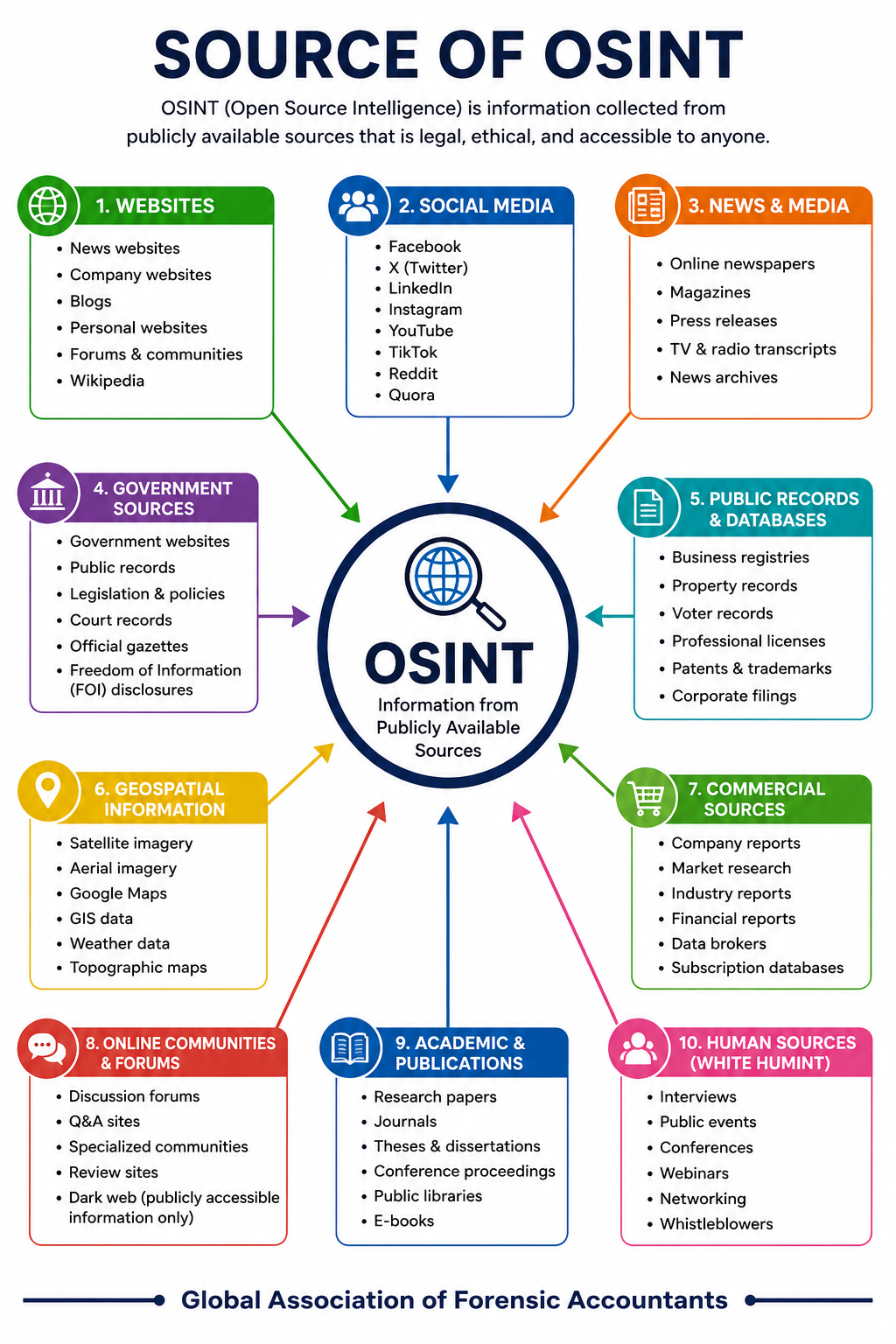
OSINT (Open-Source Intelligence) is the process of collecting, verifying, analyzing, and interpreting information from publicly available sources to produce actionable intelligence.
The emphasis is on two words:
- Open Source– The information which is public and legally available.
- Intelligence– Information by itself has little value. It becomes intelligence only after it has been verified, analysed, and connected with other facts to answer a specific investigative question or support a well-founded conclusion..
It gathers the information from publicly available data.
OSINT should not be confused with hacking. It collects the information from sources like company websites, social media, news articles, business registries even old cached web pages. Every day, people and organizations leave behind thousands of digital footprints. A company announces a new office on its website. An employee updates their LinkedIn profile. A director appears in public corporate records.
Individually, these pieces of information may seem insignificant. However, once it is clubbed together, they can reveal relationships, timelines, ownership structures, financial connections, and even potential fraud.
This is the foundation of Open-Source Intelligence (OSINT).
What is not considered as OSINT?
Searching Google is not OSINT.
Reading someone’s LinkedIn profile is not OSINT.
Downloading a company report is not OSINT.
These are simply sources of information.
Open Source Intelligence is the process by which an investigator synthesizes data from multiple independent sources, subjects it to validation and cross-referencing, identifies patterns and anomalies, and ultimately arrives at defensible, evidence-based conclusions.
Why it matters in forensic accounting
The work of forensic accountants include investigating the fraud, embezzlement, asset hiding, money laundering, and similar tasks. OSINT helps the investigators in connecting the dots together.
A few concrete examples of how OSINT gets used:
- Lifestyle Analysis vs. Reported Income— Discrepancies between an individual’s declared income and their observable lifestyle are a recognized indicator of undisclosed income or assets. Publicly available social media content — property acquisitions, luxury travel, high-value purchases — can be used to corroborate or challenge financial disclosures made in litigation, insolvency proceedings, or regulatory filings.
- Related-Party and Beneficial Ownership Analysis— Corporate registries, filings, and public records can reveal undisclosed relationships between a company and its vendors or counterparties. In certain cases, entities receiving substantial payments are found to be beneficially owned or controlled by related parties — such as an officer’s family member or an affiliated shell entity — raising concerns around conflicts of interest, related-party transactions, or fraudulent disbursements.
- Asset Tracing in Divorce and Insolvency Matters— Property records, licensing databases, and other public filings are frequently used to identify assets that have not been disclosed in matrimonial or bankruptcy proceedings. This supports counsel and the court in ensuring a complete and accurate accounting of the parties’ financial position.
- Verification of Business Legitimacy— A standard step in fraud and financial crime investigations is confirming that a counterparty is a bona fide operating business, rather than a shell entity established to facilitate the movement of funds. This typically involves assessing physical presence, employee footprint, and overall commercial substance through publicly available sources.
- Timeline and Relationship Reconstruction— Publicly available information, including media coverage, corporate announcements, and social media activity, can assist in establishing a factual timeline of events, associations, and locations relevant to the matter under investigation. This is often used to support or challenge representations made by involved parties.
Use of OSINT in forensic Accounting
OSINT has become a core skill across many industries. Through OSINT, an investigator may discover:
- Undisclosed businesses
- Fake vendors
- Shared addresses
- Multiple companies controlled by the same individuals
- Lifestyle inconsistent with declared income
- Social media evidence contradicting claims
For example, an employee claiming to work exclusively for one company may publicly list ownership of several businesses on professional networking platforms.
These findings can become valuable investigative leads.
Anti-Money Laundering (AML)
Financial institutions increasingly rely on OSINT during customer due diligence and enhanced due diligence.
Analysts may use open sources to:
- Verify Ultimate Beneficial Owners (UBOs)
- Identify politically exposed persons (PEPs)
- Check sanctions and watchlists
- Review adverse media
- Assess reputational risks
- Understand corporate structures
OSINT helps institutions build a clearer picture of customer risk beyond the information provided in onboarding documents.
Corporate Investigations
Organizations use OSINT to investigate:
- Employee misconduct
- Vendor fraud
- Procurement irregularities
- Conflict of interest
- Intellectual property theft
- Insider threats
Public information often uncovers relationships that are not disclosed internally.
Insurance Investigations
Insurance investigators frequently use OSINT to verify claims. GAFA’s CIIP teaches the practical way to use the OSINT techniques in insurance fraud investigation.
Examples include:
- Examining publicly shared photos and videos
- Reviewing business registrations
- Confirming employment information
- Establishing timelines
- Verifying locations
A claimant’s public online activity may sometimes contradict the circumstances described in an insurance claim.
Cybersecurity
OSINT also plays a major role in cybersecurity.
Security teams use it to identify:
- Exposed credentials
- Data leaks
- Domain ownership
- Infrastructure exposure
- Brand impersonation
- Fake websites
- Executive impersonation
Best Practices for Using OSINT
To ensure findings are reliable and defensible:
- Always verify information using multiple independent sources.
- Check the source of Information. Not every information is a good information.
- Respect privacy laws like DPDP and applicable regulations.
- Avoid drawing conclusions from a single source.
- Treat OSINT as intelligence tool of investigation, not as an evidence on its own.
Final Thoughts
The internet has become one of the richest sources of investigative intelligence ever created.
Every public record, company filing, news report, digital image, website, and social media profile has the potential to contribute to an investigation. The challenge is no longer finding information—it is identifying what matters, verifying its accuracy, and connecting the dots.
For today’s investigators, auditors, compliance professionals, forensic accountants, and cybersecurity specialists, OSINT is no longer a specialist skill. It is becoming a core investigative competency.
Those who know how to combine technology with critical thinking will always have an advantage. After all, tools can gather data—but only skilled investigators can turn that data into meaningful intelligence.