

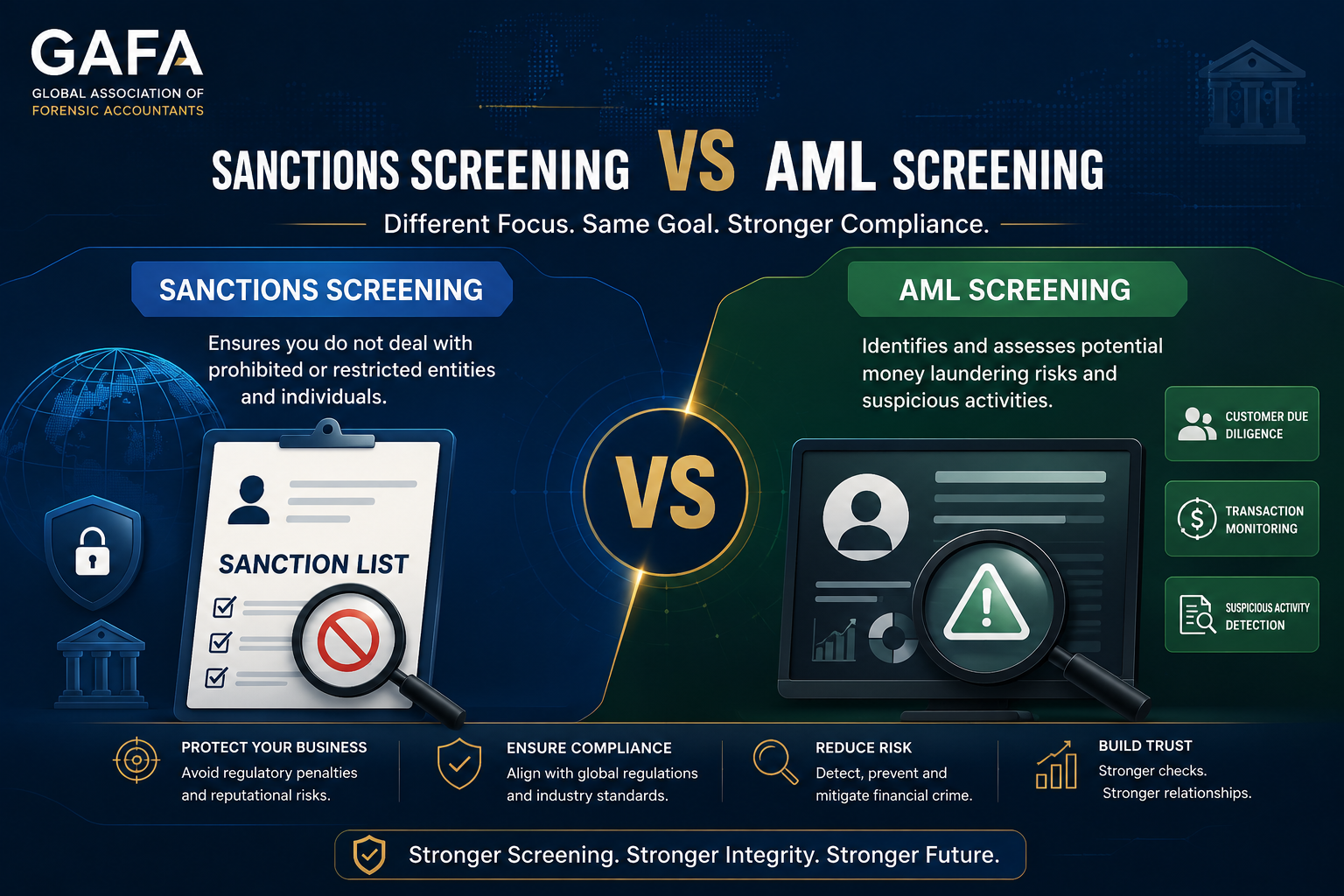
Sanctions screening is a zero-tolerance, legal compliance control designed to match individuals, entities, and transactions against government watchlists to block prohibited trades instantly.
In contrast, AML screening is a broad, risk-based framework focused on detecting, investigating, and reporting suspicious patterns of financial crime, money laundering, and illicit funds across the entire customer lifecycle. While sanctions screening stops forbidden deals before they settle, AML screening monitors behaviors to uncover hidden criminal activity over time.
Advance your compliance career and master global financial crime frameworks with GAFA AML Certifications.
Why Do Compliance Officers Confuse Sanctions Screening and AML Screening?
Compliance professionals often confuse sanctions screening and AML screening because both fall under the broader Anti-Money Laundering and Counter-Terrorist Financing (AML/CFT) regulatory umbrella and share overlapping software infrastructure, such as database checks during customer onboarding.
While both functions share the common goal of protecting the integrity of the international financial ecosystem, treating them as interchangeable creates significant operational vulnerabilities.
Money laundering prevention centers on detecting the provenance and destination of dirty money—funds derived from predicate offenses like trafficking, fraud, tax evasion, or corruption. AML protocols evaluate transaction velocity, behavioral anomalies, customer risk profiles, and complex corporate structures to identify when legitimate financial channels are being exploited.
Sanctions enforcement, on the other hand, is driven by geopolitical mandates, foreign policy objectives, and national security directives. It does not matter whether the money involved is completely clean or derived from a legitimate tech startup salary. If the person sending or receiving those funds is named on a government restriction list, or if the transaction touches an embargoed territory, the activity is strictly illegal under law.
What Is Sanctions Screening and How Does It Work in Practice?
Sanctions screening is a real-time, rule-based screening process that compares customer details, beneficial owners, and transaction counterparties against government-issued watchlists to identify designated individuals, entities, or restricted jurisdictions.
At its core, sanctions screening operates as a strict regulatory gatekeeper. Regulators like the US Department of the Treasury’s Office of Foreign Assets Control (OFAC), the UK Office of Financial Sanctions Implementation (OFSI), the European Union, and the United Nations Security Council issue legally binding restriction lists that update rapidly based on evolving international relations.
The Mechanics of an Effective Sanctions Check
A routine sanctions list check requires checking structured data fields, such as full name, date of birth, registration numbers, passport details, and SWIFT/BIC codes, against global watchlists.
Executing a proper OFAC sanctions screening process involves far more than simple exact text matching. Because criminals and sanctioned entities frequently alter spellings, use alternate scripts (such as Cyrillic or Arabic), or omit middle names to evade detection, compliance teams rely on specialized algorithms. Key technological components include:
Fuzzy Logic & Phonetic Matching
Systems calculate match confidence scores by accounting for typos, missing vowels, swapped first/last names, and phonetic similarities (e.g., matching “Jon” with “John”).
Transliteration & Alias Handling
Converting non-Latin scripts into standardized formats while referencing known aliases (AKAs) maintained within sanctioned database registries.
Jurisdiction & Port Screening
Evaluating geographical routing codes, vessel IMO numbers, and postal codes to flag indirect attempts to route payments through comprehensive embargoed regions (such as Crimea, North Korea, or Syria).
When an automated engine detects a match, the default action in a robust sanctions compliance program is instant intervention: the transaction must be blocked or held immediately pre-settlement, and the customer relationship frozen until a compliance officer conducts a manual alert adjudication.
What Is AML Screening and How Does It Function Across Customer Lifecycles?
AML screening is a continuous risk management framework that combines identity verification (KYC/CDD), adverse media monitoring, Politically Exposed Person (PEP) tracking, and post-transaction behavioral analysis to identify suspicious financial activities.
Unlike the binary nature of sanctions enforcement, anti-money laundering operates primarily on a Risk-Based Approach (RBA). Financial institutions assess the risk level of each customer based on their geographic location, line of business, transaction types, and expected account volume.
The Core Pillars of AML Screening
Modern AML screening tools operate continuously throughout the customer relationship rather than serving only as a point-in-time check during onboarding.
1. Customer Due Diligence (CDD) & Enhanced Due Diligence (EDD)
Verifying the customer’s identity, establishing ultimate beneficial ownership (UBO) for corporate entities, and determining the legitimate source of funds.
2. PEP & Adverse Media Screening
Screening individuals to determine if they hold prominent public positions (PEP status) that make them vulnerable to bribery or corruption, or if negative news stories link them to financial crimes.
3. Transaction Monitoring Systems (TMS)
Analyzing account activity after onboarding to detect anomalous patterns, such as sudden spikes in transaction volume, rapid movement of funds across multiple accounts (layering), or structuring cash deposits just below regulatory reporting thresholds.
4. Suspicious Activity Reporting (SAR/STR)
Filing detailed regulatory reports with national Financial Intelligence Units (FIUs), such as FinCEN or FIU-IND, when anomalous behavior cannot be plausibly explained by legitimate business activity.
While a sanctions match forces an immediate halt to business, an AML anomaly usually initiates an internal investigation. Compliance analysts review contextual evidence, request supporting documentation from the client, and determine whether the risk profile remains acceptable or requires law enforcement notification.
Validate your expertise in financial crime prevention by earning your GAFA AML Certifications.
Sanctions Screening vs AML Screening: What Are the Key Differences?
The key difference between sanctions screening and AML screening lies in their core objective and execution: sanctions screening strictly prevents prohibited parties from accessing financial systems using real-time blocking, whereas AML screening identifies and investigates suspicious transactional behaviors over time based on risk severity.
To help compliance officers, auditors, and system architects visualize how these two functions differ in daily operations, the table below breaks down their primary attributes side-by-side:
| Compliance Dimension | Sanctions Screening | AML Screening |
| Primary Regulatory Mandate | Strict liability enforcement (OFAC, UN, EU, OFSI). No legal safe harbor for unintentional violations. | Risk-Based Approach (FATF, Bank Secrecy Act, EU AML Directives). Focuses on adequate policies and controls. |
| Core Goal | Prohibit targeted entities, individuals, and countries from transferring assets or accessing financial channels. | Detect, mitigate, and report money laundering, terror financing, fraud, and predicate crimes. |
| Data Inputs Required | External watchlists, government databases, restricted party lists, SWIFT fields, vessel tracking, geographical codes. | Internal transaction history, peer group behavior, account velocity, KYC profile, source of wealth, adverse media. |
| Timing of Execution | Real-time pre-settlement for payment transfers; instantaneous check during customer onboarding. | Hybrid: Real-time for identity verification/PEP checks; Post-transaction / Continuous for behavioral patterns. |
| Primary Action Taken Upon Match | Immediate payment block, fund freezing, account restriction, and regulatory notification within strict deadlines. | Alert generation, internal investigation, Customer Due Diligence review, and Suspicious Activity Report (SAR) filing. |
| Tolerance for Risk | Zero Tolerance. Any transaction touching a sanctioned entity is illegal regardless of amount. | Proportional / Risk-Tolerant. High-risk indicators trigger deeper investigation based on institution risk thresholds. |
| Primary Technology Used | High-speed watchlist screening software, fuzzy text matching algorithms, transliteration modules. | AML screening tools, transaction monitoring engines, machine learning anomaly detection, link analysis. |
How Do Financial Institutions Integrate Watchlist Screening Software with Broader Compliance Stack?
Financial institutions integrate watchlist screening software into their broader compliance stack through unified API orchestrations, linking real-time screening engines with CRM, core banking, and transaction monitoring architectures to centralize data flows and reduce false positives.
One of the biggest operational hurdles facing compliance teams today is alert fatigue. Modern compliance departments process tens of thousands of automated alerts daily, with false positive rates in legacy systems frequently exceeding 90%.
When watchlist screening software operates in an isolated silo separate from broader AML screening tools, analysts spend valuable time re-verifying customer identities that have already been cleared by KYC teams.
Best Practices for System Integration
1. Centralized Data Normalizaci on
Standardize customer names, dates of birth, and addresses at the point of data entry. Cleaning incoming data before it hits fuzzy matching engines dramatically reduces false hits caused by extraneous spaces or inconsistent formatting.
2. Context-Aware Alert Scoring
Advanced compliance systems assign risk scores based on secondary identifiers. If a customer shares a common name with a sanctioned individual but has a completely different nationality and year of birth, intelligent orchestration engines automatically dismiss the low-risk match.
3. Dynamic List Updates
Watchlists change constantly due to geopolitical shifts. Leading compliance architectures use automated API connections to download and deploy official list updates immediately upon release, eliminating manual batch upload delays.
4. Unified Investigation Workflows
Unifying sanctions alerts and AML transaction anomalies into a single case management interface gives analysts a full view of customer activity. This prevents critical details from being overlooked during complex financial crime investigations.
How Do You Build an Audit-Ready Sanctions Compliance Program?
To build an audit-ready sanctions compliance program, an organization must establish five core pillars: management commitment, comprehensive risk assessment, robust internal controls, continuous testing/auditing, and ongoing employee training.
Regulators do not accept “technical glitches” or “third-party software failure” as defenses for sanctions breaches. Under strict liability enforcement frameworks, organizations are held fully responsible for non-compliance regardless of intent.
To ensure your organization can withstand rigorous regulatory examinations, your sanctions compliance program must demonstrate five essential components:
1. Senior Management Commitment
Regulators inspect company culture. Senior executives must authorize adequate compliance budgets, approve clear policy frameworks, and empower compliance officers to halt high-value transactions without fear of commercial pushback.
2. Periodic Risk Assessments
Risk exposure varies across industries. A regional credit union, a cross-border fintech payment platform, and a global maritime shipping firm face drastically different exposure levels. Your screening policies, threshold settings, and review cadences must align directly with your institutional risk profile.
3. Comprehensive Internal Controls & Audit Trails
Every alert clearance decision must be documented within an immutable audit log. If a compliance analyst marks an `OFAC sanctions screening` alert as a false positive, the system must capture:
The analyst’s identity and timestamp.
The explicit rationales and supporting documentation reviewed.
The specific match thresholds applied by the software at that point in time.
4. Continuous Model Validation & Testing
Automated tools must be tested routinely using sample datasets (including known sanctioned entities and deliberate spelling variations) to confirm that fuzzy matching thresholds capture genuine risks without missing critical hits.
5. Role-Specific Compliance Training
Compliance personnel, front-line customer service agents, and software developers require ongoing, up-to-date training. Regulatory expectations, list update schedules, and sanctions evasion tactics evolve constantly, making continuous education a core requirement.
Build a career in global financial compliance with comprehensive GAFA AML Certifications.
Frequently Asked Questions (FAQ)
Q1. Is sanctions screening mandatory for non-banking businesses?
Answer: Yes. Sanctions compliance applies to all individuals and corporate entities within a jurisdiction, not just regulated financial institutions. Non-banking businesses—including export/import firms, real estate platforms, crypto exchanges, and software companies—are legally prohibited from transacting with sanctioned parties and face severe penalties for non-compliance.
Q2. What happens if a firm misses an OFAC sanctions list check?
Answer: Failing to identify and block a transaction involving an OFAC-sanctioned entity can result in strict liability civil monetary penalties exceeding millions of dollars per violation, criminal prosecution for willful evasion, asset seizures, and severe reputational damage, including loss of banking relationships.
Q3. How do AML screening tools handle false positives in name matching?
Answer: Modern AML screening tools use advanced fuzzy logic, machine learning context scoring, and multi-attribute secondary matching (comparing dates of birth, geographic locations, and national identification numbers) to filter out common name coincidences automatically without missing genuine risks.
Q4. Can an entity be flagged in AML monitoring without being on a sanctions list?
Answer: Yes. An entity with no history on any global watchlists can be flagged by AML transaction monitoring systems if its behavior exhibits suspicious indicators—such as sudden high-volume fund transfers, unexplained round-dollar transactions, or rapid movement of money through shell company accounts.
Q5. How often should a sanctions compliance program update its watchlists?
Answer: Watchlists should be updated in real-time or as close to real-time as technically possible. Major regulatory bodies like OFAC, the EU, and the UN update their list registries without advance warning; leading screening tools download and integrate these list revisions automatically within minutes of publication.