

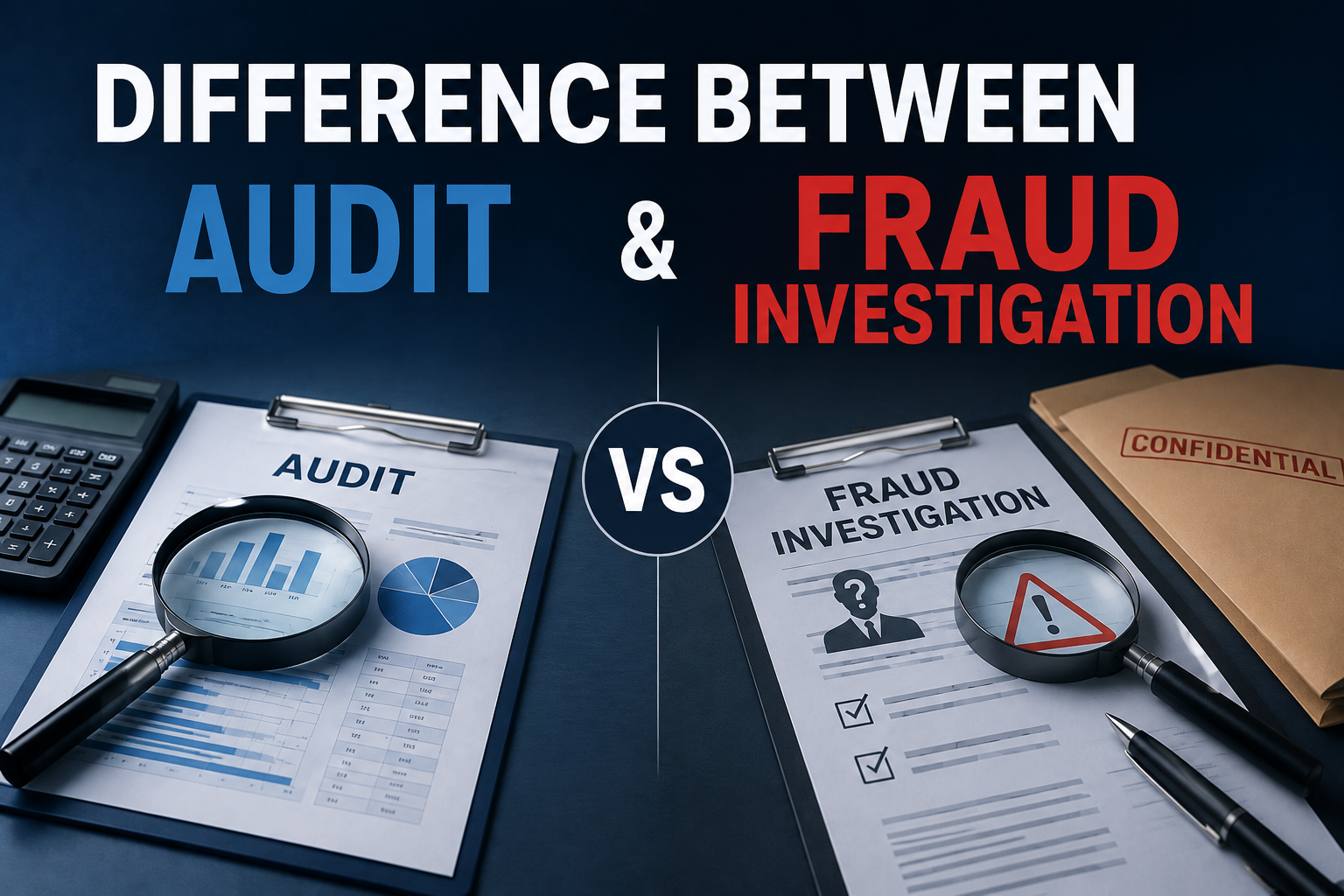
The key difference between audit and fraud investigation is that both serve different purposes. Audit is the process of assessing whether an organization’s financial statements are accurate and comply with regulatory standards. A fraud investigation on the other hand is carried out to uncover, prove or document a fraudulent activity.
Audits are done to assure accuracy of financial records whereas fraud investigation is focused on identifying fraud, misconduct and the culprit behind the fraud. Organizations conduct fraud investigations when unusual transactions or discrepancies arise. They assume the possibility of wrongdoing and actively search for evidence.
What Is an Audit?
Audit is an independent examination of financial statements and business records to check the accuracy of an organization’s position. Most audits are carried out to stakeholders such as investors, lenders, regulators and management.
The primary objective is not to find fraud, but to check whether financial records comply with applicable accounting standards and whether misstatements exist.
A standard audit typically involves reviewing financial statements, testing internal controls. They sample transactions and assess accounting policies and evaluate compliance requirements.
Auditors work within defined timelines, materiality thresholds and sampling methodologies. These limitations do not allow examinations of every transaction, hence even organizations with clean audit reports can later discover significant fraud.
Want to build expertise in forensic accounting and fraud investigations and learn how professionals uncover financial crimes? Explore GAFA’s forensic accounting programs and gain practical skills used by fraud examiners, investigators, and compliance professionals.
What Is a Fraud Investigation?
Fraud investigation is conducted when there is a suspicion or evidence of misconduct. Fraud investigation is conducted by trained professionals. They are trained in forensic accounting, digital forensics, financial crime analysis, compliance, legal procedures and evidence collection.
A typical fraud investigation includes document reviews, transactions tracing, employee interviews, email analysis, forensic data examination, and loss quantification. The findings of the fraud investigation are used in court or regulatory proceedings. Hence evidence handling standards are significantly stricter than in a standard audit.
Audit vs Fraud Investigation: Key Differences
| Factor | Audit | Fraud Investigation |
| Primary Objective | Verify financial accuracy | Detect and prove fraud |
| Scope | Broad financial review | Focused on suspicious activities |
| Trigger | Routine requirement | Suspicion of misconduct |
| Methodology | Sampling and testing | Detailed examination |
| Assumption | Records are generally reliable | Fraud may have occurred |
| Outcome | Audit opinion | Investigation report and evidence |
| Legal Use | Limited | Frequently used in litigation |
| Timeframe | Periodic | Case-specific |
| Evidence Standards | Professional assurance | Court-admissible evidence |
| Expertise Required | Accounting and auditing | Forensic accounting and fraud investigation skills |
Why Can’t Audits Always Detect Fraud?
Audits cannot always detect fraud as they are based on risk assessments and transaction sampling. Auditors do not always examine every invoice, payment, employee claim or vendor transactions.
Fraud is often designed to evade routine audit procedures by creating fake supporting documents. Fraudsters collude with multiple employees, manipulate system access. They conceal transactions across departments and override internal controls. This makes detection significantly more challenging. Hence organizations increasingly combine audits with specialised forensic accounting and fraud detection programs.
How Does Forensic Accounting Support Fraud Investigations?
Professionals involved in forensic accounting fraud investigation assignments analyze financial records to uncover patterns that may indicate misconduct. Some common techniques include:
1.Transaction Analysis
Investigators trace money flows across accounts, vendors, departments, and individuals.
2. Data Analytics
Large datasets are examined using data analytics for unusual trends, duplicate payments, suspicious vendor activity, or unauthorized transactions.
3. Lifestyle Analysis
Individual’s income is compared against their spending habits and asset accumulation by investigators
4. Document Examination
Contracts, invoices, purchase orders, and supporting records are reviewed for inconsistencies.
5.Evidence Preservation
All findings are documented according to legal standards to support potential litigation.
This combination of financial expertise and investigative methodology makes forensic accounting one of the most valuable tools in modern fraud detection programs.
Looking to develop skills in forensic accounting and fraud detection that employers actively seek? Enroll with GAFA’s industry-focused certification programs and learn practical investigation techniques used in real-world financial crime cases.
How Are Careers in Auditing and Fraud Investigation Different?
While both fields involve accounting and financial analysis, the skill sets differ significantly. Auditors typically focus on financial reporting, internal controls, regulatory compliance, risk assessment and accounting standards.
Fraud investigators on the other hand focus on evidence collection, interviewing techniques, fraud schemes, financial crime analysis, litigation support and digital investigations.
As financial crime becomes more complex, demand for professionals trained in forensic accounting and fraud investigations continues to grow. They are needed in fields across banking, consulting, insurance, regulatory agencies, and corporate compliance functions.
Why Businesses Need Both Audits and Fraud Investigations
Organizations often view audits as sufficient protection against fraud. However, the strongest governance frameworks recognize that audits and fraud investigations serve different purposes.
On one hand audits strengthen transparency and financial reporting, whereas fraud investigations address misconduct when warning signs emerge. Companies that invest in both functions typically experience stronger governance, better regulatory compliance, improved stakeholders trust, reduced financial losses and faster fraud detection.
In today’s environment, where financial crimes are increasingly complex and technology-driven, integrating forensic accounting fraud investigation capabilities into risk management programs is becoming a business necessity rather than an option.
Ready to advance your career in forensic accounting fraud investigation and financial crime examination? Start your learning journey with GAFA today and gain the practical expertise needed to investigate fraud, analyze financial evidence, and support compliance initiatives.
Frequently Asked Questions (FAQs)
Q1.What is the main difference between audit and fraud investigation?
Answer: An audit evaluates financial records for accuracy and compliance, while a fraud investigation focuses on detecting, proving, and documenting fraudulent activity.
Q2.Can auditors detect fraud?
Answer: Auditors may identify indicators of fraud, but audits are not specifically designed to uncover every fraud scheme. Their primary objective is providing reasonable assurance regarding financial statements.
Q3.What is forensic accounting?
Answer: Forensic accounting combines accounting, auditing, investigative techniques, and legal knowledge to examine financial misconduct and support legal proceedings.
Q4.When should a company conduct a fraud investigation?
Answer: Organizations should conduct fraud investigations when they observe suspicious transactions, receive whistleblower complaints, identify control failures, or detect unusual financial activity.
Q5.Is forensic accounting a good career?
Answer: Yes. Demand for forensic accountants continues to rise due to increasing financial crime, regulatory scrutiny, and corporate governance requirements.
Q6.What skills are needed for fraud investigation?
Answer: Key skills include financial analysis, forensic accounting, interviewing, evidence collection, data analytics, risk assessment, and regulatory compliance knowledge.
Q7.How does forensic accounting help detect fraud?
Answer: Forensic accountants analyze transactions, identify suspicious patterns, trace funds, review documentation, and gather evidence to determine whether fraud occurred.