

How Mule Accounts Actually Work: The Hidden Pipeline Behind Online Fraud (2026 Global Trends)
Every online scam has a second half that victims never see. The first half is the deception: a fake investment app, a bank impersonation call or a phishing link. The second half is moving the stolen money, and it depends on one thing: other people’s bank accounts. These are mule accounts, and in 2026 regulators and investigators treat them as the backbone of fraud worldwide.
What a mule account really is
A mule account is any bank, wallet or payment account used to receive and pass on money that came from crime. The account is real. It was opened with genuine documents, it passes the bank’s checks, and it sits in an actual person’s name. That is why criminals value it: it puts a layer of legitimacy, and someone else’s legal liability, between the crime and the criminal.
Mules fall into a few groups. Unwitting mules are deceived by fake job offers or romance scams and do not know the money is stolen. Witting mules know or suspect it and accept the risk for a commission. Coerced mules are pressured into taking part. Complicit mules open accounts specifically for laundering, sometimes with false or synthetic identities. And some accounts are simply taken over by criminals using stolen credentials, in which case the owner is a victim.
How the pipeline works
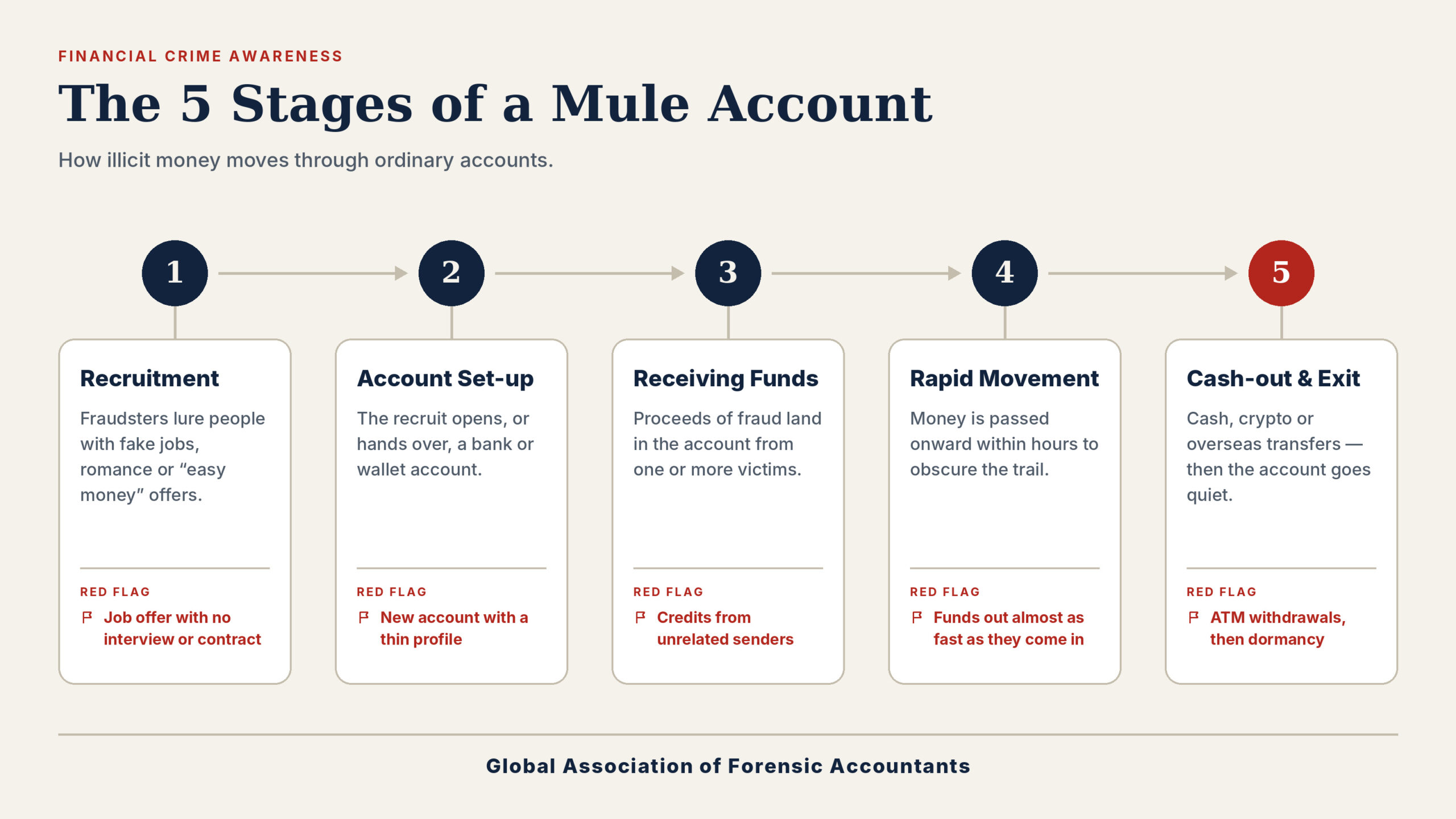
Mule activity is a repeatable process with five stages.
1.Acquisition: the network gets accounts by recruiting people, renting or buying existing accounts, or hijacking them. Recruitment happens through fake job adverts, social media, messaging apps and dating platforms.
2. Receipt: a victim, convinced by a scam, sends money to the account. Often the victim makes a genuine, authorised payment, so it looks normal to the bank.
3. Layering: the money is moved on within minutes or hours through other accounts. Research by the Royal United Services Institute using Lloyds Banking Group data found that over half of the funds entering the mule accounts studied left within an hour, mostly via the UK’s Faster Payments system.
4. Cash-out: the money leaves the banking system as cash, resold goods, cross-border transfers or digital assets such as stablecoins.
5. Recycling: the account is abandoned or frozen and the network moves to the next one. Investigators call this whack-a-mole, because closing one account does not stop the network.
The design is built for speed. Money is easiest to recover in the first minutes, so criminals split it across many accounts in small, unremarkable amounts. One account looks harmless. Only when many accounts are seen together does the pattern appear.
From individuals to organised networks
The networks behind mules increasingly look like businesses, with operators, controllers, recruiters and cash-out teams. In May 2026, the threat intelligence firm KELA reported “mule-as-a-service” offerings advertised openly on Telegram and underground forums, with tiered options and replacement guarantees. It also described accounts built on stolen or synthetic identities and attempts to pass identity checks with forged documents and AI-generated media.
What the latest data shows
Fraud is a core laundering risk. The Financial Action Task Force’s February 2026 report on cyber-enabled fraud found that 156 jurisdictions, about 90 per cent of those assessed, identify fraud as a major money laundering risk. It called for tools such as confirmation of payee, payment freezing powers, machine learning on transaction data and faster information sharing.
Mule numbers are rising. The UK Financial Conduct Authority has reported more than 200,000 mule accounts identified in 2024, up over 20 per cent in a year, and says social media is now a primary recruitment channel.
Accounts are being handed over across borders. Incognia’s September 2026 report found that 81 per cent of the financial institutions it surveyed had seen a rise in mule account handover fraud, and 64 per cent suspected or confirmed cross-border cases. A local person opens a genuine account and later hands control to an operator abroad, so nothing looks forged at onboarding.
Scam networks operate at industrial scale. The UN Office on Drugs and Crime estimated losses of roughly 88 to 114 billion US dollars in 2025 across East and Southeast Asia, Australia and New Zealand, with much of the money moving through cryptocurrency.
Policing is coordinated. Europol’s ninth EMMA operation, run in 2023 across 26 countries and about 2,800 financial institutions, led to 1,013 arrests and identified 10,759 mules and 474 recruiters.
India’s response
The Reserve Bank of India has promoted MuleHunter.AI, an AI tool for detecting mule accounts, which the government said in March 2026 was operational in 26 banks. In May 2026 the Indian Cyber Crime Coordination Centre signed an agreement with the Reserve Bank Innovation Hub to share fraud intelligence and reduce mule accounts across banking and digital payments.
How detection works
Because rules based on a single large transaction are easy to beat, modern systems look at behaviour (sudden inflows from many senders, rapid forwarding, dormant accounts waking up), networks (accounts sharing devices, phone numbers or beneficiaries), device and session signals (someone else operating the account), real-time payment scoring, and intelligence shared between banks and law enforcement.
What you should do
Your bank account is your legal responsibility. If money passes through it, your name is on the record. Never lend, rent or sell your account, card, SIM or login details. Treat any job that involves receiving and forwarding money as a scam. If money you do not recognise arrives, do not send it on; contact your bank. If you think you have been used, tell your bank at once, keep all messages, and report it. In India, call the cyber crime helpline 1930 or use cybercrime.gov.in.
Conclusion
The mule account is the least visible and most essential part of modern fraud. It works because it is real. In 2026 mule activity is more organised, more cross-border and more automated, and the response is becoming more data-driven and collaborative. For individuals the best defence is simple: your account is yours alone.
Disclaimer: This article is for general awareness and does not constitute legal advice. Figures are as reported by the sources below; methods differ between sources.