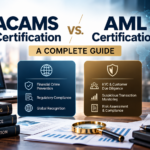
This course teaches students how to investigate frauds and prevent financial crime by building their skills in forensic accounting.
Numbers can tell more than what financial records do. A large proportion of suspicious activity and transactions can be red flags for fraud or financial misconduct. Being able to recognise these indicators involves a knowledge of the field, analysis and the understanding of financial investigations.
This is where a forensic accounting course would come in handy. It allows learners to appreciate the accounting principles, financial analysis and investigative practice which can be applied to investigate suspicious financial transactions.
Forensic accounting is a specialized branch of accounting that provides students, accountants, auditors, and professionals with an avenue to learn skills related to financial crime prevention. When paired with an anti money laundering certification, this knowledge can also enlighten learners about how organizations detect suspicious transactions and boost their compliance procedures.
Let’s discuss Forensic Accounting Course.
In a forensic accounting course, students will learn how to review financial records and determine if any of them fit the outline of an irregularity or financial misconduct. Forensic accounting is more than just the recording and reporting of financial transactions, as traditional accounting would be; it is about the investigation of financial evidence and understanding the information reflected in that evidence.
An organization might find that expenses reported do not align with supporting documentation, for instance. The forensic accounting expert could review invoices, bank statements, transaction records, and financial statements for inconsistencies.
The topics of forensic accounting courses can include fraud detection, financial statement analysis, evidence collection, evidence reporting, and the basics of financial crime investigation, depending on the program that is offered.

What is the significance of Forensic Accounting in the present times?
With the increasing digital payment and intricate financial systems, investigating financial irregularities is becoming more difficult. Manipulation of records, unauthorized transactions, identity theft or hidden financial relationships could constitute fraud.
Organizations can use forensic accounting to analyze these scenarios in a systematic way. Financial red flags and analytical techniques are utilized by professionals to gain insight into unusual activity and aiding internal investigations.
It can be of interest for banks, accounting firms, insurance companies, consulting firms, corporate investigation departments as well as regulatory compliance departments.
What skills might be acquired in a Forensic Accounting course?
The skills taught will vary from provider to provider, but there are a few that are especially beneficial for financial investigators.
- Financial Statement Analysis: Understand how to analyse financial statements, look for inconsistencies and understand unusual transaction patterns.
- Fraud detection techniques: Learn what are some common signs of financial fraud, such as fake invoices, mysterious payments and out-of-the-normal accounting entries.
- Investigative documentation: Understand the need to structure financial information, keep records and create clear investigation reports.
- Financial Risk Assessment: Understand the financial risks and internal controls implemented in organisations to minimise potential fraud.
- Analytical thinking: Develop the skill to relate data from various records and determine if transactions need to be investigated further.
The skills can be leveraged alongside existing knowledge within the accounting, auditing, finance, and compliance field.
What does Anti Money Laundering Certification add to Forensic Accounting?
Forensic accounting and anti-money laundering (AML) training cover different but interrelated aspects of financial crime prevention.
Forensic Accounting deals with analyzing financial data and investigating any irregularity in the financial information. AML training is aimed at grasping the dangers of money laundering, red flags, customer due diligence and compliance.
This anti money laundering certificate will enable learners to grasp the financial institutions’ ongoing responsibility to recognise potentially suspicious activity and implement relevant compliance measures.
These learning areas can be linked together to give a wider knowledge of financial investigations. A professional investigating odd payments, for instance, might be useful to understand not only how to analyze the underlying financial records, but also how money laundering risks are evaluated.
The best path to training will be determined by your career goals, experience, and skill sets.
What GAFA does for Professional Learning
The Global Association of Forensic Accountants (GAFA) is devoted to forensic accounting, financial investigations, fraud prevention and education of professionals.
GAFA offers training on different areas related to financial crime prevention, such as the GAFA Certification in Anti Money Laundering (CAML).
Its AML program is applicable to anyone wanting to know about compliance frameworks, investigation methods, and future financial crime threats. Learners can review the published curriculum to see if it aligns with their professional development objectives.
For more information on financial investigations, visit the GAFA AML certification program to learn about the role AML knowledge plays in financial investigations.
Who can benefit from studying Forensic Accounting?
If you are one of the following persons, you may want to consider taking a forensic accounting course:
- Students wanting to pursue a field of specialization other than accounting in commerce or accounting.
- An accountant or auditor who needs to learn how to investigate finances.
- A banking and/or financial professional with a keen interest in fraud prevention and compliance.
- A risk management specialist interested in better understanding financial irregularities.
- A budding investigator who likes to study financial evidence and suspicious transactions.
Check course prerequisites, practical requirements, assessment, and recognition, before enrolling. Select a program that suits your existing knowledge and career aspirations.
Frequently Asked Questions
What is the aim of Forensic Accounting course?
It assists students to appreciate that financial documents can be analysed to detect fraud, investigate irregularities and record financial evidence.
Does Anti Money Laundering certification benefit the accountant?
It can be helpful for compliance, financial crime prevention, transaction monitoring and other related investigations for accountants.
Is forensic accounting beginner friendly?
A number of introductory courses are geared towards students who have never studied the subject. Applicants must have met the specific course requirements, however, this varies so check the specific requirements of the course before submitting an application.
How can I find out where to get more information on AML training through GAFA?
Please check out GAFA’s Anti Money Laundering Certified program information on its official website.
Conclusion
Financial investigations require more than an understanding of accounting figures. They include analyzing evidence, looking for irregularities, and grasping the risks in financial transactions.
Taking a forensic accounting class can provide investors with valuable investigative knowledge, and an anti money laundering certification can build their expertise in compliance and unusual financial transactions.
Financial crime prevention professionals may find it helpful to supplement their financial crime learning with a view into complementary educational fields such as those offered by GAFA.