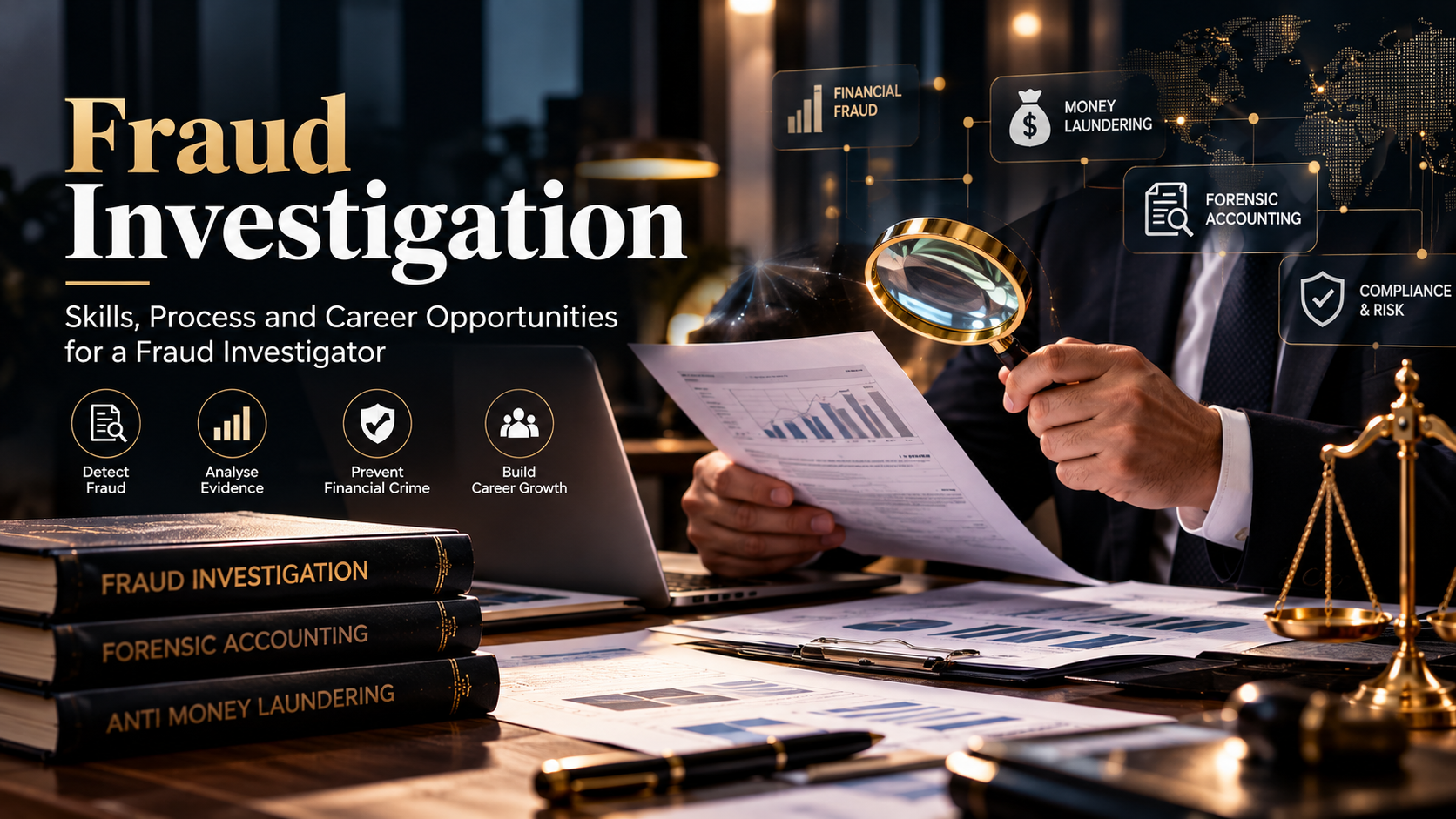
Businesses of all sizes can be the target of financial fraud. It could start with an irregular transaction, a fake invoice, altered accounting documents, or a payment that doesn’t coincide with the documentation. These warning signs do not fall into a neat perforated envelope with labels, and thus require more than knowledge of accounting to be recognized. Requires analytical approach, attention to details and sense of design and structure to find facts.
It’s here money laundering investigations come into the picture. It aids in the improvement of internal review and control, the documentation of any suspicious transactions, and identifying any areas of weakness in an organization’s processes. These abilities can be useful for those aiming for advancement in their careers who specialize in financial investigations, forensic accounting, and fraud detection.
Fraud Investigation is what?
Fraud investigation involves a systematic process of analyzing and understanding the potential, specific and alleged fraud and determining what evidence supports that fact.
The process of a fraud investigation could include reviewing financial statements, analysing transactions and other data, looking at business invoices, talking to concerned people, and looking at places where there seems to be a discrepancy in business records.
An investigation can be undertaken when an organization identifies unusual amounts of missing money, payments or receipts, a conflict of interest, a falsified document or unusual employee activity.
The goal is to establish facts from proper investigative procedure as well as assist organizations in making well-informed decisions. A comprehensive investigation also gives businesses information as to whether the financial controls in place are solid or need strengthening.
Part 2 explore the realities of what a fraud Investigator does
To investigate fraud, uses systems that monitor unusual activities and collect information to determine if fraud has occurred. The job tasks they can engage in will depend on their experience, employer, and industry.
Common responsibilities include:
- Financial records reviews: Checking invoices, bank transactions, accounting entries and supporting documents.
- Suspicious patterns: Identifying duplicate payments, unfamiliar payments, unusual expenses, and discrepancies in payments.
- Collecting and documenting evidence: Keeping evidence and information relevant and proper.
- Analysing financial information: Introduction to comparing transactions and investigating any discrepancies.
- Producing Investigative Reports: Providing results in a clear manner to facilitate internal investigations, compliance or additional legal action as required.
The job requires a strong ability to write and analytical skills, the right to integrity, details, and financial procedures. Investigators should also be unbiased and refrain from making conclusions before reviewing the evidence.
What is the Fraud Investigation Process?
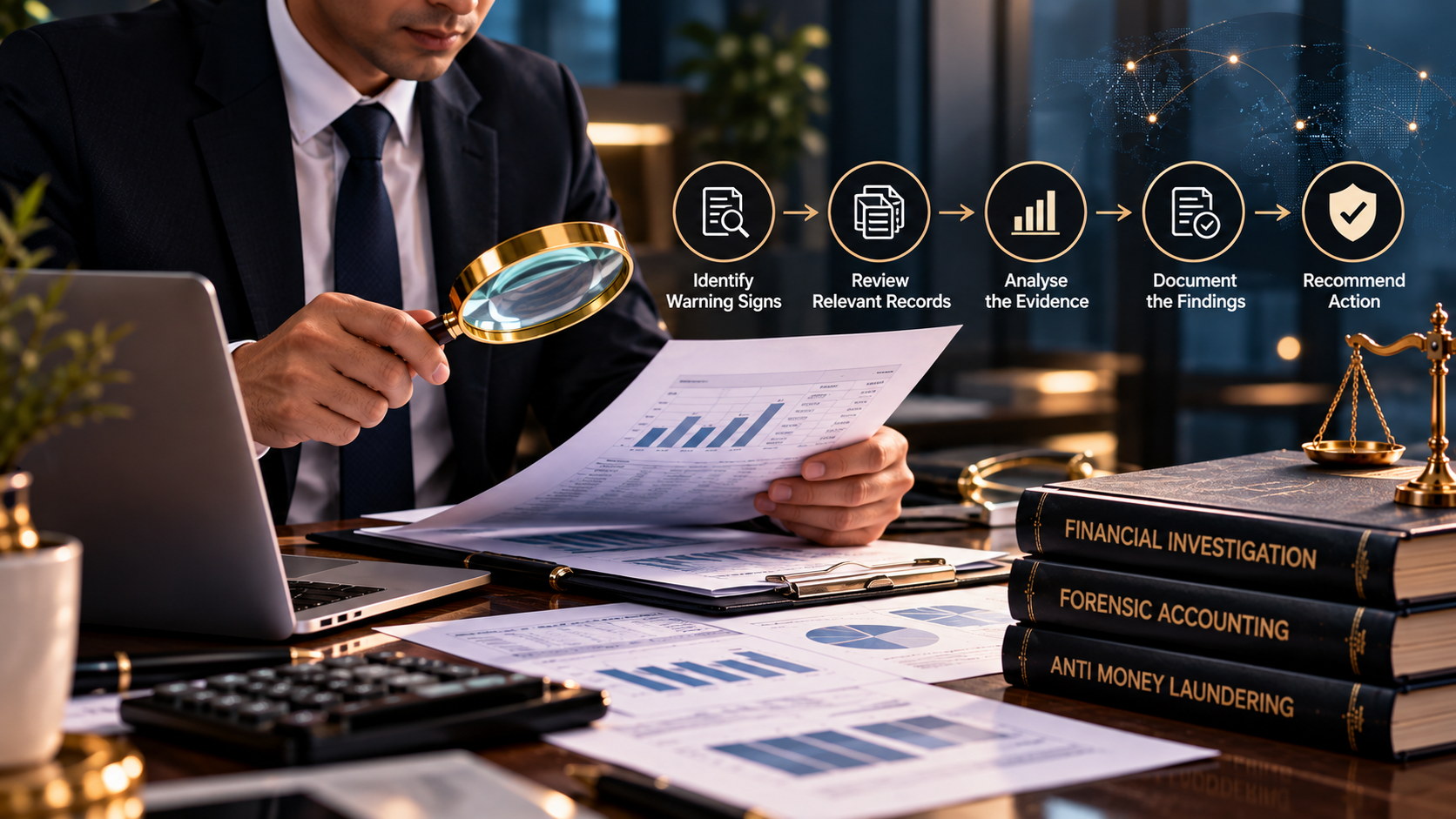
A structured investigation provides a framework that ensures that suspicious activity is thoroughly investigated and substantiated with evidence.
2. Decrease the Risk
It starts when an organization recognizes a transaction, missing money, questionable documents, or some other signs of potential fraud. An investigation could also commence because of a report from an employee, an internal audit or compliance report.
2. Review Relevant Records
Financial statements, invoices, payment history, emails, and other records are analyzed, as appropriate, in light of access and privacy restrictions. Seeing through the papers will help build up the background of the suspected activity.
3. Analyse the Evidence
Collected information is compared to see if there are discrepancies—then patterns of transactions are determined and rules about how it is suspected that happened. Investigators can also analyze if the pattern is present throughout several transactions or departments.
4. Document the Findings
Investigators keep good record of their procedures, findings, and evidence. Checked records will help ensure that the finding is understood and is easily verifiable and will assist with accountability during the investigation.
5. Recommend Appropriate Action
On the basis of the given conclusions, the organizations can take any of the measures to enhance the internal control, solve compliance issues, recover losses if the same occurs, or escalate to the authorized department. Action taken will vary according to evidence and type of incident.
What is the value of a fraud investigation to business?
Fraud undermines an organization’s financial, reputation and customer relationships as well as violates employee rights and relationships. Early detection may be used to minimize potential losses and/or prevent future incidents.
Organizations can help by effectively investigating fraud in their business:
- Catch bad money transactions in time before more money is lost.
- Discuss, design and evaluate suggestions for strengthening accounting systems and internal controls.
- Enhance compliance and risk management process
- Provide detailed evidence to support decision-making.
- Hone the skills of fraud prevention.
- Hold individuals accountable and responsible financially.
For instance, a company could uncover duplicate payments to an unknown supplier. An investigator can go over invoices, transactions, and approvals to base whether payments have a legit leg to stand on or not and whether further action is required or not.
Being proactive enables organizations to be responsive to warning signals and establish a greater culture of ethical business practices.
The skills and training required to become a Fraud Investigator
Accounting, auditing, financial analysis, investigative procedure, and fraud risk management skills can all be of great value to a person interested in a career as a fraud investigator.
Essential skills such as critical thinking, data analysis, documentation of evidence, report writing and ethical issues are included. Knowledge of anti-money laundering and compliance can also be beneficial in the relevant role.
It might be useful for learners to get some training in forensic accounting and financial fraud investigation to provide an appreciation of the examination process of financial information, suspicious transaction analysis and how findings are documented.
These learning opportunities are provided by the Global Association of Forensic Accountants (GAFA), which includes two certifications: Global Certified Financial Fraud Investment (CFFI) and Global Certified Anti Money Laundering (CAML).
Check out the GAFA website to gain more knowledge on GAFA certification programs and why they are relevant to your career objectives.
Mastering Fraud Investigation for Careers.
Depending on their background and expertise, fraud investigation skills can be applicable to a range of jobs.
Career Options:
- Fraud investigator
- Forensic accounting professional
- Internal auditor
- Financial crime analyst
- Compliance analyst
- Palatine is a fraud risk management professional.Palatine is a fraud risk management professional.
They can be tackled at financial services companies, corporate institutions, consulting companies and other sectors that rely heavily on financial soundness and risk management.
These requirements and duties depend on the specific employers and jurisdictions. Continuous professional learning, suitable qualifications and suitable opportunities can be provided, based on the individual’s practical experience.
Frequently Asked Questions
What is the main purpose of Fraud Investigation?
It is primarily used to investigate possible incidents of fraud, identify facts, record the evidence and assist in deciding on a course of action.
What qualifications are helpful to a Fraud Investigator?
It can be beneficial to have backgrounds in accounting, finance, or investigation. Relevant professional training and experience can develop the skills further.