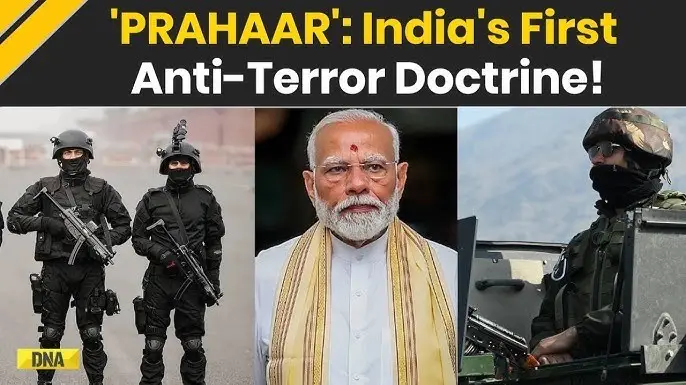
Marking 23 February 2026 as a historical day in India, PRAHAAR – India’s first comprehensive National Counter-Terrorism Policy and Strategy, formally launched by the Ministry of Home Affairs . It is a first of its kind- a structured and a unified framework to prevent, respond to, and recover from terrorism in all its evolving forms.
ndia’s PRAHAAR policy marks a major step in countering terrorism with a proactive, comprehensive approach.
The name “Prahaar,” meaning “strike,”
It symbolically conveys- resolve and readiness.
· Resolve refers to strong determination. It shows that the government is firm, unwavering, and committed to combating terrorism without hesitation or compromise.
· Readiness suggests preparedness. It implies that the state is alert, equipped, and prepared to act quickly and effectively whenever a threat emerges.
So, symbolically, the word Prahaar communicates that India is not passive or reactive, but determined in intention and prepared in action when dealing with security challenges.
PRAHAAR Acronym Breakdown
PRAHAAR breaks down into five strategic pillars, each analytically designed to address terrorism’s multifaceted nature in 2026’s threat landscape.
1.Proactive: This pillar prioritizes intelligence foresight by focusing on improving intelligence sharing through stronger coordination at the Multi-Agency Centre. The aim is to detect and stop terror plots before they happen, which is very crucial part of Preventive mechanism.
2.Response: It highlights a step-by-step rapid response system — starting with state police as the first responders and, if needed, moving to specialized forces like the National Security Guard (NSG) for major incidents and National Investigation Agency (NIA) for probes.
This streamlining is required for faster neutralization while minimizing collateral risks. Intelligence forms the backbone, with the Multi-Agency Centre (MAC) and Joint Task Force on Intelligence (JTFI) enabling real-time data sharing across agencies and states. Prevention focuses on disrupting over-ground workers (OGWs), terror financing, and online extremist networks.
3.Against: This third pillar represents terrorism as a serious threat that cannot be tolerated. The approach combines legal action, financial controls, and technology-based monitoring to block terrorist activities.
It also focuses on identifying not just the attackers but those who support or sponsor them, so that pressure can be applied to prevent further escalation.
4.Hybrid: The fourth pillar acknowledges that modern terrorism has become increasingly complex and unpredictable. Threats are no longer limited to traditional attacks; they now include things like:
· Drones used for attacks or surveillance
· Cyber intrusions targeting systems or data
· Cryptocurrency being used to fund terror operations
· Narco-terror links, where drug trafficking supports terrorist activities
By addressing all these threats together, it bridges the gap between conventional warfare and asymmetric, unconventional tactics. This integrated approach ensures that India is prepared to counter both traditional and high-tech forms of terrorism in a coordinated and proactive manner.
5. Aggressors and Radicals-This fifth pillar focuses on both outside attackers (like cross-border terrorists) and inside threats (such as sleeper cells or people spreading radical ideas online). In order to deal with the risk, It combines strong action against active threats along with the soft measures, like working with communities to prevent radicalization, which helps society stay safer and more resilient.
Structurally, PRAHAAR’s acronymic precision signals a mature doctrine, moving India from ad-hoc measures to institutionalised deterrence.
Zero Tolerance on Terrorism
India’s new counter-terrorism policy firmly reiterates a zero-tolerance approach toward terrorism in all its forms, clearly rejecting any attempt to justify violence. At the same time, it reflects a shift in mindset — moving beyond reactive responses to a more proactive, intelligence-driven strategy that emphasizes prevention, swift and proportionate action, and coordinated participation across government and society.
The policy targets state-sponsored terrorism from across borders, global jihadist groups like Al-Qaeda and ISIS, and their radicalization efforts via sleeper cells and online propaganda. It highlights convergence with organized crime, misuse of drones, encrypted apps, dark web tools, and crypto for terror financing.
Emerging cyber-attacks and criminal hacking also feature prominently.
Relevance of PRAHAAR for common man
India’s PRAHAAR counter-terrorism doctrine isn’t just a set of military or police plans—it’s designed so that ordinary people can go about their daily lives with more safety, resilience, and peace of mind.
1. Safer neighborhoods and public spaces – By focusing on early detection and prevention of attacks, the policy reduces the chances of terrorist incidents in cities, towns, transport hubs, and public events.
2. Quicker emergency response – With first responders like state police and specialized forces (NSG) working in a coordinated, step-by-step system, threats can be neutralized faster, reducing harm to civilians.
3. Reduced radical influence – Community engagement, online monitoring, and de-radicalization efforts aim to stop extremist ideas from spreading, protecting young people and vulnerable groups from being drawn into violence.
4. Protection from modern threats – The policy tackles emerging dangers like cyberattacks, drones, and terrorist financing, which could otherwise affect everyday life, banking, or digital systems.
5. Confidence in the system – Knowing that intelligence-led, proactive measures are in place gives citizens a sense of security, showing that the government is prepared to handle evolving terrorist threats.
In essence, PRAHAAR represents a decisive and modern approach to counter-terrorism—combining intelligence, swift action, legal measures, and community engagement. By addressing both traditional and emerging threats, it not only strengthens national security but also safeguards the everyday life of the common citizen, reflecting India’s commitment to a resilient, proactive, and zero-tolerance stance against terrorism.