

Psychology Behind White-Collar Crime
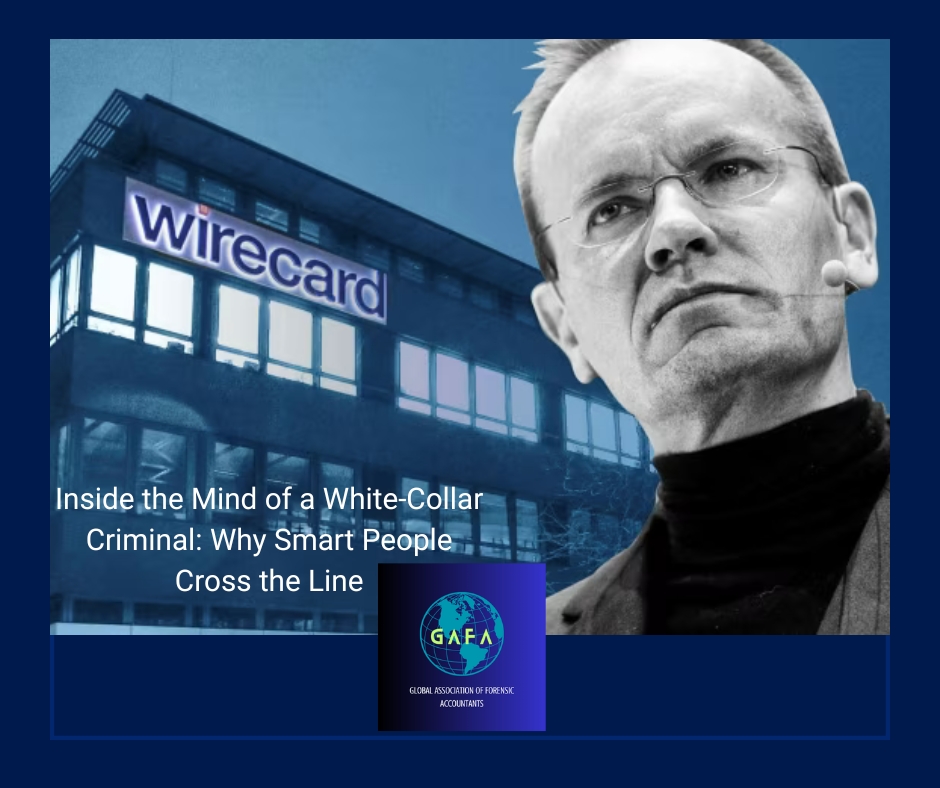
Why Smart People Cross the Line
The boardroom was gleaming — panoramic views, digital dashboards, the quiet hum of wealth. Yet behind the polished surface sat a CEO who had just engineered one of the largest accounting deceptions of the decade. When questioned, he didn’t flinch.
“It wasn’t fraud,” he said evenly. “It was creative strategy.”
That sentence captures the secret life of white-collar crime.
It isn’t driven by desperation or rage. It’s powered by ego, intellect, and a deep belief that rules exist for lesser minds.
The Psychology of Rationalized Corruption
White-collar criminals don’t just wake up and decide to commit fraud. They slowly talk themselves into it — reasoning, justifying, and convincing themselves it’s smart, not wrong.
This mental trick, called moral disengagement, lets them believe deceit is just “strategy” and wrongdoing is “necessary.” In the end, their biggest lie isn’t to the company — it’s to themselves.
As the Global Association of Forensic Accountants (GAFA) explains, this cognitive self-deception is often paired with situational entitlement — the belief that one’s position, intellect, or past success grants immunity from scrutiny. It’s not greed that drives the act; it’s the illusion of control.
The Power Poison: How Success Can Twist the Mind
Neuroscience has shown that power can literally alter brain function.
When people hold authority for too long, their empathy responses weaken, while their dopamine reward centers become more reactive to personal success. In simpler terms, the brain starts to crave dominance the way an addict craves a fix.
Take the Enron scandal. Executives there didn’t merely manipulate balance sheets — they built an entire belief system around their superiority. They prided themselves on “outsmarting” regulators, analysts, even reality itself. They called it innovation. The world called it deception.
That’s the paradox of white-collar psychology: the smarter the individual, the more complex their justification.
The Culture of Turning a Blind Eye
Fraudsters thrive in environments that glorify ambition but ignore accountability.
Wirecard, the German fintech once hailed as Europe’s crown jewel, became a textbook case. Its leadership created a culture where questioning authority was career suicide. Auditors trusted too easily, investors worshipped growth, and regulators hesitated — until $2 billion simply “vanished.”
Psychologically, this culture mirrors a collective denial mechanism — everyone sees the cracks but chooses faith over facts. GAFA’s research into organizational fraud dynamics calls this “the silence loop”: when systems designed to prevent misconduct are undermined by the very people they’re meant to protect.
How Fraud Starts: The Ethical Slide
White-collar crime begins innocently.
- A late-night adjustment to meet quarterly targets.
- A missing disclosure rationalized as “temporary.”
- A small lie told to buy time.
Each act seems justified until morality fades out of focus — a process psychologists term ethical fading. Over time, conscience becomes background noise, and success becomes the only moral compass.
By the time the fraud explodes, the perpetrators have long stopped believing they did anything wrong. They’ve rewritten reality.
The Post-Fraud Realization
After the investigation, many convicted executives often admit they had a chilling realization:
“I thought I was smarter than the system.”
They didn’t fear getting caught — they didn’t think they could be.
GAFA’s behavioral analysis of financial offenders reveals that most white-collar criminals share three traits:
- Overconfidence rooted in past achievements,
- A belief that their intellect justifies their actions, and
- A moral rationalization that frames wrongdoing as “for the greater good.”
they lie not because they’re bad — but because they believe they’re right.
The Real Crime Is in the Thinking
The physiology of white-collar crime isn’t found in fingerprints or forged signatures. It’s found in thought patterns — subtle shifts in perception that turn ambition into manipulation.
Every fraud starts in the same place: in the boardroom mirror, where an intelligent person convinces themselves they’re exceptional enough to cheat and still remain “ethical.”
That’s why, as GAFA emphasizes, the next era of forensic accounting must focus not just on tracing money — but on decoding how power and self-deception intersect in the human brain.
Because fighting financial crime isn’t just about better audits or AI tools — it’s about understanding how brilliance can become blindness.
And that’s the story behind every headline — not money stolen, but morals reengineered.