

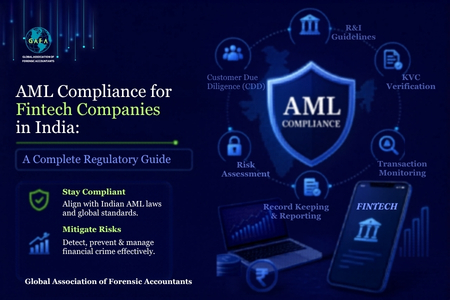
The rapid rise of fintech in India has transformed how individuals and businesses access financial services. From digital lending to payment gateways and neobanking platforms, fintech innovation is reshaping the financial ecosystem. However, with this growth comes increased regulatory scrutiny—especially around AML compliance fintech India.
Anti-Money Laundering (AML) compliance is no longer optional for fintech companies. It is a critical requirement to ensure financial transparency, prevent fraud, and build long-term trust with regulators and users.
This comprehensive guide explains everything fintech companies in India need to know about AML compliance from regulations to best practices.
Understanding AML Compliance in Fintech India
AML compliance fintech India refers to the set of laws, policies, and procedures fintech companies must follow to detect and prevent money laundering and financial crimes.
In India, AML compliance is primarily governed by the Prevention of Money Laundering Act, 2002 (PMLA), along with guidelines issued by the Reserve Bank of India (RBI) and the Financial Intelligence Unit – India.
For fintech companies, this means implementing systems to:
- Verify customer identities (KYC)
- Monitor transactions
- Report suspicious activities
- Maintain records
Ignoring AML requirements can lead to heavy penalties, license suspension, or even business shutdown.
Enroll the AML Certification
Why AML Compliance is Crucial for Fintech Companies
Fintech platforms operate in a high-risk environment due to:
- High transaction volumes
- Digital onboarding
- Cross-border payments
- Anonymous or pseudonymous users
This makes them attractive targets for money laundering activities.
Implementing strong AML compliance fintech India frameworks helps:
- Prevent financial fraud and cybercrime
- Ensure regulatory approval and business continuity
- Build trust among users and investors
- Avoid legal penalties and reputational damage
In today’s regulatory landscape, compliance is not just a legal obligation—it is a competitive advantage.
Key AML Regulations for Fintech Companies in India
1. Prevention of Money Laundering Act (PMLA)
The backbone of AML compliance in India is the Prevention of Money Laundering Act, 2002.
Under PMLA, fintech companies classified as “reporting entities” must:
- Conduct KYC verification
- Maintain transaction records for 5 years
- Report suspicious transactions to FIU-IND
2. RBI AML Guidelines for Fintech
The Reserve Bank of India issues AML guidelines applicable to:
- Payment aggregators
- NBFCs
- Digital lenders
- Prepaid instrument providers
Key requirements include:
- Customer Due Diligence (CDD)
- Risk-based AML approach
- Ongoing transaction monitoring
KYC Norms in Fintech India
Know Your Customer (KYC) is a fundamental part of AML compliance fintech India.
Fintech companies must follow:
- Aadhaar-based eKYC
- Video KYC (V-CIP)
- PAN verification
- Address validation
Strong KYC ensures that users are genuine and reduces identity fraud risks.
Core Components of AML Compliance Framework
To meet AML compliance fintech India requirements, companies must implement a structured framework.
1. Customer Due Diligence (CDD)
CDD involves verifying customer identity and assessing risk levels.
Types of CDD:
- Simplified Due Diligence (low risk)
- Standard Due Diligence
- Enhanced Due Diligence (high-risk customers)
2. Transaction Monitoring Systems
Fintech companies must track and analyze transactions in real time.
Red flags include:
- Unusual transaction patterns
- Large cash movements
- Frequent international transfers
- Structuring or layering activities
Advanced fintech platforms use AI-based monitoring tools for better detection.
3. Suspicious Transaction Reporting (STR)
If suspicious activity is detected, companies must report it to the Financial Intelligence Unit – India.
Failure to report can result in regulatory penalties.
4. Record Keeping
As per PMLA guidelines:
- Maintain customer records for 5 years
- Store transaction data securely
- Ensure easy retrieval for audits
5. AML Policy and Internal Controls
A well-defined AML policy should include:
- Risk assessment procedures
- Employee training programs
- Internal audit mechanisms
- Compliance officer appointment
Learn About the AML course
AML Compliance Challenges in Fintech India
Despite clear regulations, fintech companies face several challenges:
1. Digital-First Customer Onboarding
Remote onboarding increases identity fraud risks.
2. High Transaction Volumes
Managing millions of micro-transactions requires scalable AML systems.
3. Evolving Regulatory Landscape
Frequent updates from the Reserve Bank of India require constant adaptation.
4. Cross-Border Transactions
International payments increase exposure to global money laundering risks.
5. Cost of Compliance
Small fintech startups often struggle with compliance costs.
Best Practices for AML Compliance in Fintech India
To build a robust AML compliance fintech India system, fintech companies should adopt the following best practices:
1. Implement Risk-Based Approach
Classify customers based on risk and apply appropriate due diligence.
2. Use Advanced AML Technology
Leverage AI and machine learning for:
- Fraud detection
- Behavioral analytics
- Real-time alerts
3. Strengthen KYC Processes
Use multi-layer verification to ensure accuracy and authenticity.
4. Continuous Monitoring
AML compliance is not a one-time activity—ongoing monitoring is essential.
5. Employee Training
Train staff regularly on AML regulations and red flag identification.
6. Regular Compliance Audits
Conduct internal and external audits to ensure regulatory adherence.
Penalties for Non-Compliance in India
Failure to comply with AML compliance fintech India regulations can result in:
- Heavy monetary fines
- Business restrictions
- License suspension
- Criminal liability in severe cases
Regulators are increasingly strict, especially with fintech growth.
Future of AML Compliance in Indian Fintech
The future of AML compliance fintech India is evolving rapidly with technology.
Key trends include:
- AI-driven compliance systems
- RegTech integration
- Blockchain-based identity verification
- Real-time compliance monitoring
Fintech companies that proactively adopt these technologies will stay ahead of regulatory challenges.
How GAFA Can Help You Achieve AML Compliance
Ensuring full AML compliance can be complex, especially for growing fintech companies.
At GAFA, we provide:
- AML certification programs
- Compliance training for fintech teams
- Practical implementation guidance
- Industry-aligned regulatory insights
If you’re looking to build a strong compliance framework, explore our AML certification programs at https://gafa.org.in/ and equip your team with real-world expertise.
FAQs
Q1. What is AML compliance in fintech India?
Answer: AML compliance in fintech India refers to the processes and regulations that fintech companies must follow to prevent money laundering and financial crimes. It includes KYC verification, transaction monitoring, and reporting suspicious activities under the Prevention of Money Laundering Act. Regulatory bodies like the Reserve Bank of India and FIU-IND ensure that fintech firms operate transparently and securely within the financial ecosystem while protecting customers from fraud and illegal transactions.
Q2. Is AML compliance mandatory for fintech companies in India?
Answer: Yes, AML compliance is mandatory for fintech companies operating in India. Under the Prevention of Money Laundering Act and RBI guidelines, fintech firms classified as reporting entities must follow strict compliance measures. These include verifying customer identity, maintaining transaction records, and reporting suspicious transactions. Non-compliance can result in penalties, legal action, and even suspension of business operations, making AML compliance essential for sustainable fintech growth.
Q3. What are the key AML regulations for fintech in India?
Answer: The key AML regulations for fintech in India include the Prevention of Money Laundering Act (PMLA), RBI AML guidelines, and KYC norms. These regulations require fintech companies to implement customer due diligence, monitor transactions, and report suspicious activities. Additionally, companies must maintain records for a minimum of five years and adopt a risk-based approach to compliance, ensuring financial transparency and reducing the risk of money laundering activities.
Q4. How do fintech companies implement AML compliance?
Answer: Fintech companies implement AML compliance by setting up structured frameworks that include KYC processes, transaction monitoring systems, and reporting mechanisms. They use advanced technologies like AI and machine learning to detect suspicious activities in real time. Additionally, companies appoint compliance officers, conduct employee training, and perform regular audits to ensure adherence to regulatory guidelines and maintain a secure financial environment for users.
Q5. What are the penalties for AML non-compliance in India?
Answer: Penalties for AML non-compliance in India can be severe and include heavy fines, operational restrictions, and license suspension. In serious cases, companies and responsible individuals may face criminal charges. Regulatory authorities like RBI and FIU-IND actively monitor fintech companies to ensure compliance. Failure to meet AML requirements not only results in legal consequences but also damages the company’s reputation and trust among customers and investors.