

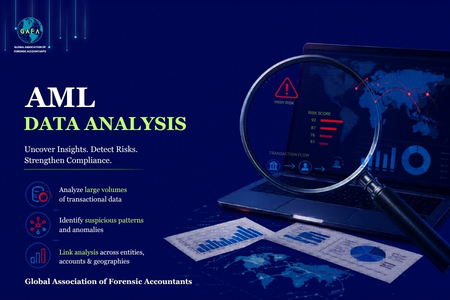
In today’s rapidly evolving financial landscape, preventing illicit activities such as money laundering has become more complex than ever. Traditional compliance methods are no longer sufficient to handle the growing volume of financial transactions. This is where AML data analysis plays a critical role.
The Role of Data Analytics in AML is no longer optional—it is a necessity. Financial institutions, fintech companies, and regulatory bodies rely on data-driven insights to detect suspicious activities, reduce fraud risks, and ensure regulatory compliance.
At GAFA, we emphasize the importance of integrating advanced analytics into Anti-Money Laundering (AML) frameworks to build smarter, faster, and more accurate detection systems.
What is AML Data Analysis?
AML data analysis refers to the use of advanced analytical techniques, algorithms, and tools to monitor, detect, and prevent financial crimes. It involves processing large volumes of transactional and behavioral data to identify unusual patterns that may indicate money laundering.
Key Components of AML Data Analysis
- Transaction monitoring systems
- Customer due diligence (CDD) analytics
- Risk scoring models
- Behavioral pattern analysis
- Suspicious Activity Report (SAR) generation
By leveraging these components, organizations can proactively identify risks instead of reacting after damage is done.
Enroll the AML Certification
Role of Data Analytics in AML Compliance
The Role of Data Analytics in AML compliance is transformative. It enhances efficiency, accuracy, and scalability in identifying financial crimes.
1. Enhanced Transaction Monitoring
Traditional rule-based systems often generate too many false positives. Data analytics helps refine these systems by:
- Identifying patterns across multiple transactions
- Reducing unnecessary alerts
- Improving detection accuracy
2. Real-Time Risk Detection
With real-time data processing, organizations can:
- Detect suspicious transactions instantly
- Prevent fraud before it escalates
- Improve response time for compliance teams
3. Improved Customer Risk Profiling
Data analytics enables deeper insights into customer behavior by analyzing:
- Transaction history
- Geographic risk factors
- Behavioral anomalies
This helps assign accurate risk scores and prioritize investigations.
4. Automation of Compliance Processes
Automation powered by analytics reduces manual effort in:
- Report generation
- Alert investigations
- Compliance reporting
This allows teams to focus on high-risk cases rather than routine tasks.
Key Technologies Used in AML Data Analytics
Modern AML systems rely on cutting-edge technologies to strengthen fraud detection capabilities.
Machine Learning (ML) in AML
Machine learning models learn from historical data to:
- Detect evolving fraud patterns
- Reduce false positives
- Improve predictive accuracy
Artificial Intelligence (AI)
AI enhances AML frameworks by:
- Automating decision-making
- Detecting complex fraud networks
- Enhancing anomaly detection
Big Data Analytics
Big data tools process vast datasets in real-time, enabling:
- Faster insights
- Scalable monitoring systems
- Better risk management
Network Analytics
This technique identifies hidden relationships between entities, helping uncover:
- Fraud rings
- Money laundering networks
- Shell company linkages
Benefits of AML Data Analysis
The adoption of AML data analytics offers significant advantages for financial institutions and compliance teams.
1. Reduced False Positives
Advanced analytics minimizes irrelevant alerts, saving time and resources.
2. Faster Investigations
Automated systems streamline workflows, enabling quicker decision-making.
3. Better Regulatory Compliance
Organizations can meet global AML regulations more effectively with accurate reporting and monitoring.
4. Cost Efficiency
Reducing manual work and improving accuracy leads to lower operational costs.
5. Proactive Risk Management
Instead of reacting to fraud, organizations can prevent it before it occurs.
Read More About beneficial ownership AML verification
Challenges in AML Data Analysis
Despite its advantages, implementing AML data analytics comes with certain challenges.
Data Quality Issues
Incomplete or inconsistent data can lead to inaccurate results.
Integration Complexity
Combining legacy systems with modern analytics tools can be technically challenging.
Regulatory Changes
Frequent updates in AML regulations require continuous system upgrades.
High Implementation Costs
Advanced analytics solutions may require significant investment initially.
Best Practices for Effective AML Data Analysis
To maximize the Role of Data Analytics in AML, organizations should follow these best practices:
1. Invest in Quality Data Management
Ensure clean, accurate, and well-structured data for reliable insights.
2. Use Advanced Analytics Tools
Adopt AI and ML-driven platforms for better detection capabilities.
3. Continuous Monitoring and Updates
Regularly update models to adapt to new fraud patterns.
4. Employee Training
Equip compliance teams with the skills needed to interpret data insights effectively.
5. Collaborate with Experts
Partnering with institutions like GAFA can help implement industry-leading AML strategies.
Future of AML Data Analytics
The future of AML lies in intelligent automation and predictive analytics. Emerging trends include:
- AI-driven compliance systems
- Blockchain-based transaction tracking
- Advanced behavioral analytics
- Cloud-based AML solutions
As financial crimes become more sophisticated, the Role of Data Analytics in AML will continue to evolve, making it a cornerstone of modern compliance strategies.
Buy Now AML Certification
Conclusion
The Role of Data Analytics in AML is redefining how organizations detect and prevent financial crimes. By leveraging advanced technologies, financial institutions can move from reactive compliance to proactive risk management.
At GAFA, we believe that adopting AML data analytics is not just about compliance it’s about building a secure financial ecosystem. Organizations that invest in data-driven AML strategies today will be better equipped to handle tomorrow’s challenges.
FAQs
Q1. What is the role of data analytics in AML?
Answer: The role of data analytics in AML is to enhance the detection and prevention of financial crimes by analyzing large volumes of transaction data. It helps identify suspicious patterns, reduce false positives, and improve compliance efficiency. By using technologies like machine learning and AI, organizations can automate monitoring systems and detect fraud in real time, making AML processes more accurate, scalable, and effective in today’s complex financial environment.
Q2. How does AML data analysis improve fraud detection?
Answer: AML data analysis improves fraud detection by identifying unusual transaction patterns and behavioral anomalies that traditional systems may miss. Advanced analytics tools process vast datasets quickly, enabling real-time monitoring and faster decision-making. By leveraging predictive models and machine learning, organizations can detect emerging fraud trends, reduce manual intervention, and focus on high-risk activities, significantly enhancing the overall effectiveness of financial crime prevention strategies.
Q3. What technologies are used in AML data analytics?
Answer: AML data analytics relies on technologies such as machine learning, artificial intelligence, big data analytics, and network analysis. These technologies help process large datasets, identify hidden relationships, and detect suspicious activities. Machine learning improves accuracy over time, while AI automates decision-making processes. Together, these tools enable financial institutions to build robust AML systems that can adapt to evolving fraud patterns and regulatory requirements.
Q4. What are the challenges in implementing AML data analytics?
Answer: Implementing AML data analytics comes with challenges such as poor data quality, integration issues with legacy systems, high implementation costs, and constantly changing regulations. Organizations must ensure accurate data collection and invest in advanced tools to overcome these hurdles. Continuous system updates and employee training are also essential to maintain efficiency and ensure compliance with evolving AML standards.
Q5. Why is AML data analytics important for financial institutions?
Answer: AML data analytics is crucial for financial institutions because it enhances their ability to detect and prevent money laundering activities efficiently. It reduces operational costs, improves compliance accuracy, and enables proactive risk management. By leveraging data-driven insights, institutions can stay ahead of financial criminals, meet regulatory requirements, and protect their reputation in an increasingly complex financial ecosystem.