

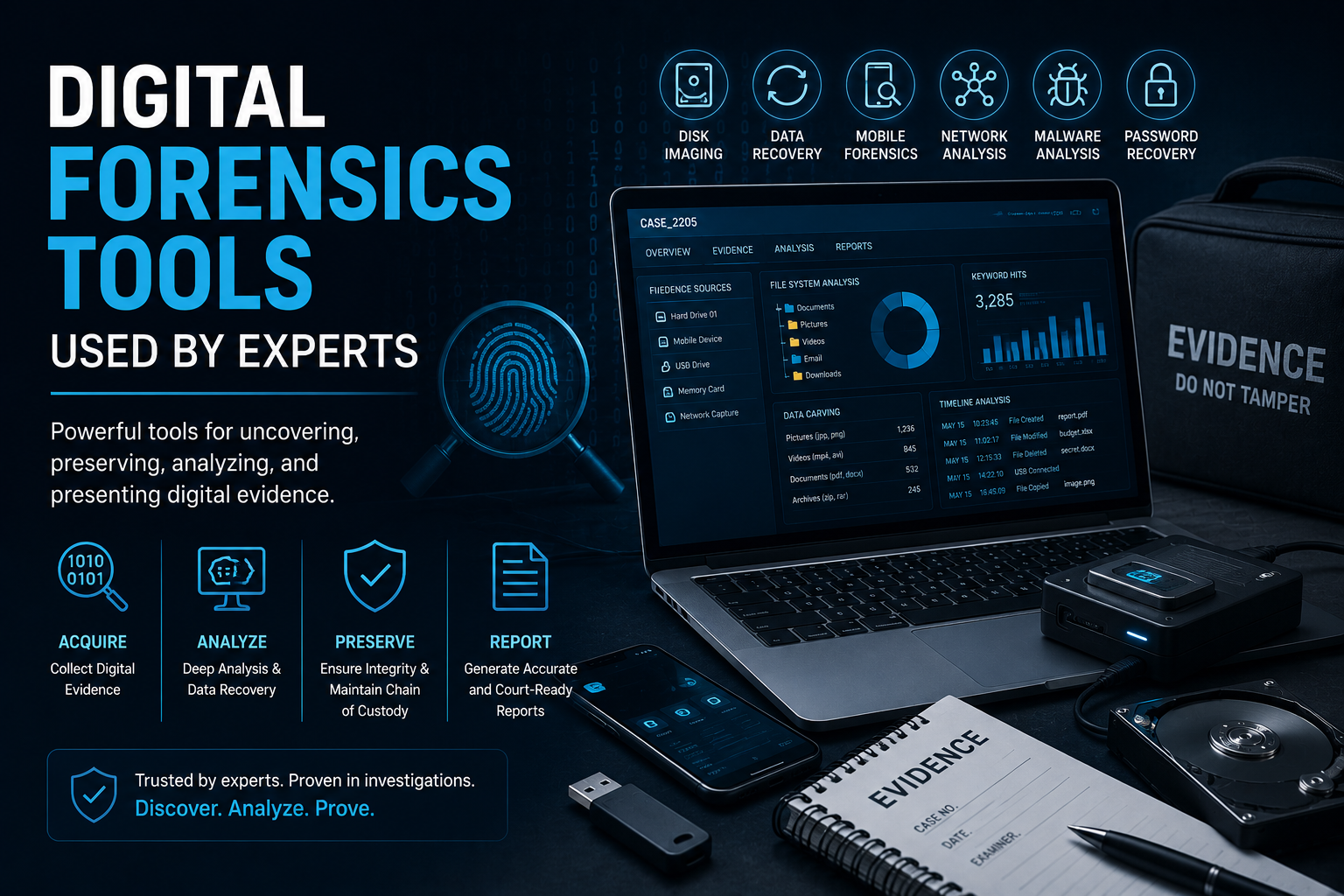
Digital forensic tools are specialized software tools used by cybersecurity professionals, law enforcement agencies, and incident response teams. These tools are used by forensic investigators to collect, preserve, analyse and present digital evidence in case of a cyber crime.
The most used digital forensic tools include Autopsy, EnCase, FTK, X-Ways Forensics, Magnet AXIOM, Cellebrite, Volatility, and Wireshark. These tools support experts investigating cybercrimes, data breaches, ransomware attacks, insider threat and compliance violations. They protect the integrity of evidence which is useful to conduct investigation.
Want to master industry-standard digital forensics tools?
Professionals looking to gain hands-on experience with digital forensic investigation tools can explore GAFA’s Digital Forensics Training Program to learn evidence acquisition, malware analysis, incident response, and forensic investigation techniques used in real-world cybercrime cases.
What Are Digital Forensics Tools?
Every crime leaves a trail behind. Cyber crimes are more nuanced and hence searching for a trail becomes trail without any tools becomes difficult. A deleted file, a suspicious login attempt, encrypted communication all might carry evidence which can be traced back to the culprit. A trained professional knows how to uncover the hidden truth from even a small trail.
Digital forensic tools are designed to identify, collect, preserve, analyze and report evidence. It can be used on computers, smartphones, servers, cloud environments and network devices. These tools are built specifically to protect the integrity of the evidence to withstand legal scrutiny.
Every organisation relies on digital forensics software tools during internal investigations, compliance audits, intellectual property theft cases and employee misconduct inquiries.
Why Are Digital Forensics Tools Important?
Cyberattacks have evolved with the advance in technology. Attackers wipe entire bank accounts in under a minute and then hide their tracks by erasing logs, hiding malware, encrypting files, hacking and exploiting clouds. Traditional security tools can find out what happened but they cannot trace how it happened.
Digital forensic tools are built specially to figure how it happened and help investigators prepare a full report backed by evidence. They can help recover deleted files, analyze system logs, trace attacker activities. It examines malware behaviors and identifies evidence of unauthorized access. They help reconstruct timelines of cyber crime incidents and investigate insider threats. Once the evidence is collected it preserves it for safe keeping for legal proceedings.
Without forensic tools, organisations can risk losing critical evidence which can help determine the cause and the impact of the cyber incident.
What Tools Are Used in Digital Forensics?
| Category | Purpose | Popular Tools |
| Disk Forensics | Analyze storage devices | Autopsy, EnCase, FTK |
| Memory Forensics | Investigate RAM artifacts | Volatility, Rekall |
| Mobile Forensics | Analyze smartphones | Cellebrite, Oxygen Forensics |
| Network Forensics | Investigate network traffic | Wireshark, NetworkMiner |
| Cloud Forensics | Analyze cloud evidence | Magnet AXIOM Cloud |
| Malware Analysis | Examine malicious software | Ghidra, IDA Pro |
Each tool addresses a different aspect of the forensic process, making it common for investigators to use multiple platforms during a single investigation.
Top Digital Forensics Tools Used by Experts
1. Autopsy Digital Forensic Tool
Autopsy is the most widely adopted tool among the open-source forensic platform. It is built on The Sleuth Kit framework and has a user-friendly interface. This tool makes it easier to analyze hard drives, recover deleted files, examine browser history and generate forensic reports.
Experts prefer Autospy as it is cost effective and on an open source forensic platform. It supports Windows, Linux and macOS evidence. It has powerful keyword search capabilities and an extensible plugin ecosystem. It can conduct a timeline analysis.
For students and aspiring investigators, Autopsy often serves as the first introduction to professional computer forensics software tools.
2. EnCase Forensic
EnCase allows investigators to acquire, preserve and analyze digital evidence while adhering to the strict chain-custody requirements. The tool has been considered an industry benchmark in forensic investigations.
Its strength lies in handling court-admissible evidence, advanced evidence processing, enterprise scale investigations and detailed reporting capabilities.
Government agencies and law enforcement organizations frequently rely on EnCase for high-stakes investigations.
3. FTK (Forensic Toolkit)
FTK is known for its speed and index capabilities. It specialises in rapid evidence processing. Instead of scanning evidence, FTK indexes the collected data. This allows the investigator to conduct searches and analysis more efficiently.
FTK also does email analysis, password recovery support, registry examinations and comprehensive reporting. Organisations with large datasets use FTK to reduce time and for quicker efficient output.
4. Magnet AXIOM
Magnet AXIOM is for modern technology, it goes beyond traditional computers. It helps investigators analyze evidence from computers, smartphones, social media platforms and cloud applications.
It is popularly used for cross-device correlation, cloud evidence collection, mobile device analysis and visual evidence mapping. As digital ecosystems become increasingly interconnected, tools like AXIOM provide investigators with a broader investigative perspective.
5. Volatility
Memory forensics is an essential part of modern cyber investigations. Volatility specializes in analyzing volatile memory (RAM). It helps investigate information that never reaches a hard drive.
Investigators use Volatility to detect malware, identify active processes, examine network connections, recover encryption keys and analyze system memory artifacts. This makes it one of the most valuable digital forensic investigation tools for incident response teams.
Comparison of Popular Digital Forensics Software
| Tool | Type | Open Source | Best Use Case |
| Autopsy | Disk Forensics | Yes | Education and investigations |
| EnCase | Enterprise Forensics | No | Legal investigations |
| FTK | Data Analysis | No | Large-scale investigations |
| Magnet AXIOM | Multi-Source Forensics | No | Corporate investigations |
| Volatility | Memory Forensics | Yes | Malware investigations |
| Cellebrite | Mobile Forensics | No | Smartphone investigations |
| Wireshark | Network Forensics | Yes | Traffic analysis |
This combination forms the backbone of many modern digital forensics software workflows.
Ready to gain practical exposure to industry-leading digital forensics tools?
Explore GAFA’s Cyber Security and Digital Forensics Courses and learn how experts use Autopsy, FTK, memory analysis frameworks, and incident response methodologies in real-world investigations.
How Experts Use Digital Forensic Investigation Tools
Professionals do not depend on one tool or one software platform, instead they follow a structured process. They start with evidence collection by using tools to create forensic images of devices to ensure original evidence remains untouched.
They preserve the evidence with hash verification methods which confirms that evidence has not been altered.
Multiple tools are used to analyze the evidence to uncover hidden files, logs, network traces and malicious activity. After analyzing events are arranged chronologically and a timeline is recreated to determine what occurred and how.
The findings are documented in a format which is suitable for legal, regulatory and organisational review. This in depth process is what makes professional digital forensics individual different from ordinary troubleshooting.
How to Build a Career in Digital Forensics
Demand for digital forensic professionals continues to rise as organizations face increasingly complex cyber threats.
Professionals entering the field should understand operating systems, learn networking fundamentals, practise evidence acquisition and master forensic analysis tools. They need to study cybercrime investigation methodologies and learn hands-on experience through labs and simulations.
Employers increasingly value candidates who can demonstrate practical investigation skills rather than theoretical knowledge alone. Whether you’re recovering deleted evidence, analyzing malware behavior, or reconstructing an attack timeline, practical experience teaches decision-making skills that textbooks cannot replicate.
Institutions such as GAFA help aspiring cybersecurity professionals gain exposure to industry-standard computer forensics tools, investigation methodologies, and incident response frameworks that align with current industry requirements.
FAQ
Q1. What are digital forensics tools?
Answer: Digital forensics tools are software applications used to collect, preserve, analyze, and present digital evidence during cybersecurity investigations, legal proceedings, and incident response activities.
Q2. Which is the most popular digital forensic tool
Answer: Autopsy, EnCase, FTK, and Magnet AXIOM are among the most widely used digital forensic investigation tools globally.
Q3. Is Autopsy a digital forensic tool?
Answer: The Autopsy digital forensic tool is one of the most popular open-source forensic platforms used for disk analysis, file recovery, and evidence examination.
Q4.What are computer forensics tools used for?
Answer: Computer forensics tools help investigators recover deleted files, analyze system activity, identify malware, and reconstruct cyber incidents.
Q5. What is the difference between digital forensics software and cybersecurity tools?
Answer: Cybersecurity tools focus on prevention and detection, while digital forensics software focuses on investigation, evidence collection, and post-incident analysis.
Q6. Are digital forensics tools used in court cases?
Answer: Many forensic tools are specifically designed to preserve evidence integrity and generate reports that can be used in legal proceedings.
Q7. What skills are required for digital forensics?
Answer: Professionals typically need knowledge of operating systems, networking, cybersecurity, evidence handling, incident response, and forensic analysis techniques.