
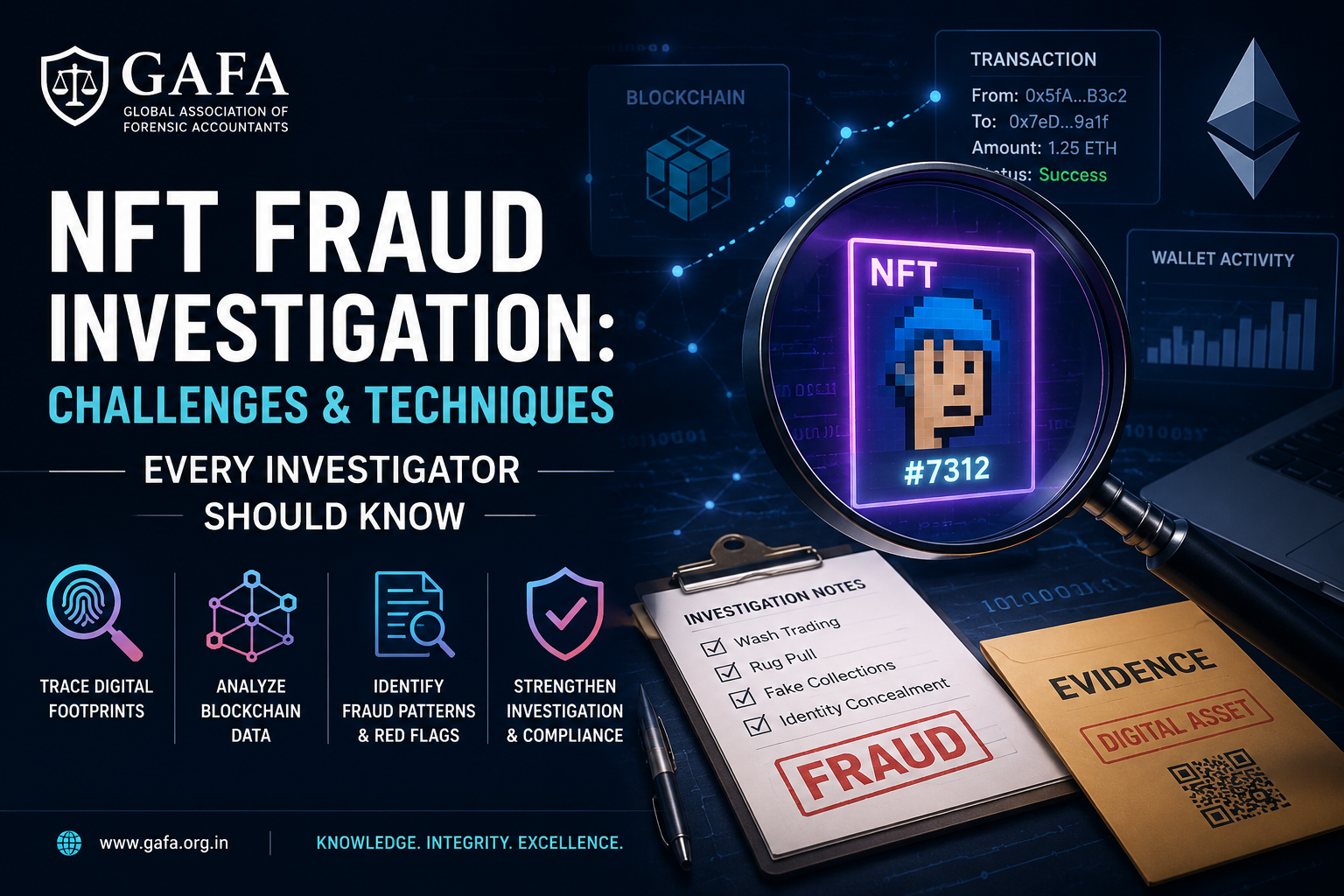
NFT fraud investigation is the process of identifying, analysing, and investigating fraudulent activities involving non-fungible tokens (NFTs). It combines blockchain analytics, digital forensics, financial investigation techniques, and cyber intelligence to uncover scams, trace cryptocurrency transactions, identify fraudulent wallet activity, and recover evidence related to NFT-based financial crimes.
As the NFT ecosystem has expanded, so have opportunities for fraud. Criminals exploit fake NFT projects, wash trading, phishing attacks, counterfeit digital artwork, and rug pulls to deceive investors and generate illicit profits. Investigators must understand how NFT marketplaces operate and apply specialised investigative techniques to identify fraudulent behaviour while preserving digital evidence.
Develop practical expertise in cryptocurrency investigations and financial crime detection with the GAFA Financial Fraud Investigation Certificate.
What Is NFT Fraud Investigation?
NFT fraud investigation focuses on identifying illegal or deceptive activities involving non-fungible tokens. Unlike traditional financial fraud investigations, NFT investigations require investigators to analyse blockchain transactions, smart contracts, digital wallets, marketplace activity, and online communications.
NFTs represent ownership of unique digital assets such as artwork, music, videos, gaming assets, and collectibles. While blockchain technology provides transparency, fraudsters often exploit the lack of regulation, investor awareness, and technical knowledge to carry out scams.
An NFT investigation may involve tracing cryptocurrency payments and analysing blockchain transaction history. It identifies suspicious wallet behaviour, examines smart contracts and recovers digital evidence. It investigates online identities and links multiple fraudulent NFT collections.
These investigations often require collaboration between financial investigators, cybersecurity experts, blockchain analysts, and law enforcement agencies.
Why Has NFT Fraud Increased?
The rapid growth of NFTs created a market where high-value digital assets can be bought and sold within minutes across global marketplaces. Unfortunately, this growth has also attracted fraudsters. Several factors contribute to the rise in NFT-related fraud.
Anonymous Transactions: Blockchain wallets typically do not reveal the real identity of users, making it easier for criminals to hide behind pseudonymous addresses.
High Market Speculation: Many investors purchase NFTs hoping for quick profits, creating opportunities for scammers to exploit fear of missing out (FOMO).
Limited Regulation: Although regulations continue to evolve, NFT markets remain less regulated than traditional financial systems.
Cross-Border Transactions: NFT transactions occur globally, making investigations more complex due to differing legal frameworks and jurisdictions.
Rapid Technology Evolution: New NFT platforms, blockchain networks, and decentralised applications emerge regularly, creating fresh opportunities for fraud.
Understanding these factors helps investigators anticipate emerging fraud patterns and improve detection strategies.
What Are the Most Common Types of NFT Scams?
Understanding NFT scams types is essential for conducting effective investigations.
Some of the most common fraud schemes include:
Fake NFT Collections
Fraudsters create counterfeit NFT projects that imitate popular collections to trick buyers into purchasing worthless digital assets.
Phishing Attacks
Attackers send fraudulent emails, fake marketplace links, or social media messages designed to steal wallet credentials or private keys.
Counterfeit Digital Artwork
Criminals mint NFTs using artwork they do not own, infringing intellectual property rights while deceiving buyers.
Pump-and-Dump Schemes
Fraudsters artificially inflate NFT prices through coordinated buying before selling their holdings at inflated prices, leaving other investors with significant losses.
Fake Airdrops
Victims are promised free NFTs but are instead directed to malicious websites that compromise their wallets.
Marketplace Impersonation
Cybercriminals build websites that closely resemble legitimate NFT marketplaces to steal login credentials and cryptocurrency.
Investigators often encounter multiple scam techniques operating simultaneously within a single case.
What Is Wash Trading in NFTs?
One of the most common forms of market manipulation is wash trading NFT activity.
Wash trading occurs when the same individual, or a group of connected individuals, buys and sells the same NFT repeatedly to create the illusion of high demand and increasing market value.
The objectives include:
- Artificially increasing NFT prices
- Generating misleading trading volume
- Attracting unsuspecting buyers
- Manipulating marketplace rankings
- Creating false perceptions of popularity
Investigators identify wash trading by analysing:
- Repeated transactions between related wallets
- Circular fund movements
- Short intervals between purchases and sales
- Identical pricing patterns
- Shared wallet ownership indicators
Blockchain analytics platforms play a critical role in detecting these suspicious transaction patterns.
How Is NFT Rug Pull Detection Performed?
Among the most damaging NFT scams are rug pulls, where project creators abandon an NFT collection after collecting investor funds. Effective NFT rug pull detection requires investigators to examine both on-chain and off-chain evidence. Key indicators include:
Sudden Liquidity Withdrawal: Project creators rapidly remove funds after selling NFTs.
Inactive Development Teams: Developers stop communicating through official channels and abandon promised project updates.
Anonymous Founders: Projects lacking verifiable team information often present higher fraud risks.
Smart Contract Red Flags: Investigators review smart contracts for hidden functions that allow developers to manipulate assets or withdraw funds unexpectedly.
Unusual Wallet Activity: Blockchain analysis may reveal project funds being transferred to exchanges or multiple newly created wallets shortly before the project disappears.
Early identification of these warning signs enables investigators to gather evidence before assets become increasingly difficult to trace.
Build advanced blockchain investigation skills with the GAFA Financial Fraud Investigation Certificate.
How Are NFT Marketplaces Investigated?
One of the most important aspects of investigating NFT marketplaces is understanding how transactions occur across blockchain networks and marketplace platforms. Unlike traditional online marketplaces, NFT platforms combine blockchain technology, smart contracts, cryptocurrency wallets, and decentralised infrastructure, creating unique investigative challenges. Investigators typically begin by examining:
Marketplace Transaction History
Every NFT purchase, sale, transfer, or listing creates an on-chain record. Reviewing these records helps investigators establish ownership history and identify suspicious transaction patterns.
Wallet Behaviour
Investigators analyse wallet activity to determine whether multiple wallets are controlled by the same individual or organised fraud network. Frequent interactions between the same wallets, repetitive purchases, or circular fund movements may indicate fraudulent activity.
Smart Contract Analysis
Many NFT collections rely on smart contracts to automate transactions. Reviewing contract code can reveal hidden functions, unauthorised privileges, or vulnerabilities that may have enabled fraud.
Marketplace Activity Logs
Listing history, cancelled sales, pricing changes, and bid activity often provide valuable context during an investigation.
Cross-Platform Intelligence
Fraudsters rarely operate on a single marketplace. Investigators compare wallet activity across multiple NFT platforms and blockchain networks to identify broader fraud patterns.
By combining blockchain analytics with marketplace intelligence, investigators can reconstruct events and identify the individuals or entities behind suspicious NFT activity.
How Is Crypto Art Fraud Investigated?
The growing popularity of digital art has led to a significant rise in crypto art fraud, where scammers exploit artists, collectors, and investors. Investigating crypto art fraud involves both technical analysis and intellectual property verification. Common investigative approaches include:
Ownership Verification: Investigators determine whether the NFT creator actually owns the artwork or has copied it without permission.
Blockchain Transaction Analysis: The movement of cryptocurrency related to the NFT sale is traced to identify recipients and associated wallets.
Metadata Examination: Metadata reveals important information such as creation dates, file history, and links to the original digital asset.
Digital Image Comparison: Investigators compare NFTs against existing artwork using reverse image searches and specialised software to identify copied or manipulated content.
Open-Source Intelligence (OSINT): Publicly available information from websites, artist portfolios, social media platforms, and community forums often helps verify authenticity and identify fraudulent actors.
Combining these techniques enables investigators to establish ownership, identify infringement, and support legal action where necessary.
Build practical expertise in blockchain investigations, crypto fraud detection, and digital evidence analysis with the GAFA Financial Fraud Investigation Certificate.
What Challenges Do Investigators Face in NFT Fraud Cases?
Despite blockchain transparency, NFT investigations remain highly complex. Some of the biggest challenges include:
Pseudonymous Wallets: Blockchain addresses do not automatically reveal the real identity of their owners, making attribution difficult.
Cross-Border Jurisdictions: NFT transactions frequently involve participants located in multiple countries, creating legal and regulatory challenges.
Rapid Market Evolution: New NFT collections, blockchain networks, and marketplace features emerge continuously, requiring investigators to stay updated.
Privacy Tools: Mixers, privacy-focused wallets, and cross-chain bridges can complicate the tracing of cryptocurrency transactions.
Evidence Preservation: Digital evidence must be collected and preserved using accepted forensic methodologies to ensure its integrity and admissibility.
Artificial Intelligence and Deepfakes: AI-generated artwork and manipulated digital assets are creating new forms of fraud that require increasingly sophisticated investigative techniques.
Addressing these challenges requires ongoing training, collaboration, and investment in advanced blockchain analytics tools.
Advance your career in cryptocurrency and financial crime investigations with the GAFA Financial Fraud Investigation Certificate.
TL;DR
NFT fraud investigation focuses on detecting scams involving non-fungible tokens using blockchain analytics and digital forensics.
Common NFT scams types include fake collections, phishing attacks, counterfeit artwork, pump-and-dump schemes, fake airdrops, and marketplace impersonation.
Wash trading NFT activity artificially inflates trading volume and prices through repeated transactions between related wallets.
NFT rug pull detection involves analysing smart contracts, wallet activity, liquidity withdrawals, and developer behaviour.
Investigating NFT marketplaces requires analysing blockchain transactions, marketplace records, wallet interactions, and smart contracts.
Crypto art fraud investigations combine ownership verification, metadata analysis, blockchain tracing, and OSINT techniques.
Modern NFT investigations require technical expertise, blockchain analytics, and strong digital evidence handling practices.
Frequently Asked Questions (FAQs)
Q1. What is NFT fraud investigation?
Answer: NFT fraud investigation involves identifying, analysing, and investigating fraudulent activities related to NFTs using blockchain analytics, digital forensics, and financial investigation techniques.
Q2. What are the most common NFT scams?
Answer: Common NFT scams include fake NFT collections, phishing attacks, wash trading, rug pulls, counterfeit digital artwork, fake airdrops, and marketplace impersonation.
Q3. What is wash trading in NFTs?
Answer: Wash trading occurs when the same individual or connected parties repeatedly buy and sell an NFT to create artificial trading volume and inflate prices.
Q4. How do investigators detect NFT rug pulls?
Answer: Investigators examine blockchain transactions, liquidity movements, wallet activity, smart contracts, and developer communications to identify signs of a rug pull.
Q5. How is crypto art fraud investigated?
Answer: Crypto art fraud investigations involve verifying ownership, tracing cryptocurrency payments, analysing metadata, comparing digital artwork, and collecting open-source intelligence.
Q6. Why are blockchain analytics important for NFT investigations?
Answer: Blockchain analytics help investigators trace cryptocurrency transactions, identify wallet relationships, uncover suspicious trading patterns, and generate evidence to support fraud investigations.