

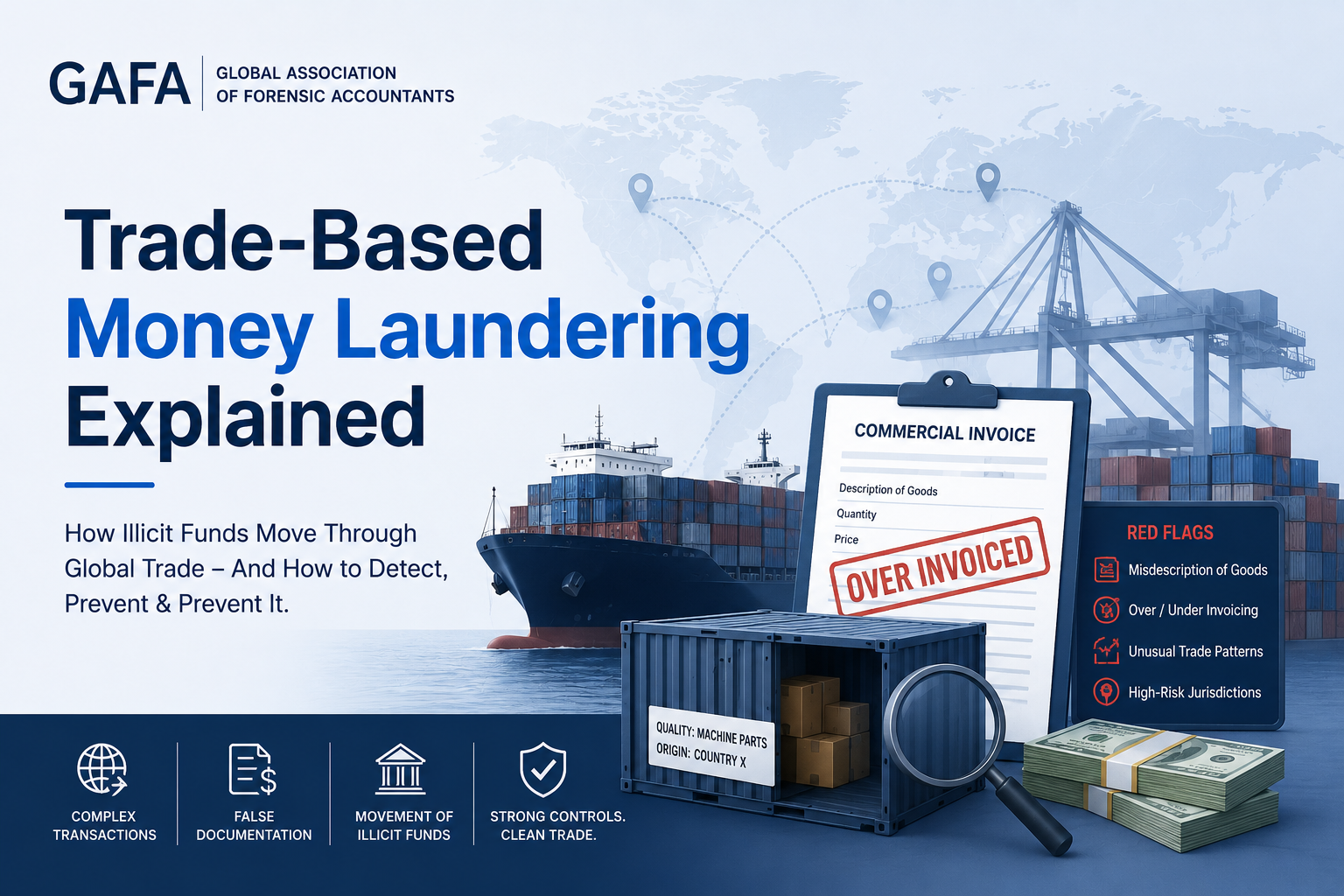
Trade-Based Money Laundering (TBML) is the process of disguising the proceeds of crime and moving value across international borders through the deliberate misrepresentation of price, quantity, or quality of goods and services in commercial transactions. By exploiting legitimate global supply chains, international trade finance documents, and cross-border payment networks, financial criminals mask illicit capital as routine commercial settlement, bypassing traditional banking controls.
Elevate your financial crime expertise and protect global trade flows with GAFA AML Certifications
What Makes Trade-Based Money Laundering the Hardest Financial Crime to Detect?
International commerce is the lifeblood of the global economy, moving over $25 trillion in goods every year. Yet, within this vast, fast-moving Web of maritime shipping containers, customs declarations, and complex trade financing structures lies one of the most sophisticated financial crime mechanisms in existence: Trade-Based Money Laundering (TBML). While traditional money laundering relies on structuring cash deposits (smurf schemes) or layering funds through offshore shell bank accounts, TBML integrates criminal proceeds directly into legitimate commercial operations.
The fundamental challenge with trade-based money laundering stems from the sheer volume and operational complexity of international trade. Financial institutions processing wire transfers for trade settlement rarely see the physical cargo being transported. They deal primarily with paper or electronic documents—bills of lading, commercial invoices, certificates of origin, and letters of credit. When bad actors manipulate these documents, distinguishing between a genuine commercial dispute, an honest clerical error, and an intentional trade finance fraud scheme becomes exceptionally difficult without specialized domain expertise.
Furthermore, international trade involves a sprawling matrix of actors: exporters, importers, freight forwarders, customs brokers, shipping lines, correspondent banks, and trade insurers. Criminal networks take full advantage of information asymmetry between these parties. An issuing bank in London might process payment for a shipment originating in South America destined for East Asia, having zero visibility into whether the container holds high-end electronics or actual bricks. This structural opacity makes TBML the preferred vehicle for drug cartels, transnational organized crime syndicates, terrorist financing groups, and state actors seeking to evade international sanctions.
How Does Trade Finance Fraud Actually Work in Practice?
To understand how trade finance fraud operates within the broader umbrella of TBML, one must look at how legitimate trade is funded. Trade finance mechanisms such as Letters of Credit (LCs), Documentary Collections,
and Supply Chain Financea re designed to mitigate counterparty risk between buyers and sellers who operate in different legal jurisdictions. However, these very risk-mitigation tools can be turned into mechanisms for value transfer when bad actors collude on both sides of the transaction.
In a classic trade finance fraud scenario, the buyer and seller are not independent arm’s-length commercial partners. Instead, they are secretly controlled by the same criminal syndicate or operating as co-conspirators. They approach a financial institution to request a Letter of Credit. The bank issues the LC based on submitted commercial documents. Once the bank verifies that the paper documents appear regular on their face (adhering to UCP 600 standards), it releases funds to the seller. In reality, the goods specified in the contract may be drastically inflated in value, entirely fictitious, or shipped in far lower quantities than claimed.
Because banks operate under the “doctrine of strict compliance” with respect to trade documents, they are legally obligated to honor payments if the documents strictly conform to the terms of the LC. Banks are not law enforcement agencies; they do not physically inspect container ships at ports. Criminals exploit this exact procedural boundary to move millions of dollars in dirty money under the guise of routine commercial payments, effectively laundering funds into clean, bank-approved commercial revenue.
What Are the Core Techniques Used in Invoice Manipulation Money Laundering?
At the mechanical heart of almost every trade-based money laundering scheme lies invoice manipulation. By distorting the fundamental commercial variables—price, quantity, and quality—money launderers can transfer arbitrary amounts of value across borders while creating a seemingly legitimate paper trail. Let us break down the four primary variations of invoice manipulation money laundering:
1. Over-Invoicing
Goods are invoiced at a price significantly higher than their fair market value. Transfers excess value from the buyer to the seller. Used to shift illicit capital into the
exporter’s jurisdiction under the cover of legitimate sales proceeds.
2. Under-Invoicing
Goods are invoiced at a price significantly lower than their fair market value.
Transfers value from the seller to the buyer. The buyer receives goods worth far more than the paid invoice amount and resells them locally at market rates to realize profit.
3. Multiple Invoicing
Issuing multiple invoices for a single shipment of goods, or presenting the same invoice to multiple banks. Extracts multiple payments for one actual physical movement of goods, amplifying value transfer without needing extra cargo logistics.
4. Phantom Shipments (Ghost Goods)
Misrepresenting the actual quantity or shipping empty containers/worthless
scrap while invoicing for premium goods. Transfers total monetary value while shipping zero or negligible physical value, maximizing profit margins for criminal networks.
Strengthen your institutional compliance framework with comprehensive training through GAFA AML Certifications.
What Are the Most Critical TBML Red Flags Every Compliance Officer Must Monitor?
Detecting trade-based money laundering requires transaction monitoring teams to look beyond basic Know Your Customer (KYC) profiles and examine the underlying commercial logic of every transaction. When investigating potential trade fraud or illicit capital flows, risk officers should evaluate these primary TBML red flags across categories:
| Indicator Category | Specific Red Flag Behavior | Underlying Compliance Risk |
| Documentary Anomalies | Vague product descriptions (e.g., “general merchandise”, “goods”) without Harmonized System (HS) codes. | Invoice manipulation, money laundering or misclassification to hide true value. |
| Pricing & Valuation | Invoiced prices deviate dramatically from international commodity benchmarks or fair market value. | Over-invoicing or under-invoicing schemes used to move capital illicitly. |
| Corporate Profile | Newly formed trading entity engaging in high-volume, multi-million dollar complex trade deals. | Shell company or nominee front structure utilized for illicit transfers. |
| Shipping Logistics | Inconsistent shipping routes involving circuitous transshipments through unrelated offshore ports. | Obscuring the true country of origin, destination, or sanctioned trade routes. |
| Payment Structure | Third-party wire transfers from unrelated offshore entities with no clear connection to the buyer or seller. | Disguising beneficial ownership or layering funds prior to settlement. |
| Business Scope | Significant mismatch between the customer’s line of business and traded commodities (e.g., seafood trader importing electronics). | Front company abusing open-account trade processing. |
Recognizing these red flags requires compliance teams to look beyond basic identity verification and analyze the commercial rationale behind every international trade transaction.
Which Advanced TBML Detection Techniques Are Transforming Trade Compliance Today?
Traditional transaction monitoring systems built for peer-to-peer wire monitoring struggle to identify trade-based money laundering because they lack context regarding physical commerce. To combat sophisticated trade finance fraud, leading financial institutions and regulatory authorities are deploying modern, data-driven TBML detection techniques:
1. AI-Powered Price Verification & HS Code Analytics
Modern compliance platforms integrate machine learning models trained on vast global trade databases (such as UN Comtrade and custom maritime data feeds). These algorithms automatically extract HS codes and unit pricing from scanned invoices using Optical Character Recognition (OCR) and Natural Language Processing (NLP). The system benchmarks the transaction price against historical global medians for that specific commodity code, flagging anomalous price variances instantly before funds are disbursed.
2. Network & Graph Analytics for Entity Resolution
Criminal networks obscure their involvement by creating webs of related shell companies with distinct legal names but shared ultimate beneficial owners (UBOs), corporate addresses, or IP ranges. Graph database technology enables compliance analysts to visualize hidden connections across buyers, sellers, freight forwarders, and banking intermediaries, uncovering collusive trade circles that traditional relational databases miss.
3. Bill of Lading & Vessel Tracking Integration
Integrating real-time Automatic Identification System (AIS) satellite tracking data allows banks to verify whether a vessel actually visited the ports listed on the bill of lading, whether container draft levels match reported cargo weights, or whether dark fleet ship-to-ship transfers occurred during transit—directly identifying phantom shipments and sanctions evasion tactics.
Advance your career as an international financial crime analyst with GAFA AML Certifications.
Frequently Asked Questions (FAQ)
Q1. What is the difference between traditional money laundering and trade-based money laundering?
Answer: Traditional money laundering typically involves moving cash or digital funds through financial institutions to disguise their origin. TBML, by contrast, uses actual or simulated commercial trade transactions moving real or fictitious goods to transfer value across international borders and integrate illicit funds into legitimate business revenue.
Q2. Why is over-invoicing used so frequently in TBML schemes?
Answer: Over-invoicing allows an importer to pay an inflated sum to an exporter. The excess amount paid above the actual market value of the goods represents the illicit value being transferred across borders under the guise of a routine commercial invoice payment.
Q3. How do Free Trade Zones (FTZs) contribute to TBML risks?
Answer: Free Trade Zones offer reduced customs oversight, duty exemptions, and relaxed reporting requirements. Criminal networks exploit FTZs to commingle goods, alter trade documentation, perform fake re-labeling, and obscure the true country of origin or ultimate beneficial ownership before re-exporting products.
Q4. What role does Optical Character Recognition (OCR) play in modern TBML detection techniques?
Answer: OCR technology automatically digitizes paper-based trade documents (such as Bills of Lading, Commercial Invoices, and Certificates of Origin). Once digitized, natural language processing algorithms can automatically extract critical data fields like unit prices, weight, counterparty names, and HS codes to check against risk databases and price tolerance thresholds.
Q5. Which regulatory bodies oversee TBML enforcement globally?
Answer: Key international and national organizations include the Financial Action Task Force (FATF), the U.S. Treasury’s Financial Crimes Enforcement Network (FinCEN), the Egmont Group of Financial Intelligence Units, national customs authorities, and central banking regulators worldwide.