

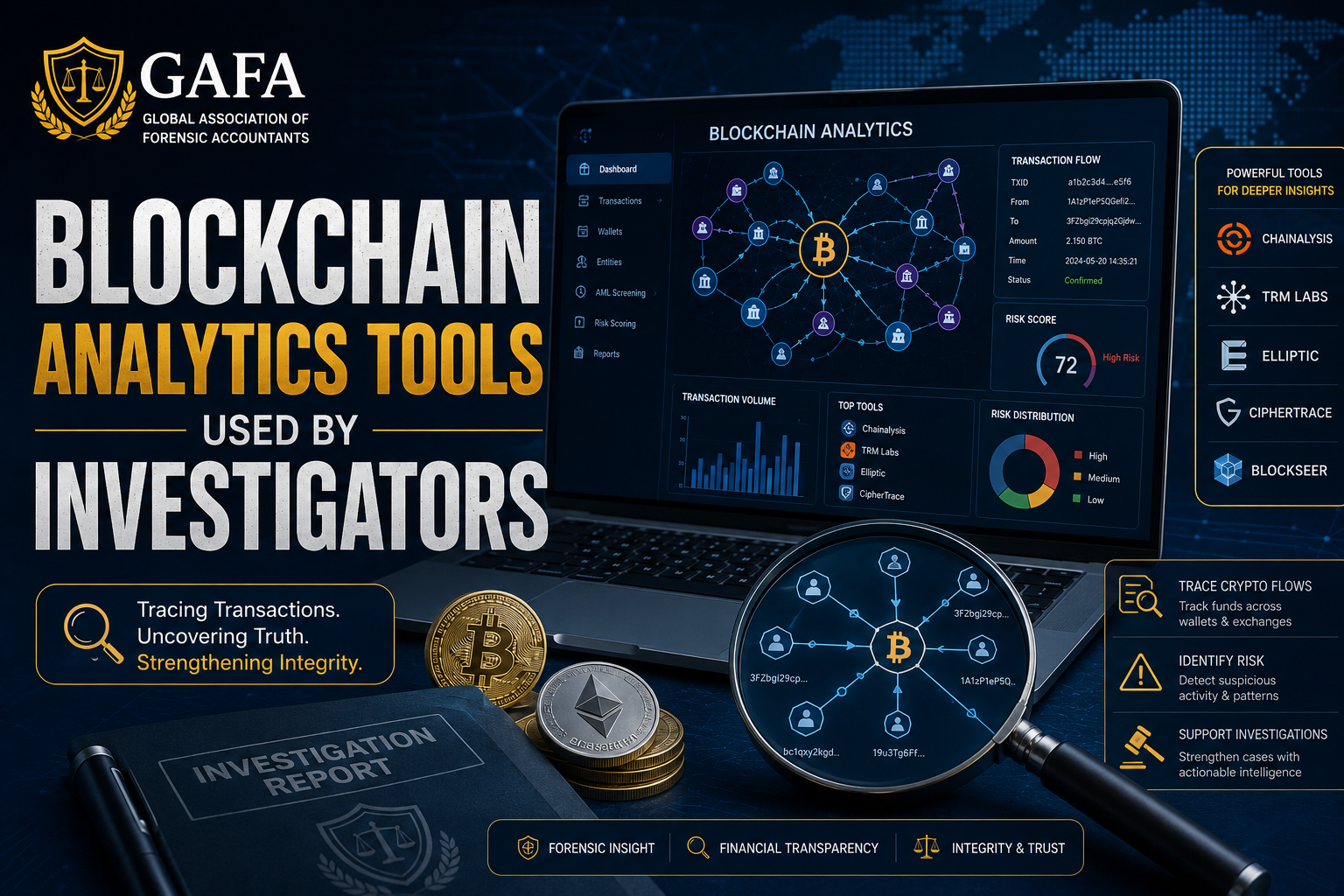
Blockchain analytics tools are specialised software platforms that help investigators trace cryptocurrency transactions, identify wallet ownership patterns, detect illicit financial activities, and uncover relationships between blockchain addresses. These tools analyse publicly available blockchain data to support investigations involving fraud, money laundering, ransomware attacks, terrorist financing, and cryptocurrency theft.
As digital assets continue to gain mainstream adoption, criminals are also finding new ways to exploit blockchain technology. Modern investigators rely on blockchain analytics to follow the movement of crypto assets, connect suspicious wallets, and generate actionable intelligence without compromising the integrity of blockchain data.
Ready to master modern financial crime detection and digital asset tracing? Get certified with the GAFA Financial Fraud Investigation Certificate.
What Are Blockchain Analytics Tools?
Blockchain analytics tools are software solutions that collect, organise, and analyse blockchain transaction data to uncover patterns, identify suspicious behaviour, and assist investigators in tracking digital assets.
Although blockchain transactions are publicly recorded, they are not always easy to interpret. Wallet addresses consist of long strings of characters rather than identifiable names, making it difficult to determine who owns or controls a particular address.
Blockchain analytics platforms simplify this process by converting raw blockchain data into visual transaction flows, risk scores, wallet relationships, and investigative reports. These tools are widely used by financial institutions, cryptocurrency exchanges, law enforcement agencies, Financial Intelligence Units (FIUs), AML compliance teams, cybersecurity firms and financial crime investigators.
They play a critical role in combating cryptocurrency-related financial crimes while helping organisations comply with evolving regulatory requirements.
Why Are Blockchain Analytics Tools Important?
Cryptocurrency transactions are fast, borderless, and irreversible. While these characteristics offer efficiency and transparency, they can also be exploited by criminals seeking to move illicit funds. This is where blockchain analytics tools become indispensable. They help investigators:
Track Illicit Funds: Investigators can follow cryptocurrency across multiple wallets, exchanges, and blockchain networks.
Identify Fraud Networks: Analytics platforms reveal hidden relationships between wallets involved in scams, Ponzi schemes, ransomware payments, or phishing attacks.
Support Regulatory Compliance: Financial institutions use blockchain analytics to strengthen Anti-Money Laundering (AML) controls and comply with Know Your Customer (KYC) obligations.
Reduce Investigation Time: Instead of manually reviewing thousands of blockchain transactions, investigators can quickly visualise fund flows and identify suspicious patterns.
Improve Risk Assessment: Many analytics platforms assign risk scores to wallet addresses based on previous criminal activity or links to sanctioned entities.
How Do Blockchain Analytics Platforms Work?
Blockchain analytics platforms combine blockchain data, artificial intelligence, graph analysis, and forensic methodologies to generate meaningful insights. The investigation process generally involves several stages.
Blockchain Data Collection: The platform continuously collects transaction data from public blockchains such as Bitcoin, Ethereum, and other supported networks.
Transaction Mapping: Every cryptocurrency transfer is linked together to create a visual map showing how funds move between wallets. This allows investigators to identify transaction chains, fund movement, mixing services, exchange deposits and wallet interactions.
Risk Analysis: The software compares wallet addresses against databases containing dark web marketplaces, sanctioned wallets, fraud databases, ransomware wallets, scam addresses and terrorist financing indicators. Addresses connected to known illicit activity receive higher risk scores.
Relationship Analysis: Advanced algorithms identify hidden links between wallet addresses, exchanges, smart contracts, and individuals. This creates an investigation graph that helps analysts understand the broader financial network.
What Are the Most Popular Blockchain Forensics Software Platforms?
Investigators use specialised blockchain forensics software to trace cryptocurrency transactions, identify suspicious wallets, and generate actionable intelligence. While each platform offers unique capabilities, they all aim to simplify complex blockchain investigations.
Some widely recognised categories of blockchain forensics software include:
1. Transaction Visualisation Platforms
These tools convert thousands of blockchain transactions into interactive graphs, making it easier to understand how funds move across wallets and exchanges.
2.Risk Intelligence Platforms
These solutions assign risk scores to wallet addresses by comparing them against databases of sanctioned entities, ransomware operators, darknet marketplaces, scam wallets, and other high-risk actors.
3. Cross-Chain Analytics Solutions
As digital assets increasingly move across multiple blockchain networks, investigators require platforms capable of tracing transactions beyond a single blockchain ecosystem.
4.Compliance Monitoring Platforms
Financial institutions and cryptocurrency exchanges use these tools to screen customer wallets, monitor transactions, and meet Anti-Money Laundering (AML) obligations.
By combining these capabilities, blockchain forensics software enables investigators to analyse complex financial networks with greater speed and precision.
What Is Wallet Clustering Analysis?
One of the most powerful capabilities offered by blockchain analytics tools is wallet clustering analysis. Instead of treating every wallet independently, clustering techniques identify groups of wallet addresses that are likely controlled by the same individual, organisation, or criminal network.
Clustering is performed using behavioural indicators such as shared transaction inputs, repeated transaction patterns, address reuse, timing analysis, exchange interaction history and smart contract behaviour.
For example, dozens of wallet addresses may appear unrelated at first glance. However, blockchain analytics software may determine that they consistently transact together, use identical spending patterns, and ultimately transfer funds to the same exchange account.
This enables investigators to build a much clearer picture of the people or entities operating behind seemingly anonymous cryptocurrency wallets.
Looking to upgrade your financial fraud detection skills? Elevate your career with the GAFA Financial Fraud Investigation Certificate.
What Are On-Chain Investigation Tools?
Unlike traditional financial investigations that rely on banking records, on-chain investigation tools analyse publicly available blockchain data to reconstruct the movement of cryptocurrency. These tools help investigators:
Track Fund Flows: Visual transaction maps illustrate how digital assets move between wallets, exchanges, and decentralised applications.
Monitor Smart Contracts: Investigators examine smart contract interactions to identify fraudulent investment schemes, rug pulls, or malicious decentralised finance (DeFi) activities.
Identify Exchange Deposits: Tracing cryptocurrency to regulated exchanges may provide valuable investigative leads, particularly when exchanges maintain customer identification records.
Analyse Token Movements: Investigators monitor transfers involving stablecoins, NFTs, governance tokens, and other blockchain-based assets to uncover suspicious activity.
Detect Mixing Services: Some criminals attempt to obscure transaction histories using cryptocurrency mixers or tumblers. On-chain investigation tools help identify these laundering patterns and follow fund movements despite attempts at obfuscation.
Together, these capabilities enable investigators to develop a comprehensive understanding of cryptocurrency transactions without relying solely on off-chain information.
What Is Crypto Transaction Tracing?
Crypto transaction tracing is the process of following the movement of cryptocurrency from one wallet to another across the blockchain. Because blockchain transactions are permanently recorded, investigators can reconstruct the complete journey of digital assets.
Crypto tracing is commonly used to investigate investment scams, cryptocurrency theft, ransomware payments, money laundering, terrorist financing, insider fraud and exchange hacks.
Investigators analyse transaction histories to determine where funds originated, how they moved through intermediary wallets, and where they were ultimately deposited or converted into fiat currency. Even when criminals attempt to hide their activities using multiple wallets or decentralised platforms, sophisticated tracing techniques can often reveal valuable investigative leads.
What Cryptocurrency Investigation Techniques Do Investigators Use?
Successful blockchain investigations rely on a combination of technology, analytical expertise, and investigative methodologies. Modern cryptocurrency investigation techniques extend beyond simply tracing wallet addresses.
1. Transaction Pattern Analysis
Investigators examine transaction frequency, timing, and amounts to identify unusual behaviour and detect potential fraud.
2. Address Attribution
Blockchain analytics platforms help associate wallet addresses with cryptocurrency exchanges, businesses, darknet services, or known criminal entities.
3.Open-Source Intelligence (OSINT)
Investigators gather publicly available information from websites, social media platforms, blockchain explorers, and online forums to supplement blockchain analysis.
4.Cross-Chain Tracking
With criminals increasingly moving assets across multiple blockchain networks, investigators use specialised tools to follow funds through bridges and cross-chain protocols.
5.Timeline Reconstruction
By analysing timestamps and transaction histories, investigators create chronological timelines that explain how illicit funds moved throughout the investigation.
Combining multiple investigative techniques provides stronger evidence and reduces the likelihood of overlooking critical connections.
Step into the future of financial risk and digital forensics. Get certified through the GAFA Financial Fraud Investigation Certificate.
Frequently Asked Questions (FAQs)
Q1. Are blockchain analytics tools completely accurate when identifying wallet owners?
Answer: Blockchain analytics tools provide high-probability attributions based on deterministic heuristics (like common-input transactions) and verified exchange deposit labels. While algorithmic clustering is extremely reliable, investigators always verify findings against off-chain evidence before taking formal legal action.
Q2. Can blockchain analytics tools trace funds sent through crypto mixers?
Answer: Yes. While mixers like Tornado Cash increase privacy by scrambling transaction history, modern analytics platforms use probabilistic algorithms, timestamp correlation, gas price patterns, and liquidity pool monitoring to trace funds passing through mixing protocols.
Q3. What is the difference between a block explorer and a blockchain analytics tool?
Answer: A block explorer (like Etherscan) is a basic public lookup engine that shows raw transaction data, wallet balances, and smart contract code for a single network. A blockchain analytics tool combines data across multiple blockchains, applies wallet clustering algorithms, and overlays proprietary attribution labels to reveal entity ownership.
Q4. How do law enforcement agencies freeze stolen cryptocurrency on-chain?
Answer: Once investigators use analytics tools to trace stolen funds to a centralized exchange or stablecoin issuer (such as Tether or Circle), they serve legal freezing orders or subpoenas. The exchange or issuer then blacklists the target wallet or account, locking the assets.
Q5. Do investigators need a court warrant to analyze blockchain transactions?
Answer: No. Because public blockchains operate as open, public ledgers, analyzing on-chain transaction data does not require a warrant. However, serving subpoenas to crypto exchanges to obtain real-world KYC identity records, IP addresses, or bank details does require legal authorization.