

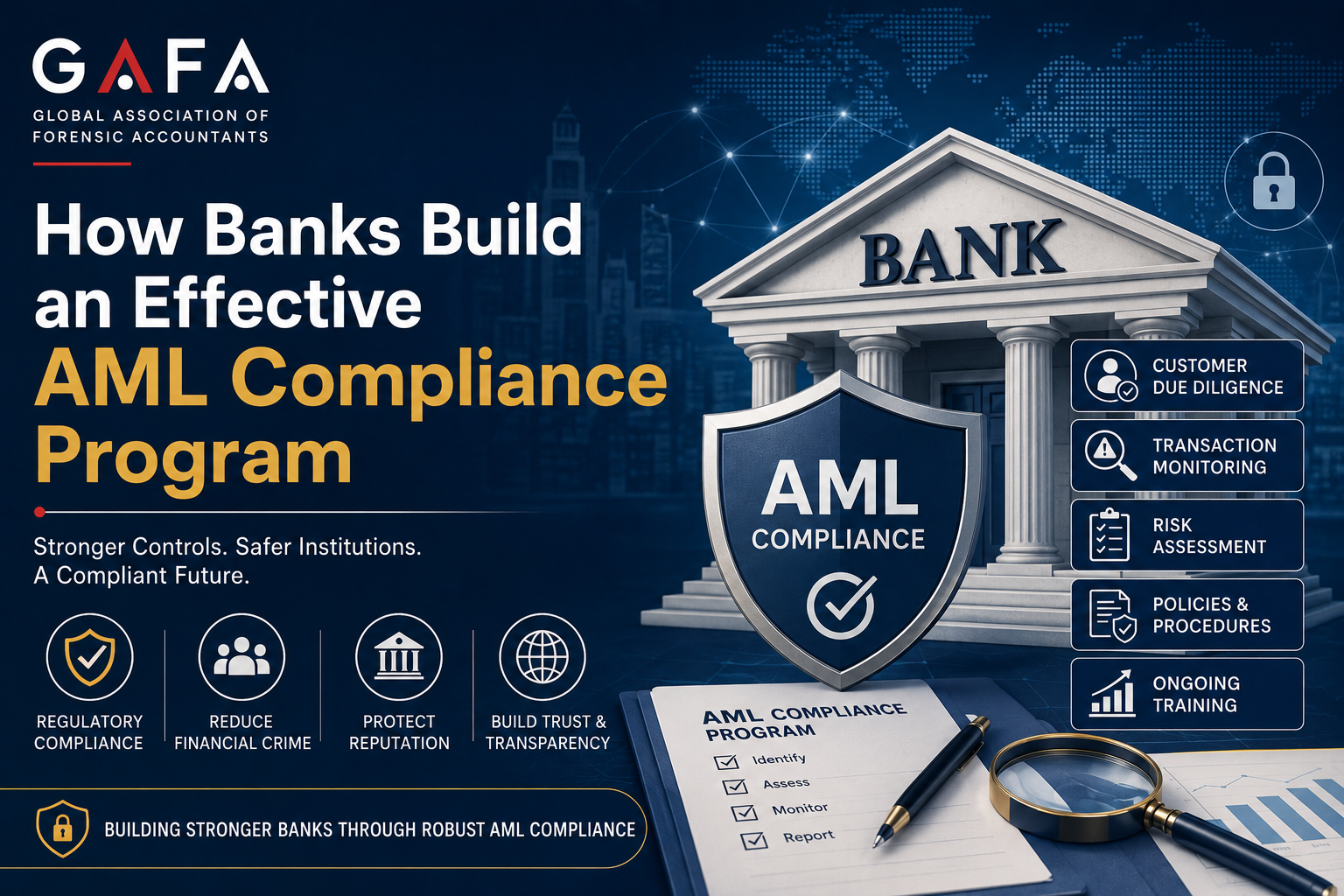
Global banks build an effective AML compliance program by embedding a dynamic, risk-based operational framework that accurately identifies, measures, and mitigates financial crime risks. A regulatory-grade infrastructure relies on a clear bank AML policy, robust internal controls, independent testing, automated transaction tracking, and ongoing compliance education. For professional enforcement teams, optimizing this architecture requires deep operational insight, which can be acquired through targeted executive training programs such as the GAFA AML Certifications.
Master the complexities of financial crime defense architectures by validating your structural skill sets with GAFA AML Certifications.
The Strategic Imperative of the Modern Corporate Banking Shield
In the current global macroeconomic landscape, banking ecosystems function as both the primary engines of economic velocity and the foundational frontline defense against transnational financial crime. Illicit networks, moving away from simple cash-smuggling operations, now utilize multi-layered digital networks, trade-based manipulation, and algorithmic asset rotation to hide illegal capital. Because of this, standard check-the-box regulatory approaches are completely outdated. Financial institutions must create an active, deeply integrated operational shield designed to address fluid risks in real time.
Building a strong financial crime system is no longer just about satisfying local banking regulators to avoid fines. It has become a vital strategic requirement that directly protects an institution’s survival, operational clearing access, and market reputation. When a bank suffers a systemic failure in its compliance defenses, the damage is severe, leading to lost correspondent banking ties, personal executive liabilities, and a permanent loss of institutional trust. Therefore, modern financial organizations must treat corporate compliance as an ongoing, highly technical discipline that requires deep industry expertise and constant system updates.
To protect cross-border transaction ecosystems, global compliance teams must look past basic compliance rules. The modern goal is to build an intelligence-driven operation that uncovers hidden financial networks before they impact the bank. Achieving this operational level requires a careful integration of human oversight, clear internal policies, and advanced analytics. Together, these elements form the baseline infrastructure known to global regulatory auditors as a certified and verified compliance architecture.
Deconstructing the Core Architectural Pillars and Framework Components
Every regulatory-grade compliance system relies on specific operational pillars that convert legal regulations into day-to-day risk management workflows. These fundamental AML program components form the core framework that protects an institution from liability. Without these distinct pillars, even the most sophisticated transaction-monitoring software will fail due to poor governance and weak human oversight.
The first foundational pillar is the creation of comprehensive internal controls, explicitly detailed within the formal bank AML policy. This master policy acts as the bank’s operational playbook, defining risk tolerance levels, onboarding rules, and explicit escalating paths for unusual customer transactions. The corporate policy cannot simply be a static document kept on an internal drive; it must serve as a functional guide that directs every product team, branch manager, and operations officer within the institution’s network.
The second vital pillar centers on the designation of a fully independent, properly funded compliance team led by a dedicated Chief AML Compliance Officer. This individual must possess the institutional authority to challenge business lines, stop high-risk client onboarding, and report directly to the board of directors without interference from revenue-generating divisions. When a compliance department faces budget restrictions or reports through standard corporate sales paths, the institution becomes highly vulnerable to regulatory gaps and systemic vulnerabilities.
The Critical Dynamic: Risk Assessment as an Operational North Star
An institution cannot properly protect its perimeters if it does not understand its specific vulnerabilities. Consequently, the performance of a regular, rigorous AML risk assessment serves as the operational compass for the entire organization. Compliance teams must systematically analyze their vulnerabilities across multiple vectors: customer profiles, geographical footprints, underlying product offerings, and delivery channels. By mapping these specific threats, the bank can distribute its resources effectively—focusing intense investigative efforts on high-risk sectors while streamlining low-risk workflows.
This targeted approach helps prevent a common challenge in modern compliance units: operational fatigue caused by millions of false alerts. When an institution treats a local small-business retail account with the same risk profile as an offshore shell corporation, its analysts become overwhelmed by irrelevant data, allowing actual financial crime to slip through undetected. A sharp, data-backed risk assessment sharpens the organization’s focus, helping teams isolate anomalies that match complex, multi-layered criminal activity.
Furthermore, these internal risk assessments must adapt to changing operational realities. When a banking group expands into new offerings, such as digital asset custody, real-time cross-border retail payments, or embedded fintech applications, the compliance team must immediately update their risk models. Failing to update risk parameters before rolling out new corporate products exposes the financial platform to exploitation by quickly moving criminal rings.
Equip your financial risk management divisions with next-generation tactical skills by enrolling them in GAFA AML Certifications.
Comparative Breakdown: Traditional Controls vs. Next Generation Automation
As transaction volumes scale exponentially, manual review structures are hitting their physical limits. To highlight the operational differences between legacy mechanisms and modern risk engines within a robust AML compliance framework, we look at how different layers handle compliance operations below:
| Operational Dimension | Legacy Structural Control Elements | Legacy Structural Control Elements | Systemic Institutional Impact |
| Transaction Screening | Rule-based batch filters looking for exact matches with high false-positive rates. | Real-time behavioral analysis, graph neural networks, and fuzzy logic engines. | Drastically reduces investigative backlogs while isolating complex hiding techniques. |
| Customer Onboarding | Paper-based identification collection with delayed manual verification protocols. | Biometric validation, instant corporate registry queries, and continuous risk scoring. | Improves the customer acquisition experience without weakening KYC data collection. |
| Audit & System Testing | Retrospective annual reviews checking sample files on an irregular basis. | Continuous monitoring engines that flag process drift instantly. | Provides immediate visibility to senior management before external regulators audit the platform. |
Transitioning to modern systems requires significant capital and a deep shift in company culture. Technology alone cannot solve underlying data systemic issues; it requires highly skilled analysts who know how to interpret machine learning outputs, refine alert parameters, and translate analytical findings into clear, actionable suspicious activity reports.
Compiling the Definitive Regulatory Structural Evaluation Checklist
For executive teams preparing for an intense regulatory audit, following a structured internal roadmap is essential for identifying operational vulnerabilities. Utilizing a comprehensive AML compliance checklist ensures that every critical part of the defense system is operational, tested, and ready for examination
First, verify that your customer due diligence (CDD) and enhanced due diligence (EDD) programs gather clear data on beneficial ownership. Investigators must look past multi-tiered offshore holding companies to find the actual individuals controlling the assets. Second, ensure that the bank’s transaction monitoring systems match the current risk profile of the business, with all rule changes fully documented to show the reasoning behind them.
Finally, the checklist must verify that employee training modules are updated regularly to address new criminal tactics, rather than relying on outdated modules from years past. Tellers, trade-finance specialists, and board members all need customized training that matches their specific roles in the organization’s defense line.
Continuous System Evolution, Governance, and Long-Term Program Viability
The ultimate success of an institution’s compliance program depends on its internal governance and commitment to independent testing. A system that is never challenged will inevitably fall out of step with changing regulatory expectations and market realities. Independent third-party testing must be conducted regularly, assessing the operational health of the bank’s networks without internal bias. These independent reviews give senior management an objective view of the organization’s true security stance, highlighting hidden vulnerabilities before they turn into major regulatory violations.
Furthermore, executive leadership must foster an organizational culture that prioritizes transparency and ethical accountability over short-term transaction revenue. When front-line relationship managers are rewarded solely for onboarding high-net-worth clients without considering compliance concerns, the entire institution faces severe risk. True security requires active collaboration across all departments, ensuring that compliance professionals work as strategic partners alongside product innovators to build safe, sustainable financial services.
As we look toward the future of financial services, the connection between robust risk management and sustainable business growth will continue to strengthen. Financial networks that invest in top-tier educational development and advanced risk frameworks protect their assets while positioning themselves as trusted leaders in the global digital economy.
Ensure your corporate compliance infrastructure meets global audit standards by upskilling your personnel through GAFA AML Certifications.
Frequently Asked Questions (FAQ)
Q1. What triggers an immediate transition from standard to Enhanced Due Diligence (EDD)?
Answer: An immediate transition to Enhanced Due Diligence occurs when a client presents an elevated risk profile. This includes Politically Exposed Persons (PEPs), entities operating out of high-risk jurisdictions flagged by FATF, complex shell companies lacking clear commercial purposes, or businesses heavily reliant on cash operations. EDD requires deeper verification of the source of wealth and explicit executive approval.
Q2. How often should a financial institution perform an independent AML audit?
Answer: Most regulatory bodies require an independent testing cycle to occur annually or bi-annually. However, if a bank undergoes significant structural changes, launches new high-risk products, or operates under regulatory remediation orders, the audit frequency should be increased to ensure new systems are operating correctly.
Q3. What is the fundamental role of the Board of Directors in program governance?
Answer: The Board of Directors holds ultimate structural responsibility for the program’s success. They ensure the compliance department receives adequate funding, approve major policy changes, and review regular reports from the Chief Compliance Officer to maintain strong operational oversight across all business units.
Q4. Can advanced AI models completely replace human compliance analysts in transaction monitoring?
Answer: No. While machine learning excels at identifying patterns across large datasets, human investigators are essential for analyzing qualitative context, conducting deep inquiries, and making final decisions regarding filing Suspicious Activity Reports (SARs). AI serves as a powerful tool to enhance efficiency, not a total replacement for human judgment.
Q5. How do regulators evaluate the effectiveness of an internal compliance training program?
Answer: Regulators look past simple attendance sheets. They check if the training material addresses the bank’s specific risk profile, evaluate how well teams retain information through testing data, and check if training modules are updated quickly when internal policies or broader financial crime trends change.