

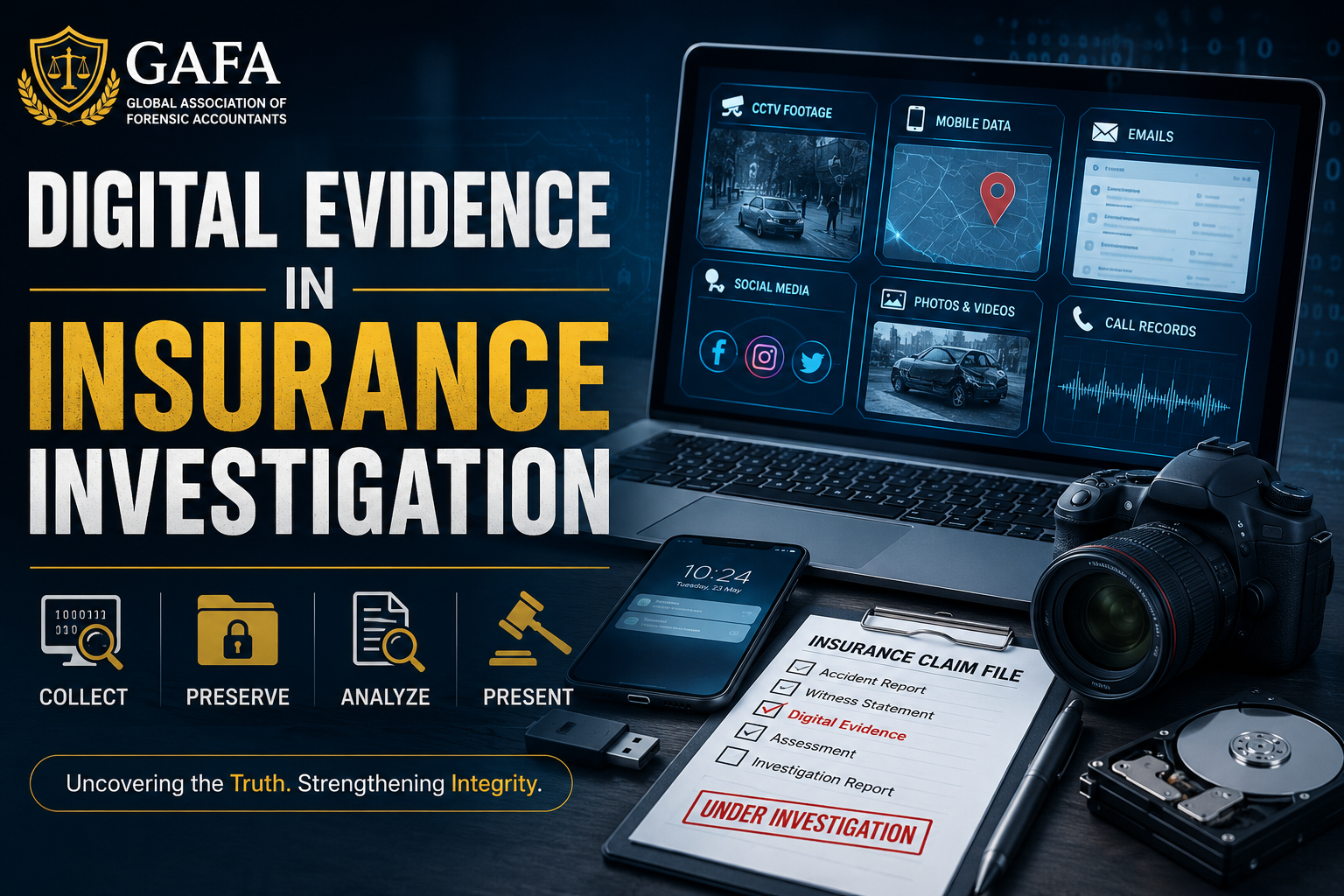
Digital evidence in insurance investigation refers to electronic information collected from devices, online platforms, surveillance systems, and digital records to verify the authenticity of insurance claims. It helps investigators uncover fraud, reconstruct incidents, validate timelines, and identify inconsistencies that traditional investigations might overlook.
Today, insurers increasingly rely on digital forensics, metadata analysis, GPS records, CCTV footage, smartphone data, and social media activity to assess claims accurately. As insurance fraud becomes more sophisticated, digital evidence has become an indispensable tool for Special Investigation Units (SIUs), claims investigators, and fraud examiners.
Looking to build a high-impact career in financial compliance and fraud risk management? Master modern risk detection with GAFA AML Certifications.
What is Digital Evidence in Insurance Investigation?
Digital evidence refers to any electronically stored information that can support or challenge the legitimacy of an insurance claim.
Unlike traditional evidence such as witness statements or physical documents digital evidence provides objective, time-stamped, and often verifiable information. Whether it’s a GPS location, a deleted text message, a surveillance video, or a social media post, these digital traces help investigators reconstruct events with greater accuracy.
The growing reliance on technology has transformed insurance investigations from largely manual processes into data-driven inquiries.
Why is Digital Evidence Important in Insurance Claims Investigation?
Insurance fraud costs the industry billions every year, leading to higher premiums for honest policyholders and increased operational costs for insurers. Digital evidence helps investigators separate genuine claims from fraudulent ones by providing factual information that supports or contradicts a claimant’s account. Its importance includes:
Improving Claim Accuracy: Digital records help verify dates, locations, communication history, and activities surrounding an incident.
Detecting Fraud Early: Advanced digital analysis can uncover fabricated accidents, staged thefts, identity fraud, or exaggerated injury claims before payouts are made.
Supporting Legal Proceedings: Properly collected electronic evidence is often admissible in court, making investigations stronger during litigation.
Speeding Up Claim Resolution: Digital evidence enables insurers to verify claims faster, reducing delays for genuine customers.
What Types of Digital Evidence Are Used in Insurance Claims?
Modern investigations rely on a combination of electronic data sources.
1. Mobile Device & Computer Forensics
When handling complex property fires, staged auto crashes, or commercial inventory losses, SIUs conduct targeted digital forensics insurance claims extractions. Analyzing call logs, messaging app timestamps, and cell tower connections allows investigators to verify whether a claimant was actually present at the scene during an event.
2. Vehicle Telematics & Infotainment Systems
Modern connected cars store detailed operational logs. In disputed crash cases, investigators extract telematics data to check exact driving speed, braking patterns, seatbelt usage, and impact angles, instantly exposing staged collision schemes.
3. Smart Home & IoT Sensor Data
Property damage claims benefit directly from connected Internet of Things (IoT) hardware. Smart water meters, connected smoke alarms, and security system logs establish exact timelines for water leaks, electrical fires, or burglaries, ensuring claims align with physical realities.
How Does Metadata Analysis Catch Fraudulent Claims?
One of the most overlooked yet powerful forms of digital evidence is metadata.
Metadata claims investigation involves analysing hidden information stored within digital files.
1. GPS Coordinates
Reveals the exact latitude and longitude where a photo was taken, exposing instances where a claimant submits damage photos taken in a different city
2.Original Timestamps
Shows when the photo was originally shot, catching policyholders who try to claim old, existing vehicle damage as a new incident.
3.Camera & Hardware Specs
Captures phone serial numbers and camera lens settings, exposing cases where multiple unrelated claimants submit photos taken by the same device.
4.Software Edit History
Identifies hidden tags left behind by image editing tools like Adobe Photoshop, Canva, or AI generation engines.
| Forensic Metric | Genuine Claim Photo | Fraudulent Claim Photo Indicator |
| Creation Timestamp | Matches the date/time of the reported incident | Pre-dates policy start date or occurs months prior |
| Geolocation Data | Matches the verified accident/property address | Points to an offshore location, scrap yard, or auto shop |
| Software Headers | Standard iOS/Android native camera specs | Shows tags from editing apps or generative AI engines |
| Image Hash (MD5) | Unique cryptographic digital signature | Duplicate hash found across prior unrelated claim files |
Expand your expertise in financial crime prevention and digital investigation. Enroll in GAFA AML Certifications.
How Is Social Media Evidence Used in Insurance Fraud Detection?
The rise of social media has transformed the way insurers investigate suspicious claims. Today, social media evidence insurance fraud investigations have become a valuable part of Special Investigation Unit (SIU) operations.
1. Exposing Fake Personal Injury Claims
A policyholder claims permanent back injury and total physical disability following a workplace accident, seeking a massive ongoing payout. Investigators review public video posts on social platforms, discovering recent footage of the individual lifting weights or competing in recreational sports.
2. Catching Fake Theft Claims
An individual files a commercial claim for high-value camera gear allegedly stolen during a studio break-in. Days later, automated OSINT scrapers flag the exact items matching serial numbers listed for sale on social media marketplaces by an account linked to the business owner.
3.Proving Collusion in Staged Crashes
Two drivers claim an accidental rear-end collision at an intersection, swearing they are complete strangers. Social media link analysis shows long-standing social connections, mutual group memberships, and tagged family photos, proving a staged collision scheme.
While social media can offer useful leads, investigators must ensure that any evidence is collected ethically, lawfully, and in compliance with privacy regulations. Publicly accessible information should be documented carefully, preserving timestamps and screenshots to maintain evidentiary value.
What Insurance SIU Digital Tools Are Reshaping Investigations?
Modern Special Investigation Units rely on purpose-built insurance SIU digital tools to analyze massive datasets quickly and isolate high-risk files.
1. Automated Image Forensics & Reverse Search
Automated visual scanning engines cross-check uploaded claim photos against global databases. These systems flag whether an image was stolen off the internet, recycled from an older claim file, or altered using generative AI editing tools.
2. Network Link Analysis Software
Fraud rings often operate across multiple policies, using different fake names, addresses, and bank accounts to avoid detection. Link analysis tools combine unstructured data across carriers, surfacing hidden relationships such as shared phone numbers, IP addresses, or repair shops across seemingly unrelated claims.
3. Policy & Coverage Intelligence Platforms
Advanced AI coverage engines review incoming loss descriptions alongside complex policy terms, instantly flagging coverage exclusions, suspicious policy updates, or odd timing.
How to Ensure Proper Electronic Evidence Collection for Legal Defensibility
Extracting digital proof is only useful if it stands up in court or regulatory hearings. Following strict electronic evidence collection standards ensures that digital proof remains admissible during formal legal disputes or regulatory audits.
Maintain Chain of Custody: Every transfer, examination, and storage of evidence should be documented to establish accountability and authenticity.
Use Cryptographic Hashing: Generate SHA-256 or MD5 cryptographic hash values immediately upon extracting data. If a file is altered later, its hash value changes, invalidating the evidence.
Rely on Write-Blockers: When extracting data directly from hard drives, mobile phones, or vehicle infotainment units, use hardware write-blockers to prevent the investigation process itself from modifying underlying system timestamps.
Adhere to Privacy Rules: Ensure all digital data collection respects local data protection laws, avoiding unauthorized surveillance or illegal wiretapping.
Ready to lead in financial crime prevention and fraud management? Elevate your career with industry-recognized GAFA AML Certifications.
Frequently Asked Questions (FAQs)
Q1. How is digital evidence used in insurance claims investigations?
Answer: Digital evidence refers to electronic information such as emails, mobile phone data, CCTV footage, GPS records, metadata, and social media content used to verify or dispute insurance claims.
Q2. Can insurance companies legally inspect your social media during a claim investigation?
Answer: Yes. Publicly available social media posts, photographs, videos, and location data may provide valuable evidence if collected lawfully and ethically.
Q3. What is EXIF metadata, and how does it catch fake insurance claims?
Answer: EXIF metadata is hidden technical data embedded within digital photos. It captures the original date, time, GPS location, and camera device details, allowing investigators to identify whether a photo was taken before the policy started, shot in a different location, or altered in editing software.
Q4. What tools do Special Investigation Units (SIUs) use to process digital evidence?
Answer: SIUs use digital forensics software (for extracting mobile and computer logs), automated image manipulation detectors, network link analysis software, and OSINT web scraping tools to spot fraudulent patterns.
W5. Why is maintaining a chain of custody critical for electronic evidence?
Answer: Investigators should preserve original data, maintain chain of custody, use certified forensic tools, securely store evidence, and document every step of the investigation process.