

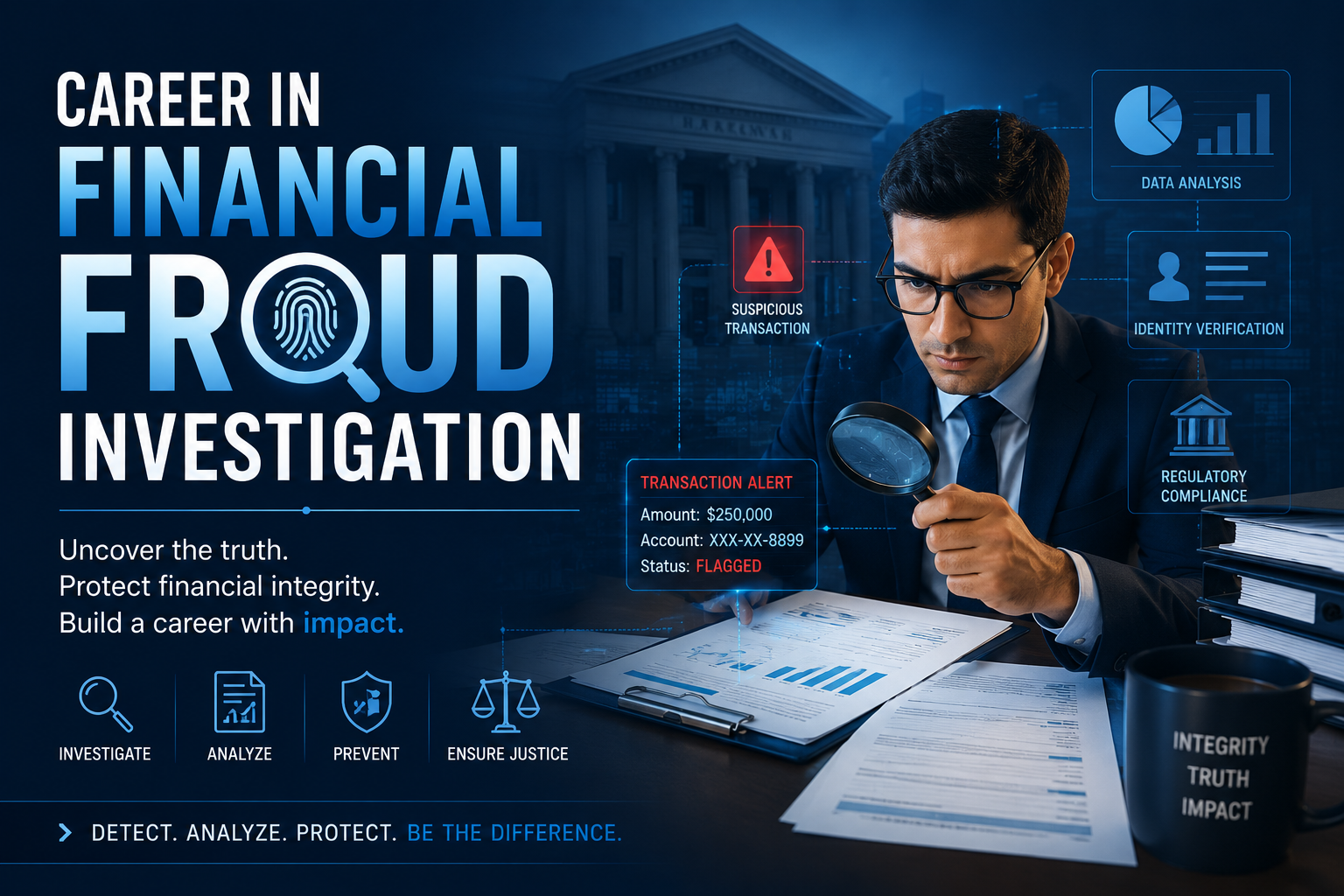
A career in financial fraud investigation is one of the fastest growing career opportunities in today’s technical and digital landscape. Every organisation involved with money faces threats from digital scams, insurance fraud, money laundering, identity theft, and financial misconduct. A skilled fraud investigator is the need of the hour.
A career in financial fraud investigation as the name suggests requires financial knowledge along with analytical thinking. Professionals should also be able to conduct investigations using investigative techniques. They should possess technology driven intelligence and knowledge of legal frameworks. A professional in this field works in banks, insurance companies, government agencies, corporate compliance firms and private investigation firms. They identify fraudulent activities and prevent financial losses.
This is the right career for individuals who are interested in contributing to financial justice and enjoy solving complex problems and uncovering hidden patterns. A career in financial fraud investigation comes with a strong earning potential, has long term stability and diverse opportunities.
Ready to build expertise in fraud investigation? Develop industry-relevant investigation skills through GAFA’s Fraud Investigation Programs and gain practical exposure to real-world financial crime scenarios.
What Is Financial Fraud Investigation?
Financial fraud investigation involves identifying, examining, documenting, and preventing fraudulent financial activities. Financial fraud can happen through various outlets including Insurance fraud, Identity theft, Investment scams, Credit card fraud, Banking fraud, Corporate embezzlement, Procurement fraud, Money laundering and Cyber-enabled financial crimes.
Financial fraud focuses on finding the traces of the crime. Investigators gather evidence, interview witnesses, analyze transactions and then based on the findings prepare reports that may support legal action or internal actions.
Why Are Fraud Investigators in High Demand?
Financial crimes have evolved over the years and have become more complex in nature. Today cybercrime criminals use artificial intelligence, deepfake technology,
digital payment platforms, cryptocurrency networks, social engineering tactics and cross-border financial systems to scam.
Relying on traditional security or automated fraud detection tool is no longer enough. Organizations need professionals capable of interpreting data, understanding criminal behavior, and conducting detailed investigations. As per the global financial crime records, businesses annually lose billions due to fraud related incidents. Hence making fraud prevention and investigation strategy a priority is important across sectors.
What Does a Financial Fraud Investigator Do?
Not all financial fraud investigators have the same responsibilities. One investigator might be involved in suspicious insurance claims. Another may focus on internal misconduct or unauthorized transactions within the organization.
| Responsibility | Purpose |
| Transaction analysis | Detect suspicious financial activity |
| Evidence collection | Support investigations and legal proceedings |
| Interviews | Gather information from stakeholders |
| Report preparation | Document findings clearly |
| Surveillance and monitoring | Track suspicious behavior |
| Regulatory compliance reviews | Ensure legal adherence |
| Risk assessments | Identify future vulnerabilities |
The work often combines technology, critical thinking and investigative instincts.
What Skills Are Needed for a Fraud Investigation Career?
1.Analytical Thinking
Financial fraud often hides within enormous datasets. Investigators must identify unusual patterns, anomalies, and inconsistencies that others overlook.
2.Financial Literacy
It is important to understand financial statements, accounting principles and transaction flows. Without this foundation, recognizing complex fraud schemes becomes difficult.
3.Interviewing Skills
Investigators have to question multiple witnesses. Knowing how to ask questions, build rapport and identify inconsistencies can significantly influence outcomes.
4.Attention to Detail
Due to the nature of the task and involvement of heavy financial datasets, it is important to be accurate to avoid error. A slight error can change the direction of an investigation.
5. Legal Awareness
Investigators need to be aware of financial regulations, compliance laws, evidence handling requirements, privacy laws. They should be able to submit the final report. Modern investigations heavily involve technology like data analytics tools, digital forensics, and fraud detection software.
Professionals who combine investigative expertise with technology knowledge are particularly valuable in today’s market.
What Does the Fraud Investigator Career Path Look Like?
There are many career progressions of an investigator. At entry level most professionals begin as Fraud Analyst, Risk Analyst, Compliance Associate, Investigation Assistant and Claims Examiner. At this stage it is important to understand fraud indicators and investigation processes.
At mid-level positions, professionals often progress to Fraud Investigator, Senior Fraud Analyst, Corporate Investigator, Financial Crime Specialist and Compliance Investigator. Responsibilities expand to managing independent investigations and interacting directly with stakeholders
Experienced professionals advance into Investigation Manager, Head of Financial Crime, Compliance Director, Forensic Consultant and Corporate Security Leader.
These positions often involve strategy, leadership, and regulatory engagement.
The fraud investigator career path offers both vertical growth and opportunities to specialize in niche domains.
Looking to enter the financial crime investigation industry?
Explore GAFA’s Professional Investigation Training to develop practical fraud detection, evidence analysis, and investigative reporting capabilities aligned with industry requirements.
Which Industries Hire Fraud Investigators?
| Industry | Common Investigation Areas |
|---|---|
| Banking | Account fraud, AML violations |
| Insurance | False claims, policy abuse |
| FinTech | Payment fraud, identity theft |
| Healthcare | Billing fraud |
| Government | Public fund misuse |
| Retail | Transaction fraud |
| E-commerce | Payment and refund fraud |
| Corporate Enterprises | Internal misconduct |
Salary Expectations for Fraud Investigators in 2026
Professionals working in financial crime compliance, banking investigations, forensic consulting, and multinational corporations often earn above-average compensation. International opportunities can significantly increase earning potential.
| Experience Level | Average Annual Salary (India) |
| Entry Level | ₹4 LPA – ₹7 LPA |
| Early Career (2–5 Years) | ₹7 LPA – ₹12 LPA |
| Mid-Level Specialist | ₹12 LPA – ₹20 LPA |
| Senior Investigator | ₹20 LPA – ₹35 LPA |
| Investigation Leader | ₹35 LPA+ |
Which Certifications Help Advance a Fraud Investigation Career?
While experience remains important, certifications help demonstrate specialized expertise.
Popular options include Certified Fraud Examiner (CFE), Anti-Money Laundering Certifications, Financial Crime Investigation Certifications, Corporate Investigation Programs, AQRTDigital Forensics Certifications and Risk and Compliance Certifications
Training programs that combine theoretical learning with practical case studies tend to provide the strongest career value.
How GAFA Supports Aspiring Fraud Investigators
Breaking into financial fraud investigation can feel overwhelming because the profession demands expertise across multiple disciplines. This is where structured learning becomes valuable.
Through industry-focused training, practical case studies, and investigation-oriented learning frameworks, GAFA helps learners understand fraud detection methodologies, evidence evaluation techniques, financial crime patterns, and professional investigation processes.
Whether you’re exploring a fraud investigator career path, transitioning from finance or compliance, or considering a private investigator career insurance fraud specialization, focused training can significantly improve your readiness for real-world investigative responsibilities.
Frequently Asked Questions
Q1.Is financial fraud investigation a good career in 2026?
Answer: Demand for fraud investigators continues to grow due to increasing financial crime risks, stricter regulations, and advancements in digital fraud techniques.
Q2.What qualifications are required for a fraud investigation career?
Answer: Most employers prefer backgrounds in finance, accounting, law, criminology, compliance, cybersecurity, or business administration. Specialized certifications can strengthen employability.
Q3.What is the typical fraud investigator career path?
Answer: Professionals often begin as analysts or compliance associates before progressing to investigator, senior investigator, investigation manager, and leadership positions.
Q4.Can private investigators specialize in insurance fraud?
Answer: Insurance fraud investigation is a major specialization involving claims verification, surveillance, evidence gathering, and fraud detection activities.
Q5.What skills are most important for fraud investigators?
Answer: Analytical thinking, financial literacy, interviewing abilities, report writing, legal awareness, and technology proficiency are among the most important skills.
Q6.Is fraud investigation related to cybersecurity?
Answer: Increasingly, yes. Many modern financial fraud schemes involve cybercrime, digital identities, online transactions, and electronic evidence.