

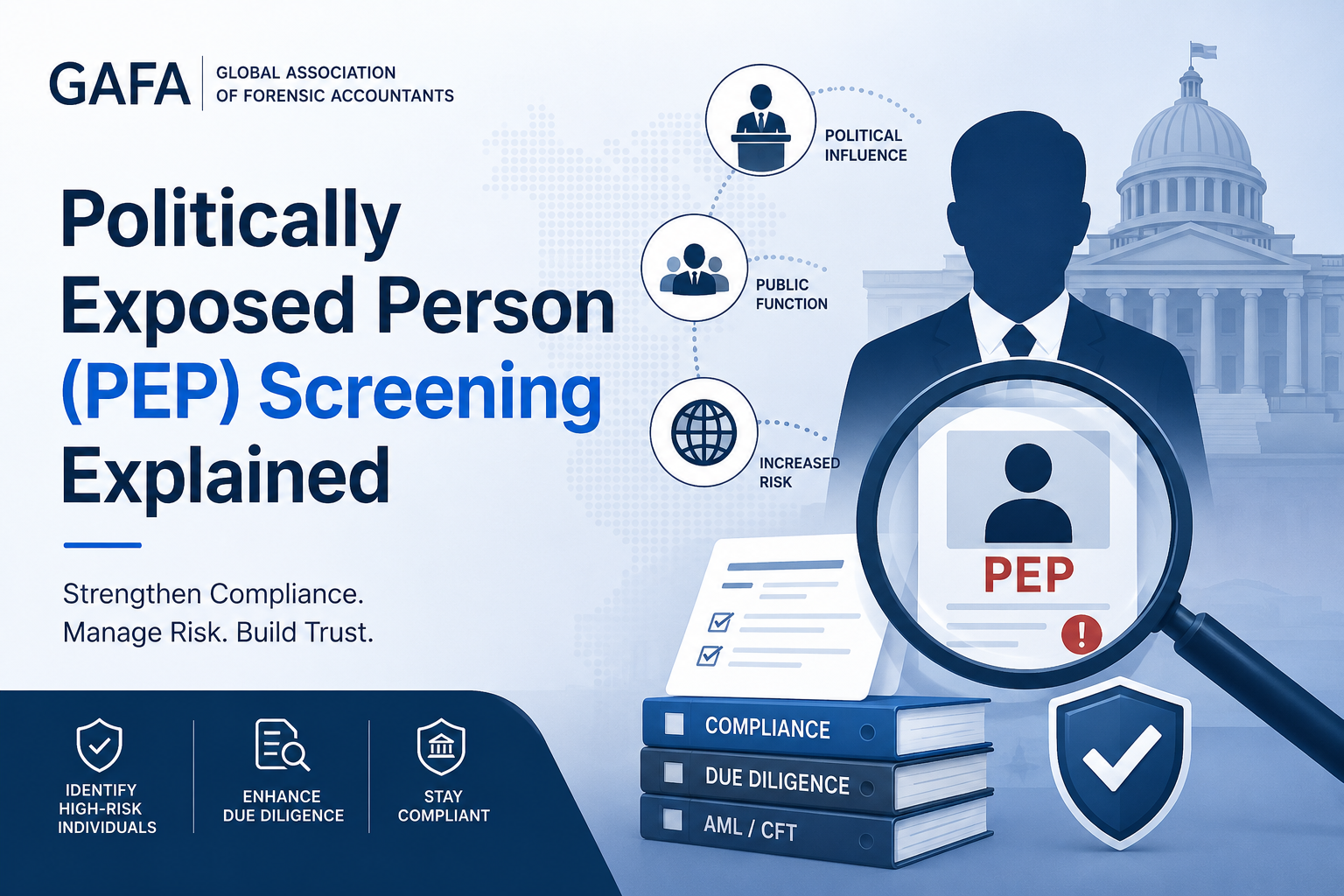
Global financial institutions execute effective PEP screening by implementing an ongoing, risk-based operational framework that cross-references customer records against global databases of public officials. Driven by international AML guidelines, this process relies on real-time PEP list screening, rigorous identity verification, and advanced fuzzy matching algorithms to isolate politically exposed individuals. To master the practical execution of these advanced regulatory protocols, compliance departments turn to professional training pathways such as the GAFA AML Certifications.
Advance your team’s compliance and analytical capabilities by certifying them through GAFA AML Certifications.
Why Public Office Triggers Regulatory Scrutiny
The international financial system runs on trust. But it’s also incredibly vulnerable to people holding massive public power. Think about it. Political leaders, senior government officials, and military commanders control huge state budgets. They greenlight massive development contracts. They steer national resources. This concentration of power opens the door wide for financial crimes—like systemic bribery, embezzlement, and state-level corruption. To protect global finance, institutions have to run strict screening protocols. You have to keep public funds from slipping into standard retail accounts.
Historically, compliance teams processed identity checks manually, verifying passports and basic registration records. However, in today’s fast-moving digital environment, these basic screening methods are completely inadequate. Modern compliance systems must go beyond basic identity checks, building an ongoing, data-driven defense network that monitors public registers, political influence, and cross-border transaction patterns in real time. This operational philosophy forms the foundation of every modern financial crime defense system.
Missing these high-risk relationships brings brutal consequences. Regulators don’t just issue slap-on-the-wrist warning letters anymore. They hand out crushing fines. They pull banking licenses. They even launch criminal investigations against executives. To stay safe, banks need a clear risk hierarchy. You need to process standard onboarding quickly while handling complex, politically connected profiles with absolute security.
The Legal Definition of a Politically Exposed Person
To build a strong security perimeter, compliance teams must first master the legal and operational foundations of this specialty. The definition of a politically exposed person is incredibly broad. It covers anyone entrusted with prominent public functions. This isn’t just for heads of state or prime ministers. It spans senior politicians, judicial or military officials, top executives at state-owned enterprises, and key political party leaders.
Once a compliance analyst identifies an individual matching this definition, standard customer due diligence is no longer enough. The relationship must be escalated immediately to Enhanced Due Diligence (EDD), which requires tracing the customer’s source of wealth (SoW) and source of funds (SoF) to verify that their capital was
earned through legitimate, documented activities. Under global regulatory frameworks, this advanced screening must be completed before any account can be opened or any transactions executed.
Additionally, the screening scope must extend beyond the primary official. It is a common practice for corrupt actors to move illicit capital through family members or close business associates. Consequently, robust screening systems must identify these connected individuals, treating them with the same elevated risk classification to prevent loopholes in the bank’s compliance perimeter.
How PEP Monitoring Software Identifies Hidden Links
While manual processes are sufficient for low-risk accounts, they cannot handle the scale of modern global banking. When you’re managing thousands of transactions every minute, specialized PEP monitoring software is mandatory to automate risk detection. These systems use fuzzy matching algorithms and phonetic tools to spot variations in name spellings, aliases, and corporate entities across multiple languages and alphabets.
Fuzzy matching stops common evasion tactics in their tracks. It catches when someone slightly tweaks a name spelling or uses a middle name. The software weighs name combinations, date-of-birth records, and geographic data to generate a risk match score. If that score crosses your risk threshold, the system halts onboarding or pauses transactions until an analyst can review the alert.
Top-tier PEP tools also leverage natural language processing (NLP) to scan global news and adverse media continuously. This real-time scanning catches when an existing customer gets appointed to a public office or caught up in a political scandal. By blending automated database checks with active media tracking, banks get ahead of reputational risks before they turn into regulatory disasters.
Ensure your operational units can confidently navigate complex PEP risk matrices by enrolling them in GAFA AML Certifications.
Domestic, Foreign, and International Organization PEP Rules
Not all politically connected individuals present the same risk level or fall under the same regulatory rules. To highlight these distinctions, we compare the key operational elements of different PEP classifications below:
| PEP Classification | Core Institutional Risk Profile | Typical Regulatory Triggers | Standard Compliance Action Requirements |
| Foreign PEPs | High risk. Individuals holding prominent public office in a foreign nation | Immediate trigger. Automatic escalation to Enhanced Due Diligence (EDD) | Requires senior management sign-off, detailed source of wealth verification, and continuous monitoring |
| Domestic PEPs | Medium-to-high risk. Individuals holding prominent national public office in the bank’s home country. | Risk-based trigger. Escalation depends on the specific office and transaction volumes. | Standard due diligence with increased transaction reviews; escalated to EDD if high-risk factors appear. |
| International Organization PEPs | Medium risk. Senior officials of global bodies like the UN, IMF, or World Bank | Risk-based trigger. Focuses on the individual’s specific spending authority. | Periodic reviews of transaction activities combined with standard media screening. |
Managing this multi-tiered risk system requires a clear understanding of international guidelines and national laws. Compliance teams must balance standard automated database checks with deep, qualitative research on high-risk corporate accounts to identify complex hiding techniques.
AML PEP Checks Evaluation Checklist
For risk analysts working on client files, following a structured process is essential for ensuring no critical details are missed. Utilizing a comprehensive customer due diligence checklist helps operational teams verify that every key control is in place, functioning correctly, and fully documented for future regulatory audits.
First, check the identity of any individual owning or controlling 25% or more of a corporate entity. Who are the actual human beings behind complex corporate structures? Second, cross-reference every party against updated PEP registers, sanctions lists, and adverse media databases. This flags political connections early.
Finally, document every finding, step, and rationale in a secure, centralized log. If regulators run a surprise audit, you must be able to prove the exact steps taken, documents reviewed, and the logic behind your risk ratings.
Overcoming False Positives and Maintaining Board Oversight
Long-term AML success relies on tight governance and regular, independent system audits. A screening framework that isn’t regularly tested will quickly fall out of sync with evolving criminal tactics and changing regulatory expectations. Independent third-party audits need to evaluate the operational health of your compliance tech without internal bias. This helps leadership patch hidden vulnerabilities before they turn into regulatory actions.
Financial institutions also need to foster a culture of compliance that prioritizes transparency and ethical risk management over raw transaction volume. What happens when front-line relationship managers are rewarded solely for onboarding high-net-worth clients while compliance red flags are ignored? The entire bank faces severe regulatory exposure. True security takes active collaboration across all departments. Compliance professionals must work alongside business innovators to build safe, sustainable financial services.
As global financial networks evolve, the connection between tight risk management and sustainable corporate growth will only strengthen. Banks that invest in top-tier professional training and modern, data-driven due diligence frameworks protect their assets from exploitation while positioning themselves as trusted leaders in the digital financial economy.
Ensure your corporate compliance program meets global regulatory audit standards by upskilling your personnel with GAFA AML Certifications.
Frequently Asked Questions (FAQ)
Q1. Does an individual remain classified as a PEP forever after leaving office?
Answer: It depends entirely on the jurisdiction. While some local regulations apply a strict “once a PEP, always a PEP” rule, others use a risk-based approach. This allows an individual’s PEP status to be downgraded after a specific window (like 12 to 24 months after leaving office) if their ongoing political influence and corruption risks are low.
Q2. Who are classified as “Close Associates” under PEP screening rules?
Answer: Close associates include individuals with close social, business, or professional ties to a primary PEP. Think business partners, joint venture shareholders, advisors, and romantic partners who might be used to hold assets or execute transactions on behalf of the public official.
Q3. Why do PEP screening tools generate high rates of false positives?
Answer: Because screening software has to use wide search parameters—like fuzzy matching and phonetic checks—to prevent criminals from evading detection through minor name changes. This broad net inevitably flags standard-risk citizens with similar names, requiring human analysts to review and clear the matches manually.
Q4. What is the difference between PEP screening and Sanctions screening?
Answer: Sanctions screening checks if a customer is on a list of legally restricted individuals with whom transaction activity is strictly prohibited. PEP screening checks if a client holds public office, which carries an elevated risk of financial crime, requiring additional verification and monitoring rather than an immediate transaction block.
Q5. How often must banks screen their customer databases for PEP updates?
Answer: To maintain effective defenses, banks should run automated batch screening daily or in real time as client details or global public directories change, ensuring newly elected officials or connected parties are identified immediately.