

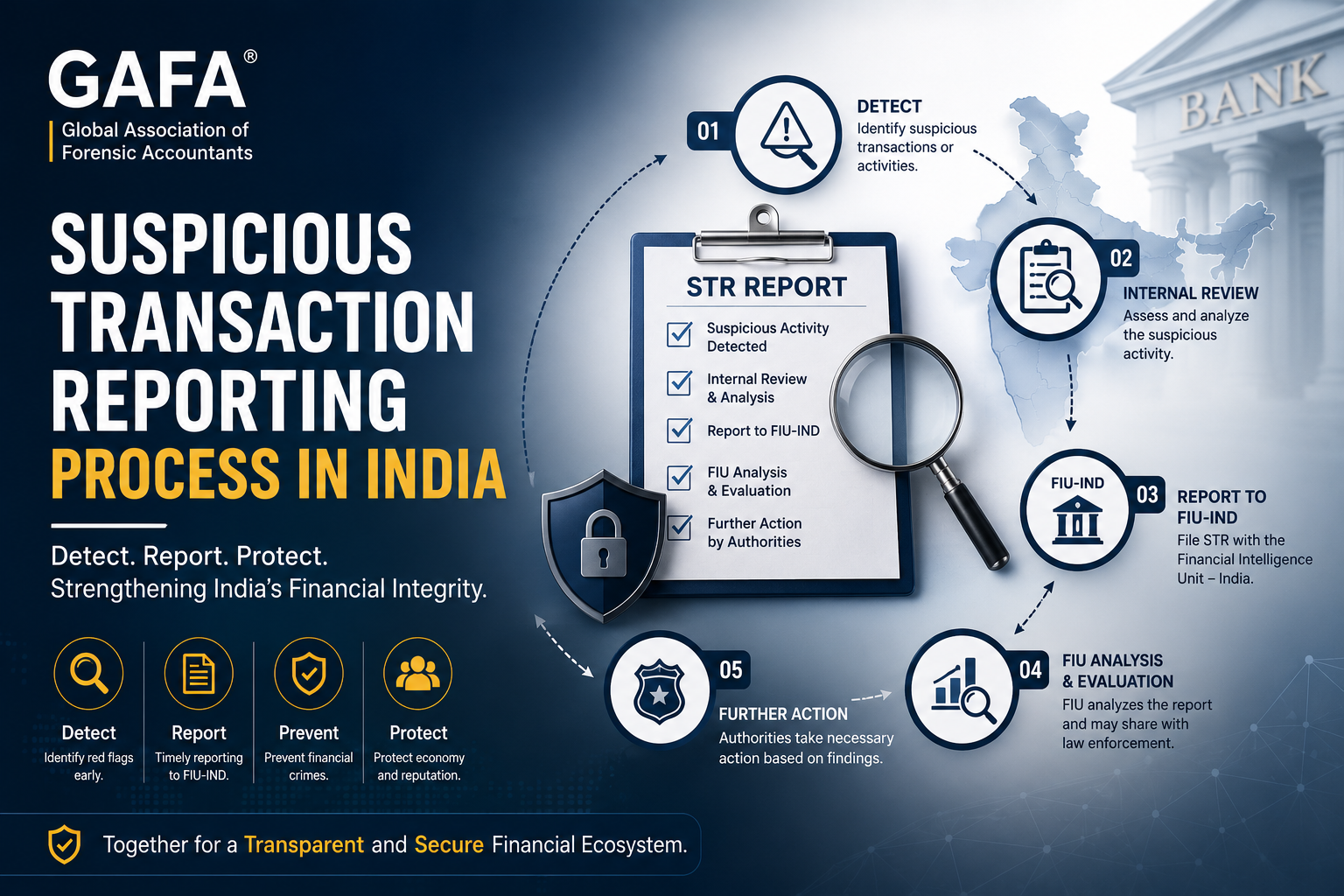
The suspicious transaction reporting process is a mandatory compliance requirement under India’s Anti-Money Laundering (AML) framework. It requires banks, financial institutions, fintech companies, NBFCs, insurance providers to identify unusual financial activities and report them to the Financial Intelligence Unit-India (FIU-IND) whenever they suspect money laundering, terrorist financing, fraud, or other financial crimes.
Looking to build a career in financial compliance? Skill up with GAFA AML Certifications to master transaction monitoring and regulatory compliance.
What is Suspicious Transaction Reporting?
Suspicious transaction reporting refers to the process of documenting and reporting financial transactions that appear unusual, inconsistent with a customer’s profile, or potentially linked to criminal activity.
Unlike normal compliance checks, STRs focus on identifying behavioral red flags rather than proving that a crime has occurred. A reporting entity only needs reasonable grounds to suspect illegal activity, not conclusive evidence.
The Role of FIU-IND and RBI
The central engine of this system is FIU-IND (Financial Intelligence Unit – India), an independent government body established under the Ministry of Finance in 2004. FIU-IND acts as the central national agency responsible for receiving, processing, analyzing, and disseminating information regarding suspect financial transactions to law enforcement agencies like the Enforcement Directorate (ED), Central Bureau of Investigation (CBI), and Income Tax Department.
Simultaneously, sector regulators—most notably the Reserve Bank of India (RBI), Securities and Exchange Board of India (SEBI), and Insurance Regulatory and Development Authority of India (IRDAI)—issue master directions that operationalize RBI suspicious transaction guidelines. These guidelines mandate that every regulated entity must establish robust transaction monitoring mechanisms, assign clear compliance roles, and maintain complete audit trails for all customer accounts.
Which Transactions Should Be Reported as Suspicious?
1. Unusual Transaction Patterns
A customer with a history of small deposits suddenly begins transferring large sums without a reasonable explanation.
2. Structuring or Smurfing
Multiple cash deposits are intentionally made below reporting thresholds to avoid regulatory attention.
3. Inconsistency with Profile
A newly incorporated firm claiming to sell stationary goods begins receiving high-frequency cross-border wire transfers from offshore entities known as shell company havens.
4. Unjustified Complexity
Moving money through a convoluted series of internal ledger transfers, multiple sub-accounts, or digital asset platforms without any sensible commercial logic.
5. Customer Non-Cooperation
When asked to provide updated Know Your Customer (KYC) documentation or account for a sudden spike in turnover, the customer offers evasive responses, fabricated documents, or suddenly requests account closure.
How Does the STR Filing Process Work Step-by-Step in India?
Filing an STR is not a knee-jerk decision. It is a structured process that requires objective analysis, clear documentation, and strict adherence to statutory timelines.
Here is the exact step-by-step workflow followed by Indian financial institutions:
Step 1: Transaction Monitoring
Institutions continuously monitor customer activities through automated AML monitoring systems and manual reviews. Alerts are generated when predefined risk indicators are triggered.
Step 2: Internal Review and Fact-Gathering
A compliance analyst reviews the customer’s KYC profile, historical account statements, tax filings, and transaction rationale. The objective is to determine whether there is a legitimate business explanation or if the activity remains genuinely suspicious.
Step 3: Determination by the Principal Officer
If the analyst finds no legitimate reason for the behavior, the case is escalated to the institution’s Principal Officer. The Principal Officer evaluates the evidence. The moment the Principal Officer arrives at a conclusion of suspicion, the official statutory clock begins.
Step 4: Submission via FINnet 2.0
Under STR filing India protocols, the Principal Officer must submit the report through FIU-IND’s secure web application, FINnet 2.0 (Financial Intelligence Network). The report includes details on the reporting entity, customer profiles, account details, related counterparties, and a comprehensive narrative explaining the basis of suspicion.
Step 5: Post-Filing Confidentiality and Record Keeping
By law, the filing process must remain completely confidential. Under Section 12 of the PMLA, the customer or any third party must never be informed that an STR has been filed against them (known as the prohibition against “tipping off”). Furthermore, all supporting evidence, account files, and correspondence must be archived securely for a minimum of 5 years.
What is the Difference Between STR and SAR in Banking?
One of the most common questions among AML professionals is the distinction between STR vs SAR.
Although both reports serve the same objective of reporting suspicious financial activities, the terminology varies across jurisdictions.
| Feature | Suspicious Transaction Report (STR) | Suspicious Activity Report (SAR) |
| Primary Jurisdiction | India (FIU-IND), UK, Singapore, Australia | United States (FinCEN), select global markets |
| Primary Focus | Financial transactions (completed, pending, or attempted) | Broader range of illegal activity, including non-financial behavior, insider threats, and attempted fraud |
| Monetary Threshold | No minimum monetary threshold in India; any suspicious value | Varies in the US (e.g., $5,000 for banks when a suspect is identified; $25,000 overall) |
| Reporting Deadline | Within 7 working days of forming suspicion (India) | Within 30 calendar days of initial detection (US) |
| Governing Framework | PMLA 2002 & RBI AML Directions | Bank Secrecy Act (BSA) & USA PATRIOT Act |
In Indian suspicious activity report banking practice, the framework strictly operates around the STR terminology defined under PMLA 2002. However, because STR guidelines cover attempted transactions and customer behavior during account opening, the functional scope of an STR in India effectively mirrors that of a global SAR.
Key Obligations and Penalties for Non-Compliance under FIU-IND Reporting
The RBI suspicious transaction guidelines require regulated financial institutions to establish robust Anti-Money Laundering (AML) and Know Your Customer (KYC) controls.
Key Mandatory Requirements:
1.Appointment of Nodal Officers
Every reporting entity must appoint a Principal Officer (responsible for day-to-day reporting) and a Designated Director (a senior board-level officer holding overall oversight accountability). Both appointments must be formally communicated to FIU-IND.
2.Strict Seven-Day Window
The PMLA Rules explicitly mandate that an STR must be furnished to the Director, FIU-IND, within 7 working days of being satisfied that a transaction is suspicious. Delaying reports due to prolonged internal bureaucracy is one of the most common reasons for regulatory penalties.
3.Maintenance of Records
Section 12 of the PMLA mandates that records of all transactions, KYC documents, and account files must be stored securely for at least 5 years after the business relationship ends or the account is closed.
Penalties for Default
Failing to comply with reporting obligations carries severe statutory consequences under Section 13 of the PMLA:
1.Monetary Fines
Fines ranging from ₹10,000 up to ₹1,000,000 (10 Lakhs) for each failure or default.
2.Regulatory Sanctions
Public censures, restrictions on business growth, license suspensions, or restrictions on launching new banking products.
3.Personal Liability
Both the Designated Director and Principal Officer can face personal administrative penalties or regulatory actions if deliberate negligence or systemic failure is proven.
Advance your career in financial crime compliance! Enroll in GAFA AML Certifications.
How Can Financial Institutions Strengthen Their AML Compliance Framework?
Despite advancements in compliance technology, organisations continue to face several practical challenges. Organisations can strengthen their AML programmes by adopting the following best practices:
- Implement AI-powered transaction monitoring systems.
- Update customer risk assessments regularly.
- Maintain accurate KYC records.
- Train employees on emerging money laundering typologies.
- Establish clear escalation procedures.
- Conduct periodic AML audits.
- Maintain detailed documentation for every investigation.
- Submit reports promptly in accordance with regulatory timelines.
- Review internal AML policies regularly to align with evolving regulations.
- Foster collaboration between compliance, operations, legal, and technology teams.
Ready to stand out in the anti-money laundering landscape? Validate your expertise with industry-recognized GAFA AML Certifications.
Frequently Asked Questions (FAQs)
Q1. What is the deadline for filing an STR with FIU-IND in India?
Answer: An STR must be filed within 7 working days of the Principal Officer forming a suspicion that a transaction involves proceeds of crime, lacks economic logic, or exhibits unusual complexity.
Q2. Is there a minimum money threshold required before filing an STR?
Answer: No. There is no minimum threshold amount for filing an STR in India. Any transaction even one for a small amount or an attempted transaction that was ultimately canceled must be reported if it appears suspicious under PMLA guidelines.
Q3. Can a bank inform a customer that an STR has been filed regarding their account?
Answer: No. Under Indian law, financial entities and their employees are strictly prohibited from disclosing or tipping off customers or external third parties about an STR filing. All reports are handled with complete confidentiality.
Q4. What is the main difference between CTR and STR filing in India?
Answer: A Cash Transaction Report (CTR) is a routine monthly report for all cash transactions aggregating above ₹10 lakh in a calendar month, regardless of risk. An STR, on the other hand, is a risk-based report filed within 7 days whenever a transaction raises reasonable suspicion of illegal activity, regardless of the amount.
Q5. Who within a financial institution is legally accountable for submitting STRs?
Answer: The designated Principal Officer is directly responsible for receiving internal alerts, evaluating evidence, deciding on suspicion, and submitting STRs to FIU-IND. Broader organizational oversight sits with the Designated Director.