
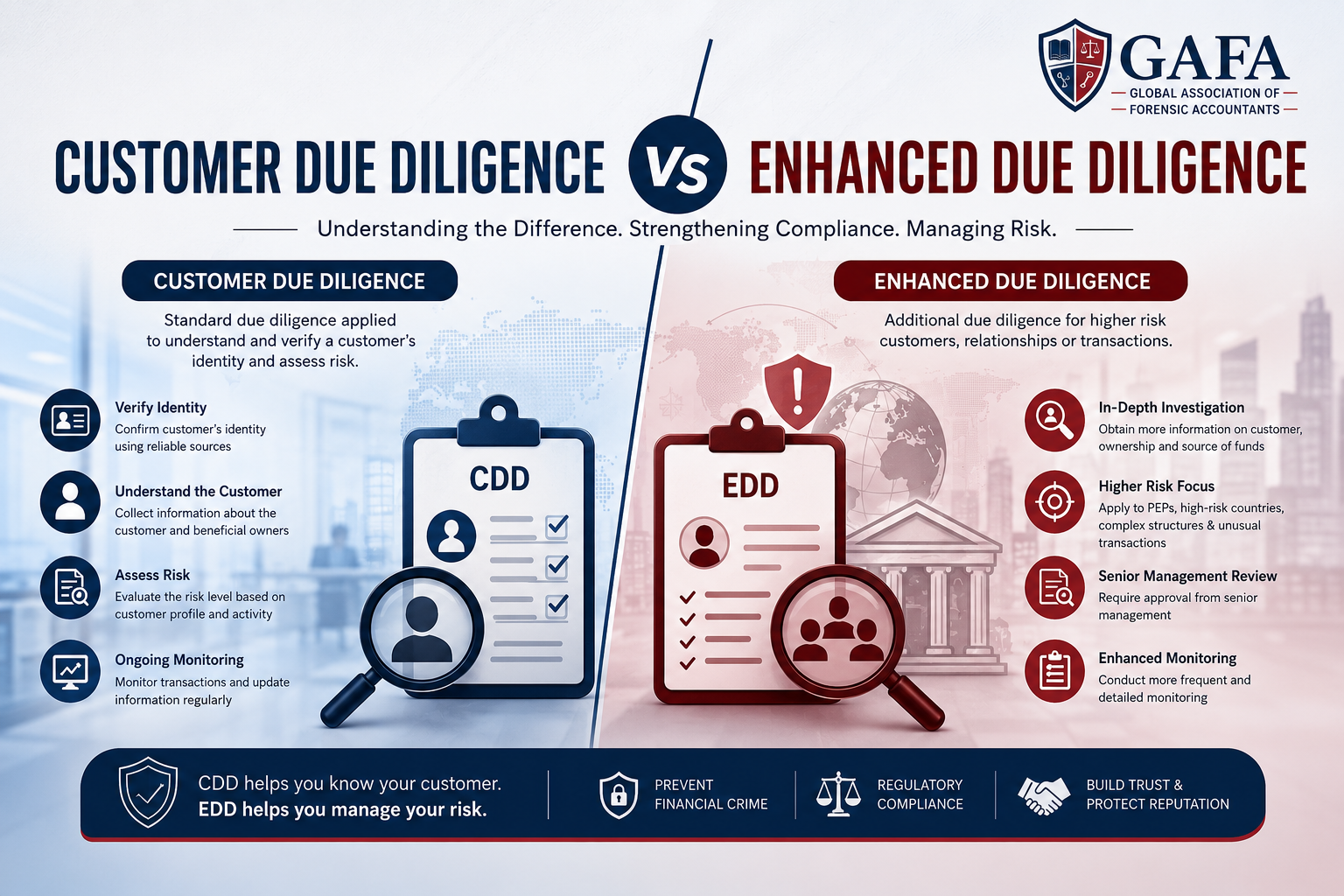
It all comes down to the financial crime risk a customer brings to your doorstep. Customer due diligence (CDD) is your baseline routine, gathering and verifying basic identity info for standard-risk clients during onboarding.
Enhanced Due Diligence (EDD), on the other hand, is a deep-dive investigation saved for high-risk accounts like politically exposed persons (PEPs) or entities tied to sanctioned regions. EDD demands rigorous source of wealth (SoW) verification and constant tracking. Compliance teams can master these operational frameworks by completing professional training programs like the GAFA AML Certifications
Elevate your compliance department’s practical investigative capacity by registering for GAFA AML Certifications.
Why Due Diligence Dictates Bank Survival
Modern banking operates under a constant barrage of sophisticated, well-funded financial crime. Criminal syndicates, tax evaders, and state-backed actors constantly prod global financial systems for vulnerabilities to clean their dirty capital. In this high-stakes environment, a bank’s due diligence framework is its primary shield. It isn’t just a bureaucratic box to check for annual compliance reports; it is what protects a bank’s licensing, reputation, and access to international clearing networks.
Gone are the days when a bank could rely on manual identity checks, like simply glancing at a physical passport or registration corporate doc. In today’s digital-first environment, those basic screening steps fail completely. Modern compliance requires a dynamic, data-driven framework that tracks customer behavior, risk shifts, and transaction patterns in real time. This operational philosophy lives under Know Your Customer (KYC) guidelines, the bedrock of financial defense.
The fallout from compliance failure is brutal. Regulators are well past handing out simple warning letters; they now levy massive fines, pull clearing licenses, and bring criminal charges against executives. To stay safe, institutions need a crystal-clear risk hierarchy that manages everyday retail accounts and complex, cross-border corporate structures with equal security and efficiency.
Deconstructing Customer Due Diligence (CDD)
To build a secure perimeter, compliance teams have to master customer due diligence (CDD) first. As the entry layer of onboarding, CDD answers one basic question: Is this customer actually who they say they are? The process starts by collecting foundational corporate and personal data: legal names, dates of birth, physical addresses, and official corporate registry numbers.
Once this information is collected, the institution must verify it against independent, reliable data sources, such as government identity registries, commercial credit databases, and official business filings. This screening is essential to ensure that the customer is not using fake identification, shell corporations, or stolen details to access the financial system.
Standard KYC rules require this baseline verification to be finished before opening an account or moving money. Standard due diligence also requires mapping out the relationship’s clear purpose. Analysts must grasp the client’s normal business activities, expected volumes, and geographic footprint. This baseline gives automated monitoring systems a benchmark to flag unusual, high-volume transactions later down the line.
Transitioning from Standard Controls to HighRisk EDD
While standard CDD processes are perfect for low-to-medium-risk retail customers, they are insufficient for clients with complex risk profiles. When an account exhibits high-risk indicators, the compliance framework must automatically escalate the file, triggering strict enhanced due diligence requirements.
This shift requires a transition from basic verification to a deep investigative process designed to uncover hidden corporate connections and trace funds back to their absolute origin. Several critical factors can trigger this transition. For example, a customer’s geographic location might place them in a jurisdiction flagged on the FATF grey list, or their business sector might involve cash-heavy operations like gambling or arms manufacturing. Another critical trigger is the presence of a Politically Exposed Person (PEP) —an individual holding a prominent public position, whose access to public funds significantly increases their vulnerability to bribery, extortion, and systemic corruption.
When these risk factors are identified, standard verification checks are no longer enough. The bank must initiate a full EDD review, which requires collecting detailed information on the customer’s source of wealth (SoW) and source of funds (SoF). This deep dive is necessary to prove that the customer’s capital was earned through legitimate business activities, protecting the institution from unknowingly facilitating corruption or money laundering
Ensure your team can identify and manage high-risk client files effectively by upgrading their analytical capabilities with GAFA AML Certifications.
EDD vs. CDD Core Requirements and Execution Timelines
Understanding the practical differences between standard and enhanced due diligence is critical for compliance teams. To highlight these differences, we compare the key operational elements of EDD vs CDD below:
| Compliance Element | Standard Customer Due Diligence (CDD) | Enhanced Due Diligence (EDD) | Operational Impact on Banking Systems |
| Target Audience | Standard-risk individual retail accounts and local, registered small-tomedium enterprises | High-risk clients, Politically Exposed Persons (PEPs), trust structures, and entities in sanctioned zones. | Focuses resources on the highest-risk files while keeping standard onboarding fast and efficient. |
| Verification Depth | Verifying physical identity documents and matching corporate registry details | Tracing ultimate beneficial ownership (UBO) and verifying the source of wealth and funds. | Requires highly skilled analysts capable of conducting advanced forensic financial investigations. |
| Monitoring Frequency | Periodic reviews conducted every 12 to 36 months, combined with automated transaction screening | Continuous, near real-time transaction monitoring and comprehensive reviews every 6 to 12 months. | Significantly increases operational costs but prevents critical regulatory compliance gaps. |
Managing this dual-track system requires advanced analytical software and highly trained investigators. Compliance teams must have the skills to handle standard automation files quickly while dedicating the necessary time and expertise to investigate high-risk corporate files thoroughly.
Customer Due Diligence Checklist for Risk Analysts
For risk analysts working on client files, following a structured process is essential for ensuring no critical details are missed. Using a definitive customer due diligence checklist keeps operational teams aligned, ensuring every key control is executed, verified, and logged for future regulatory audits.
Verify the identity of any individual owning or controlling 25% or more of a corporate entity. Find the actual human beings behind the corporate layers. Cross-reference all parties against real-time sanctions lists, adverse media databases, and PEP registers to catch reputational or regulatory red flags early.
Document every single finding, step, and decision in a secure, centralized audit trail. If regulators run a surprise audit, you must be able to prove the exact steps taken, documents reviewed, and the logic behind your risk ratings.
How Constant System Auditing Prevents Regulatory Failure
Long-term AML success relies on ironclad governance and regular, independent system audits. A due diligence framework that is never tested quickly becomes obsolete against shifting criminal tactics and changing regulatory expectations. Independent third-party audits should evaluate the health of your compliance tech without internal bias, helping leadership patch hidden vulnerabilities before regulators spot them.
Banks must also build a corporate culture that values transparency and ethical risk management over raw transaction volume. When front-line relationship managers are rewarded only for onboarding high-net-worth clients while ignoring compliance red flags, the entire bank faces severe regulatory exposure. True security requires collaboration across departments, ensuring compliance pros work hand-in-hand with business innovators to build safe, sustainable services.
As global financial networks continue to evolve, the connection between robust risk management and sustainable corporate growth will only strengthen. Banks that invest in top-tier professional training and modern, data-driven due diligence frameworks protect their assets from exploitation while positioning themselves as trusted leaders in the digital financial economy.
Train your team through GAFA AML Certifications to ensure your operational units can confidently handle complex, high-risk investigations.
Frequently Asked Questions (FAQ)
Q1. What is the difference between “Source of Funds” (SoF) and “Source of Wealth” (SoW)?
Answer: Source of Funds (SoF) looks at the origin of the money for a specific transaction (like a wire transfer or property buy). Source of Wealth (SoW) looks at the origin of the customer’s entire net worth, proving how they built up their total assets over time (e.g., via inheritance, investments, or corporate salary). EDD requires checking both.
Q2. How should a bank handle a client who refuses to provide UBO documentation?
Answer: If a client refuses to hand over Ultimate Beneficial Ownership (UBO) documents, the bank must stop onboarding immediately, freeze any existing accounts, and pass the file to compliance to determine if a Suspicious Activity Report (SAR) needs to be filed.
Q3. Are Politically Exposed Persons (PEPs) always subject to Enhanced Due Diligence?
Answer: Yes. Under FATF guidelines, PEPs are always subject to Enhanced Due Diligence. Because they hold prominent public roles, they carry a much higher inherent risk for bribery, corruption, and systemic money laundering.
Q4. What is the role of adverse media screening in the EDD process?
Answer: Adverse media screening searches global news networks for negative press about a client, like ties to criminal investigations or fraud allegations. This helps compliance teams spot risks that haven’t hit official regulatory databases yet.
Q5. How often must an institution update its customer risk ratings?
Answer: Risk ratings require continuous oversight, but formal reviews should happen at least annually for high-risk accounts and every 12 to 36 months for standard-risk profiles, keeping pace with changes in client behavior or shifting regulatory demands.