
Financial crime has become an important concern for banks, businesses, financial institutions, and governments around the world. As financial transactions increasingly move online, criminals are also finding new ways to commit fraud, hide illegal money, and misuse financial systems. Understa The aim of this course is for students to meet the standards for AML/KYC certification in financial crime, while gaining insights into the risks, prevention and compliance measures associated with anti-money laundering and the know your customer principle.
Financial crime is a critical issue for financial institutions, the business, banks and governments across the globe. With the growing prevalence of online financial transactions, criminals are also getting creative in how they defraud, cover up illegal funds, and manipulate financial systems. Therefore, knowledge of financial crimes is crucial to organizations and professionals in the banking, compliance, audit and financial investigation industries.
Implementing robust Anti-Money Laundering (AML) and Know Your Customer (KYC) controls can enhance the ability of an organisation to detect unusual behaviour and minimise financial risk. An AML KYC certification can offer beneficial insights to professionals in the industry on compliance, customer verification, risk management, and financial crime prevention.

What is Financial Crime?
Financial crime is defined as any illegal activity relating to money, financial assets or financial systems. These activities are normally conducted for financial gain, concealing illegal cash and/or misleading people or enterprises.
These can range from money laundering and financial fraud, to identity theft, bribery and corruption, tax related fraud, and some aspects of cybercrime. Financial crime can impact any size business and can lead to financial losses, regulatory fines, damage to business reputation and loss of customer confidence.
Criminals are constantly coming up with new ways of operating and it is important organisations have effective systems and trained personnel in place to detect potential risks and address them early.
Common Types of Financial Crime
Financial crime in its various forms can present a range of challenges for organisations.
Money laundering is the process of concealing the source of illegally obtained funds to make them seem to be from legal sources. Investors can disguise the movement and hiding of illegal money using complex transactions, businesses or financial accounts.
Financial fraud is the deliberate deception of individuals or organizations for a benefit to be gained. Examples include online scams, payment fraud, accounting fraud and identity-related fraud.
Financial crime is also becoming a growing concern, with criminals exploiting financial information through cyber-enabled crime – such as using digital platforms, stolen credentials, phishing and more.
Bribery/corruption, funds for terrorism and financial account abuse may also increase financial crime risks.
AML and KYC play a crucial role in preventing financial crime.AML and KYC are essential in combating financial crime.
AML and KYC are two important components of financial crime prevention.
Anti-Money Laundering (AML) is about identifying and combating money laundering and other financial crimes. AML frameworks can include transaction monitoring, customer risk assessments, suspicious activity detection, and reporting processes.
Know Your Customer (KYC) is about getting to know customers. It normally means authenticating users, gathering data, performing due diligence and risk evaluation.
The harmonisation of AML and KYC processes will enable organisations to have a better understanding of customer risks and to detect any unusual financial activity. Implementing effectively can also help to ensure regulatory compliance and enhance the overall financial controls.
Why AML KYC Certification Matters
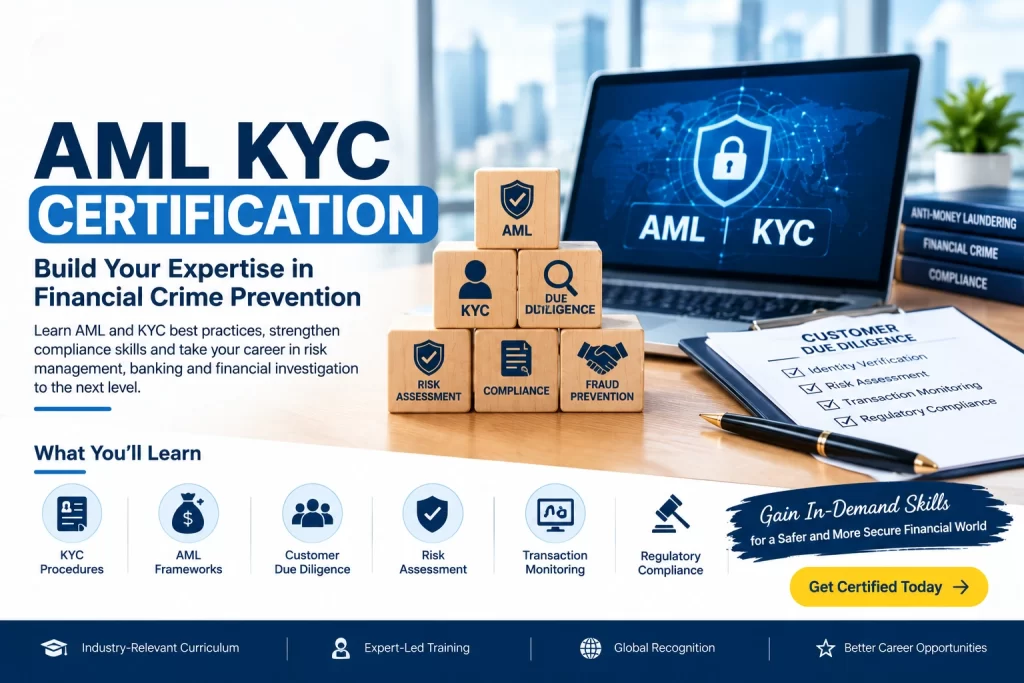
There are high stakes for professionals operating in banking, compliance, financial investigation, fintech, risk management and auditing as they must be familiar with Financial Crime risks. Professionals can gain knowledge about a wide range of topics that are relevant to AML, including customer due diligence, AML compliance, transaction monitoring, risk assessment, and identification of suspicious activity by obtaining an AML KYC certification.
For some people, certification might also be beneficial if they wish to develop a particular foundation or enhance their CV. In the ongoing effort to enhance compliance and combat financial crimes, skilled individuals in these areas can help improve the financial risk management framework within the financial sector.
The Global Association of Forensic Accountants (GAFA) offers education and certification programs in forensic accounting, financial crime, AML and fraud investigation. It offers programs that can assist students in acquiring knowledge and skills that are relevant to financial investigations and compliance needs in today’s industry.
The role of technology in the fight against financial crime.
Organizations are transforming the way they try to detect and investigate financial crime with the help of technology. Data analytics and automated monitoring systems, along with AI and machine learning, can help financial institutions detect abnormal patterns in transactions, even in large volumes.
The help of technology can aid compliance teams in conducting their investigations more efficiently. But technology is most effective when embedded in suitable policies, trained staff, human judgment, and effective compliance protocols.
Overall, financial crime detection is expected to become more digital with the rise of digital financial services (DFS).
Simple steps can help stop financial crime risks in business.
There are a number of proactive steps that businesses can implement to help minimise their risk of financial crime. The proper maintenance of KYC protocols, periodic checks on customer data, surveillance of transactions, risk analysis, and employee training are all crucial actions.
It is also a good practice for organizations to have written compliance policies and to keep good records. Periodic reviews can enable a business to detect gaps in its processes and enhance them where new financial crime risks arise.
Businesses can safeguard their finances, customers, reputation, and future business operations by taking a proactive approach.
Conclusion
Financial crime is an ongoing challenge in a changing financial system and financial technology. Organizations and customers may find themselves in serious trouble because of money laundering, fraud, cybercrime, and other crimes. Robust AML and KYC systems can enable businesses to detect fraudulent activity and handle these risks better.
An AML KYC certification can offer a structured approach to acquiring expertise in compliance, customer due diligence, risk assessment, and financial crime prevention, which is valuable for professionals seeking to strengthen their expertise in this field. Forensic accounting practitioners can turn to organizations like the Global Association of Forensic Accountants (GAFA) for specialized knowledge and career advancement in this emerging field.
Frequently Asked Questions
1.What is financial crime?
Financial crime is defined as any act of illegality undertaken with the use of money, financial assets or financial systems. Some of the most typical cases include money laundering, fraud, corruption, identity theft and financial crimes committed by cyber.
2.Why are AML and KYC important to resist financial crime?
AML and KYC procedures assist organizations in confirming that their customers are who they claim to be, evaluating risks, keeping track of the transactions that occur, and detecting suspicious activity. They work together to be key factors in minimizing financial crime risks.
3.What is AML KYC certification?
AML KYC certification is a training program or a course that educates students on anti-money laundering, customer due diligence, KYC (Know Your Customer), risk assessment, and other related disciplines.
4.What are the benefits of AML KYC Certification?
AML KYC Certification will benefit students in the fields of the finance industry, banking, compliance, accountancy, and auditing, and financial investigators and crime analysts. This accreditation can also benefit individuals in the field of financial risk management and money laundering detection.
5.How does technology help detect financial crime?
Modern technologies such as AI, analytics software, machine learning, and transaction monitoring solutions can detect suspicious behaviors and help organizations uncover financial crime and fraud more efficiently.