
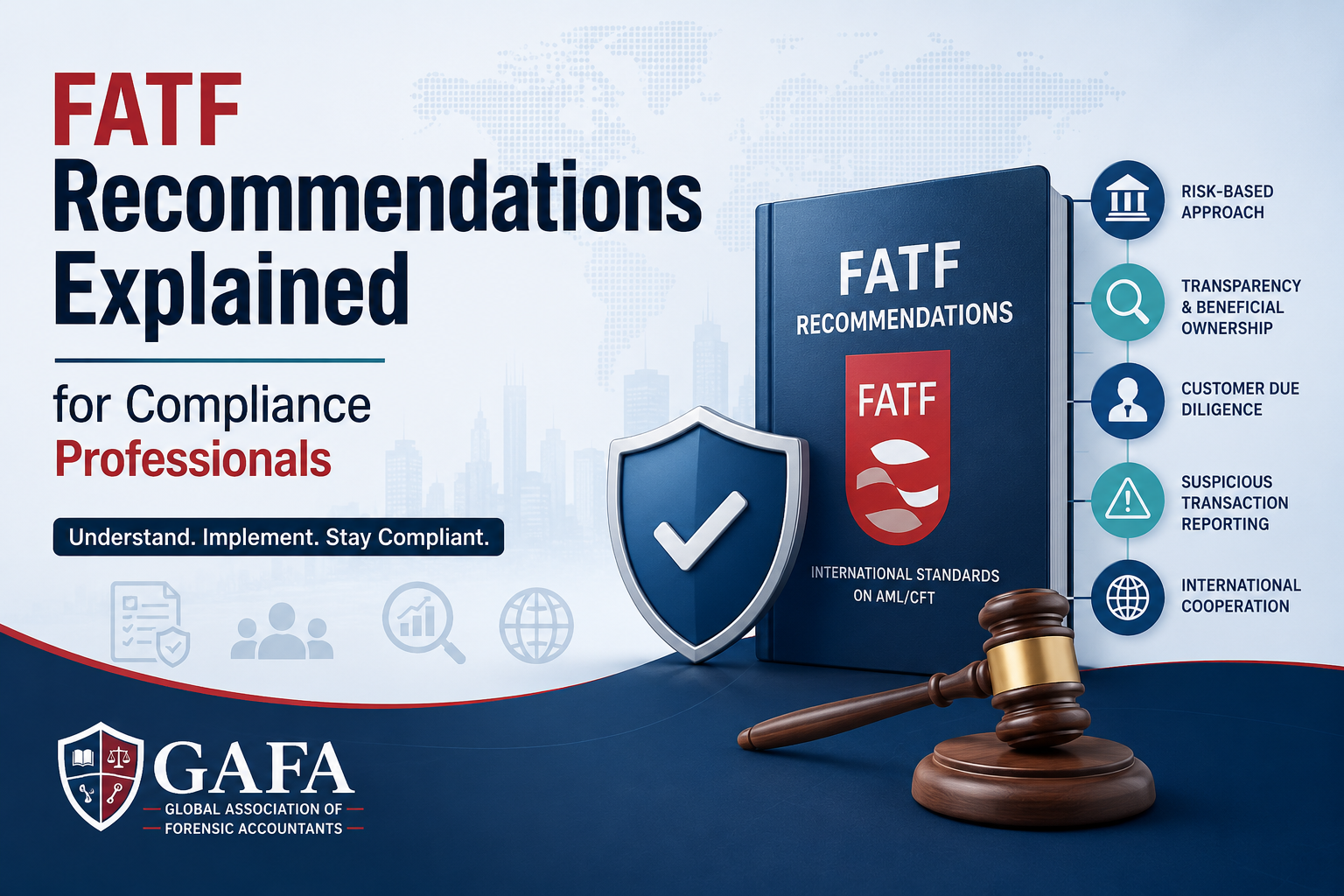
The FATF recommendations also known as the FATF 40 recommendations are a globally established benchmark for legal, regulatory, and operational measures. It is designed to combat money laundering, terrorist financing, and proliferation financing.
It is governed by the Financial Action Task Force; these standards mandate that member countries enact strong customer verification, recordkeeping, and intelligence-sharing structures. For industry practitioners, navigating these international standards requires deep, validated expertise, which can be achieved through leading global programs like the GAFA AML Certifications.
Align your compliance operations with the highest global benchmarks by obtaining the AML Certifications.
The Genesis and Global Evolution of the Financial Action Task Force
The Financial Action Task Force (FATF) was created during the 1989 G7 Summit in Paris to address a growing threat of laundering of drug money through the international banking system. In the last few decades this mission has significantly expanded and now covers terrorism financing following the events of September 11, 2001, and later, the financing of weapons of mass destruction.
As of today, the organization serves as the premier global standard-setter. It establishes the primary rules and expectations that govern how sovereign nations structure their financial intelligence units, legal frameworks, and regulatory systems.
The strength of these standards lies in their universal application. While the FATF itself is not a legislative body that can directly write national laws, its political influence is unmatched. Countries that fail to align their legal frameworks with the core standards face significant financial consequences, including being placed on high-profile public warnings that isolate their local financial institutions from the global market. Because of this, the international standard is highly effective, turning theoretical principles into actual, functional regulatory policies in nearly every major trading hub worldwide.
For compliance professionals, understanding these standards is essential for interpreting the rules that shape daily operations. Having a solid understanding of these rules helps compliance teams anticipate upcoming changes in national legislation, allowing institutions to adjust their defensive strategies before new regulations are formally signed into law.
The Structural Architecture of the FATF 40 Recommendations
The core of the international framework rests on a set of standards known as the FATF 40 recommendations. These standards are flexible in nature and principle based model and designed specifically to be integrated into diverse legal systems. They are structured into seven broad functional categories. It covers everything from criminalizing money laundering and identifying beneficial owners to facilitating seamless international law enforcement cooperation.
At the heart of these standards is the Risk-Based Approach (RBA). This principle requires countries and financial institutions to first identify, assess, and understand their specific risks, and then deploy resources proportionally. Under RBA, banks are expected to focus and put their resources in the bigger danger. Simplified certifications can be applied for low-risk accounts. The framework also emphasizes transparency, especially regarding the beneficial ownership of corporate structures.
Recommendations 24 and 25 demands countries to ensure that their national registries is accurate and up-to-date. The data records of the owners and controlship of corporate entities should be accessible. This is important to prevent criminal networks and syndicates from hiding illicit funds behind shell companies. This protects the global financial system from exploitation.
The Mutual Evaluation Process and Grey List Mechanics
The primary mechanism used to enforce these standards is the Mutual Evaluation Process. This peer-review system involves teams of international experts visiting a member country to assess both its legal compliance with the standards and, more importantly, the actual effectiveness of its systems. A country cannot simply pass laws on paper; it must prove that its courts actually prosecute money launderers, its regulators successfully monitor highrisk sectors, and its banks regularly submit high-quality suspicious transaction reports.
When a country’s systems show serious strategic weaknesses during an evaluation, it is placed under increased monitoring, commonly known as the FATF grey list. Being placed on this list is a serious economic blow. It signals to the global financial sector that doing business within that country carries higher risk, which often leads to a drop in foreign direct investment, higher transaction fees for local companies, and decreased access to international clearing systems.
Local governments try to remedy this by getting off the list as quickly as possible. This requires stricter local regulations, strengthening national enforcement agencies. It is important to increase oversight of non-financial businesses like real estate firms and luxury dealers. For compliance officers working in these jurisdictions, this transition period brings rapid regulatory changes and a significant increase in internal audit expectations.
Enhance your organization’s regulatory defense strategies by certifying your compliance specialists with GAFA AML Certifications.
Traditional Banking vs. Virtual Asset Requirements
As technology transforms the financial services landscape, the rules must adapt accordingly. To highlight how the FATF guidelines AML handle different financial sectors, we compare traditional banking requirements with the newer rules for virtual assets below:
| Compliance Pillar | Traditional Banking Requirements | Virtual Asset Service Providers (VASPs) | Strategic Enforcement Challenges |
| Customer Identification | Mandatory collection of official physical IDs, verified address records, and clear company registration files. | Advanced digital ID checks, wallet address analysis, and tracing transaction patterns back to centralized exchanges. | Verifying pseudonymous actors without slowing down decentralized transaction flows. |
| The “Travel Rule” | Routing complete originator and beneficiary details through established, secure networks like SWIFT. | Instantly sharing verified sender and receiver data alongside on-chain asset transfers between exchanges. | Solving the “sunrise problem” where different countries implement these digital rules at different times. |
| Transaction Monitoring | Analyzing account activities against historical baselines, geographic indicators, and defined volume thresholds. | Utilizing specialized blockchain analytics tools to trace asset origins and monitor transactions for interaction with high-risk platforms. | Keeping pace with complex technology changes like smart contracts, decentralized finance, and privacy-enhancing protocols. |
Implementing these digital standards requires specialized technical tools and a deep understanding of blockchain structures. For compliance officers, this means moving beyond traditional banking methods to master digital forensic tools, on-chain tracking, and transaction analysis techniques.
Translating International Principles into Day-to-Day Compliance Workflows
For financial institutions, translating these broad international principles into daily operations requires structured internal systems. These practical tasks are often organized into an FATF compliance checklist to help operational teams verify that every key control is in place and working correctly.
To begin with, the compliance team must design clear customer onboarding steps that verify beneficial ownership, ensuring the bank is not helping hide anonymous assets.
The transaction monitoring tools must be tuned to match any risk profiles identified in the bank’s internal assessments. This allows systems to flag unusual activities without creating unnecessary false alerts. The financial institution must maintain a clear, unalterable transaction log for at least five years. This ensures that law enforcement has access to a customers complete records in case of investigation.
Complying with these operational steps with regards to global standard prevents banks from regulatory actions and also helps secure the broader financial system from exploitation.
Future-Proofing compliance
Looking ahead, the role of compliance will only become more complex as digital financial networks continue to expand. Over the last few years with the advancement in online finance, instant payments and artificial intelligence scams have also evolved.
Traditional compliance frameworks are not fully equipped to handle these scams.
To stay ahead of these scammers, compliance systems must be agile and tech-driven.
Systems should be monitored using real time analytics and secure digital identity structures to verify customers safely.
This requires strong focus on professional development and continuous education. These compliance teams need the skills to interpret data outputs, adjust monitoring parameters. They require to work alongside technology innovators to build a secure and sustainable system. By prioritizing high-quality professional training and modernizing risk management frameworks, financial institutions protect their assets and build the trust needed to thrive in the modern digital economy.
Keep your compliance program ahead of changing international regulations by training your teams through GAFA AML Certifications
Frequently Asked Questions (FAQ)
Q1. What is the key difference between the FATF Black List and the Grey List?
Answer: The “Grey List” (jurisdictions under increased monitoring) identifies countries with strategic deficiencies in their AML/CFT regimes that have committed to actively working with the FATF to resolve them. The “Black List” (high-risk jurisdictions subject to a call for action) identifies countries with severe systemic deficiencies who do not cooperate, triggering strict counter-measures and serious transaction barriers from global financial institutions.
Q2. How does FATF’s Recommendation 16 (the “Travel Rule”) apply to crypto transfers? Answer: Recommendation 16 requires Virtual Asset Service Providers (VASPs) to collect, verify, and securely transmit specific sender and receiver information alongside virtual asset transfers. This mirrors the wire transfer rules used in traditional banking, ensuring digital transactions remain traceable and transparent.
Q3. Who conducts the peer-review evaluations for non-core FATF member countries?
Answer: Non-core member countries are evaluated by FATF-Style Regional Bodies (FSRBs), such as MONEYVAL in Europe, APG in Asia-Pacific, or ESAAMLG in Africa. These regional bodies utilize the exact same evaluation methodology to ensure global consistency across all jurisdictions.
Q4. What immediate steps should a compliance officer take if their country is grey-listed? Answer: Compliance officers should immediately update their institutional risk assessments, review transaction monitoring systems for country-specific risks, expect increased regulatory audits, and ensure all customer due diligence files for cross-border transactions are complete and fully documented.
Q5. How are FATF standards updated to address new technological threats?
Answer: The FATF Plenary regularly updates its standards and official interpretive notes to address emerging risks, such as decentralized finance (DeFi), peer-to-peer virtual transactions, and advanced cyber-crime techniques, ensuring the global regulatory framework remains effective as technology evolves.